

Aboriginal religion
Deities, sacred spaces and ritual practices of the ancient inhabitants of the Canary Islands before the European conquest.
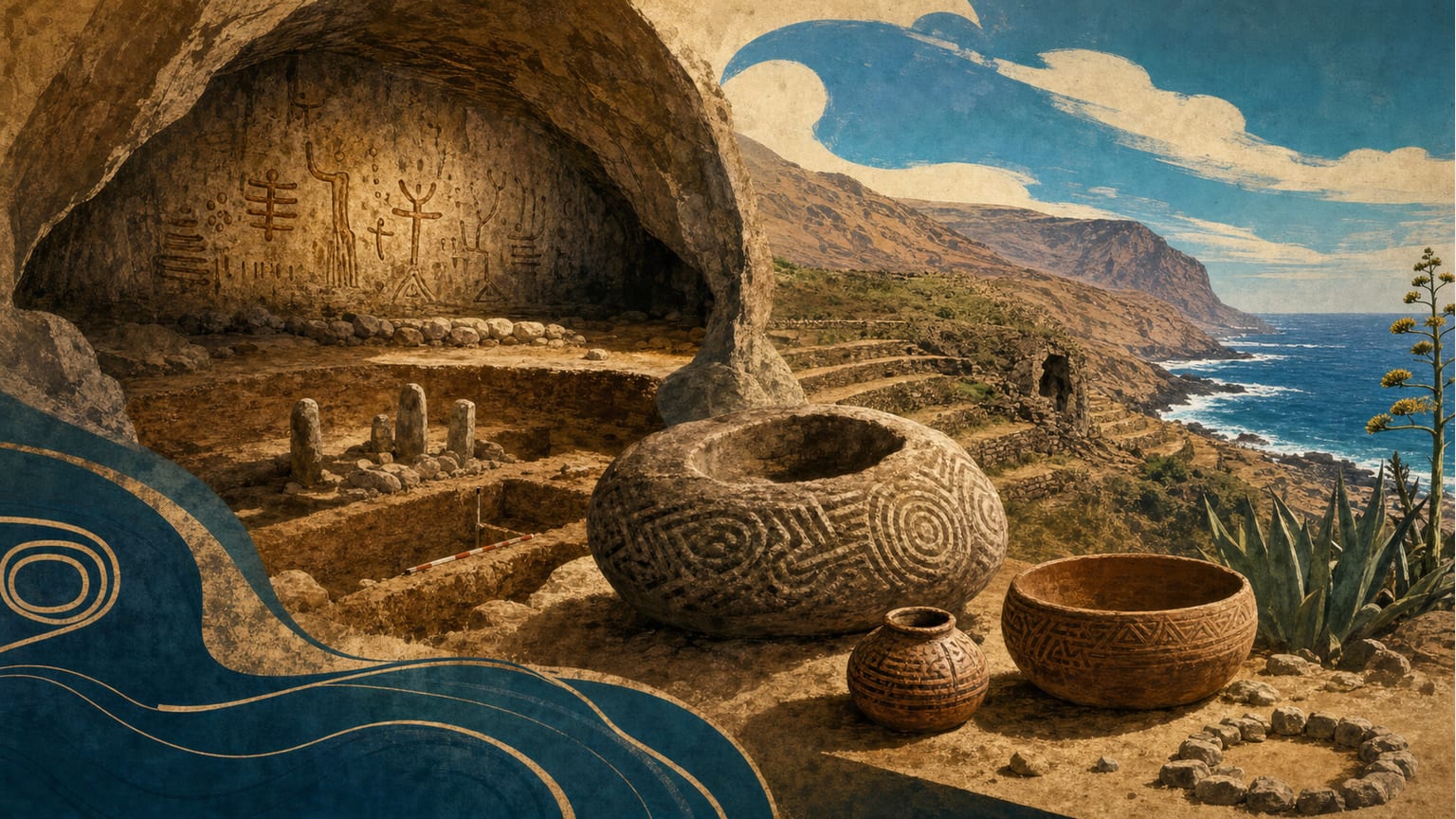
The religiosity of the ancient Canarians articulated a pantheon of deities, sacred spaces and ritual practices tied to the territory. Ethnohistorical and archaeological sources mention figures such as Achaman, Magec and Chaxiraxi, as well as places of worship known as almogarén, where offerings and ceremonies were performed.[1][2]
Deities and myths
Achaman appears as the supreme figure in the tradition of Tenerife; Magec is linked to the sun; Chaxiraxi was identified with the Virgin of Candelaria after the conquest. Guayota, associated with the interior of Mount Teide, represents the infernal dimension of the volcanic landscape.[1]
Spaces of worship
Almogarénes were raised enclosures where rituals and offerings took place. In Telde, Tegueste and Gáldar, archaeology has documented places of worship, ceremonial caves and mural paintings that allow the pre-Hispanic religious practices to be partially reconstructed.[1][2]
Related reading
The Almogarenes of Telde: Aboriginal Ritual Sites in Gran Canaria
A detailed look at the almogarenes of Telde, the ritual spaces of ancient Canarians, focusing on Cuatro Puertas, Barranco de Silva, and El Baladero.
Read more
The Painted Cave of Gáldar: Techniques and Meaning of Indigenous Mural Art
A detailed look at the techniques and meaning behind the polychrome murals of the Painted Cave of Gáldar, the most remarkable example of indigenous mural painting in Gran Canaria.
Read more
The Legacy of Indigenous Canarians: A Story of Resistance
Discover how Indigenous Canarians left a legacy of resistance and adaptation in the face of European conquest.
Read moreSources used
- Maximiano Trapero — Estudios sobre el guanche. La lengua de los primeros habitantes de las Islas Canarias (2007) Dialnet (Universidad de La Rioja)View reference
- Luis Diego Cuscoy — Los Guanches: Vida y cultura del primitivo habitante de Tenerife (1968), pp. 319 Memoria Digital de Canarias — ULPGCView reference
- Francisco Pérez Caamaño; Javier Soler Segura; Carlos J. Perdomo Pérez; Tomás Rodríguez Rodríguez — Tegueste en tiempos de guanches: la dimensión territorial de sus prácticas sociales (2014), pp. 250 p. Memoria Digital de Canarias — ULPGCView reference
- Rodríguez Santana, Carmen Gloria — Cueva Pintada. Gáldar, Gran Canaria. Museo y Parque arqueológico: visitors guide (2008), pp. 49 p. Memoria Digital de Canarias — ULPGCView reference