

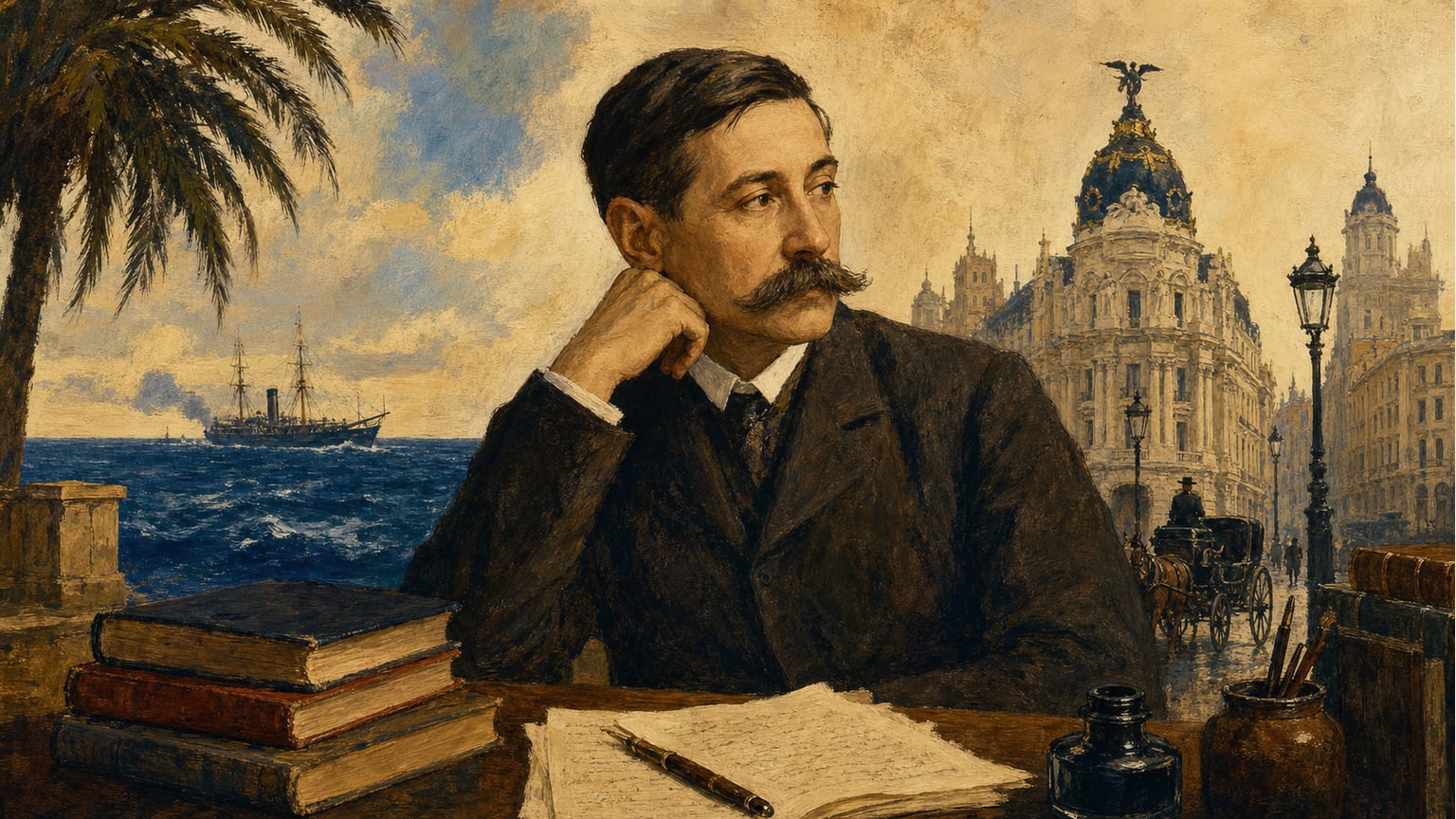
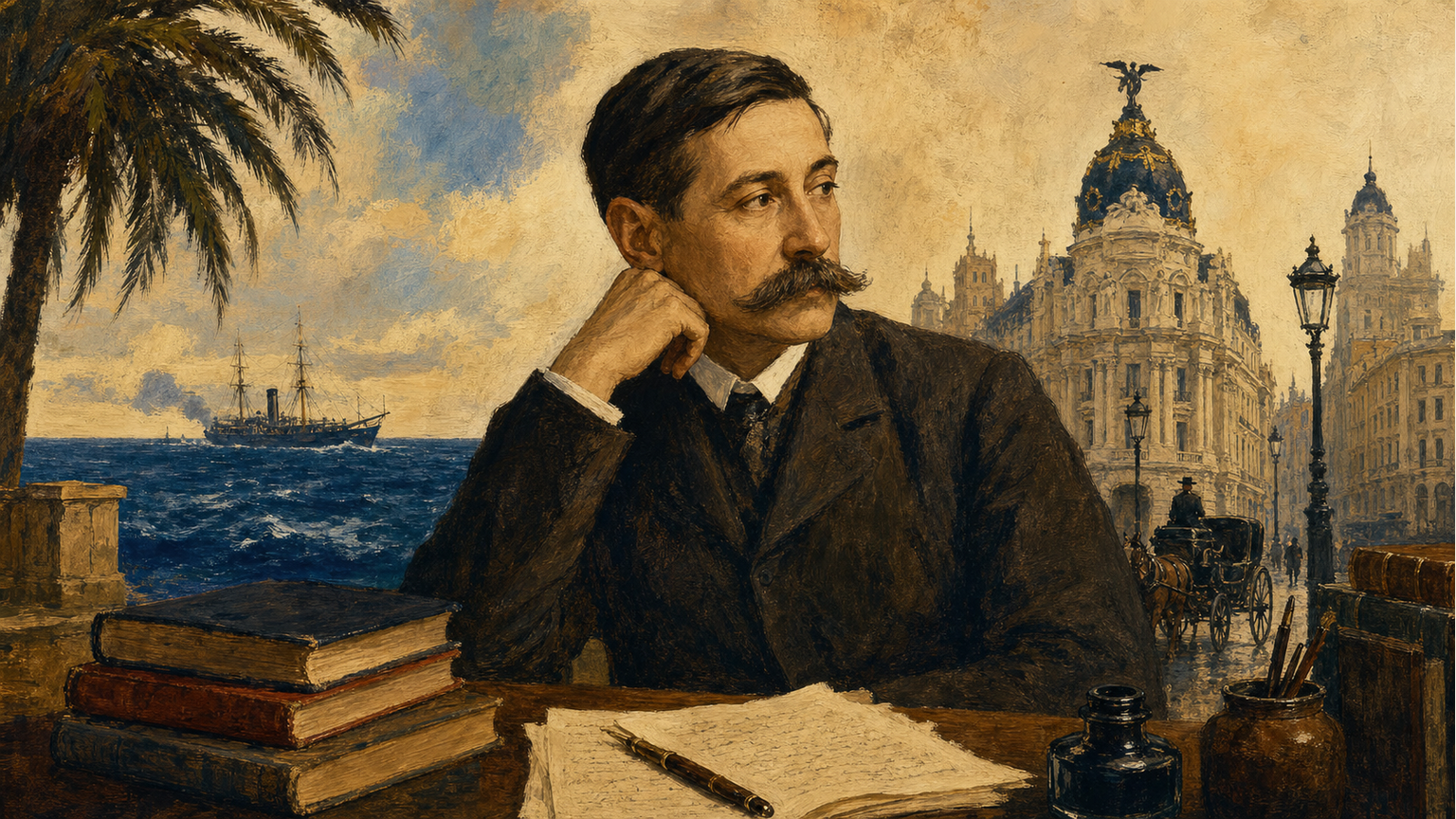
Ask anyone on the street where the greatest Spanish novelist after Cervantes comes from, and they will rarely say the Canary Islands. They will say Madrid, perhaps Castile, some landscape of La Mancha. But Benito Pérez Galdós was born in Las Palmas de Gran Canaria, on 10 May 1843, the youngest of ten siblings, in a house on Calle Cano that is today a museum[1][2]. And that part of the story is told far less often than it deserves.
An Observant Boy in Las Palmas
He was the son of an army colonel and a strong-willed Basque mother — one of those women who, as the story goes, set the course of the whole household[2][3]. As a boy he did not stand out as a student, but he had an enormous memory and an observational gift that already showed promise: he noticed everything, and then he told it. At nineteen he left for Madrid, officially to study law[1]. He ended up studying the whole city — its streets, its salons, its people — which is, in the end, what would later fill his novels.
The Chronicler of Madrid Who Never Stopped Looking to the Atlantic
Here lies the curious thing, and perhaps the most quoted fact about him that nobody ever puts in those exact words: Galdós became the definitive chronicler of 19th-century Madrid, the portraitist of the Castilian bourgeoisie, the name that appears next to Cervantes when people speak of the great Spanish novel — and yet he spent his entire childhood looking out at the Atlantic, not at the Castile he would later immortalize.
What he did not do — contrary to what is sometimes claimed — was forget the island. He always kept close ties with the Canary Islands: family, friends, memories[4]. When he founded his own publishing house in Madrid in 1897, his office became a meeting point for so many Canarians passing through the capital that people began to call it, half in jest and half in earnest, “la canariera”[4]. Those arriving from the islands knew they would find someone there ready to welcome them with open arms, as if Madrid were only a stopover and the real home were still Las Palmas.
The Canarian Writer Few Claim as Their Own
In time he became, almost without seeking the title, the most universal Canarian writer in history — and probably the least claimed as such outside the archipelago. He is studied in schools for “Fortunata y Jacinta” or “Doña Perfecta”, for the Episodios Nacionales, for his tireless portrait of 19th-century Spain[1]. It is seldom mentioned that all of this was written by someone who had learned to look at the world from an island in the middle of the Atlantic, before anyone had ever spoken to him of Madrid.
Perhaps nothing needs to be claimed after all. But it is worth remembering, every now and then: the greatest Spanish novelist after Cervantes began simply as a Canarian boy who looked long and far.