

Basalt
A mafic volcanic rock poor in silica and rich in iron and magnesium. It is the most abundant rock in the Canaries and produces very fluid lava flows.
From magma to rock: basalt, scoria, pyroclasts, tubes and dikes as keys to reading each island’s history.
Every rock seen in the Canaries is the final result of a journey that begins in the mantle and ends at the surface, sometimes in a matter of days or weeks. Magma ascending from depth may solidify underground, forming intrusive bodies such as dikes and laccoliths, or it may exit as lava and become extrusive volcanic rocks. The difference between the two is not only where they cool, but also the cooling rate and therefore the size of the crystals they contain. In a single outcrop one can find basalt with barely visible crystals alongside thick dikes with minerals several centimetres across, allowing us to reconstruct whether each material formed at the surface or at depth.[1]
The magma-lava-rock cycle explains most of the petrographic diversity of the Canaries. Magma is a mixture of melt, crystals and gases; when it loses gases and cools rapidly at the surface, it forms an extrusive volcanic rock. If it cools slowly underground, crystals have time to grow and produce intrusive rocks such as gabbros or diorites.[1]
The texture of a volcanic rock, that is, the size and arrangement of its crystals, is a fingerprint of the place and speed of cooling. Basalts with aphanitic texture cool in hours or days; phonolites or trachytes with large phenocrysts indicate a more complex history involving storage and fractional crystallisation.[1]
Basalts are the most abundant rocks in the Canaries. They are rich in iron and magnesium, poor in silica and therefore very fluid when they issue as lava. Within basalts, varieties such as basanite, tephrite and basaltic phonolite are distinguished according to their content of felsic minerals and olivine. These differences reflect different degrees of melting and evolution in the mantle and magma chambers.[1]
Alongside basalts appear ultramafic rocks such as peridotites and pyroxenites, especially in the Basal Complex of Fuerteventura and La Gomera. These rocks represent fragments of mantle and deep oceanic crust that were torn away and transported by magma during the submarine stage.[1][2]
As basaltic magma differentiates, it loses iron and magnesium and gains silica, aluminium and volatiles. The result is more evolved rocks such as trachytes, phonolites and, in extreme cases, rhyolites. In the Canaries these materials are less voluminous than basalts, but they build some of the most visible domes and flows in the landscape, such as the roques of Tenerife and Gran Canaria.[1]
The presence of evolved rocks in the same edifice as primitive basalt indicates that the magmatic system is not a simple ascending column, but a network of chambers where crystallisation, mixing and crustal contamination take place. This complexity explains the variety of compositions that can be found on a single island.[1]
Pyroclasts are fragments of all sizes expelled by the force of gases. In the field they are classified by diameter: ash less than two millimetres, lapilli between two and sixty-four millimetres, and bombs or blocks above that limit. Pyroclastic deposits can form well-defined strata that allow individual explosive episodes within a larger eruption to be read.[1]
In the Canaries, scoria deposits are especially abundant in cones of Strombolian eruptions, while ignimbrites, the product of more violent eruptions, are less frequent but occur in the geological record of some islands. Identifying these deposits is fundamental for reconstructing eruptive history and assessing the explosive potential of each volcanic centre.[1]
Lava flows are the most characteristic product of Canarian effusive volcanism. Their advance depends on viscosity, slope and effusion rate. On gentle slopes a basaltic flow can extend several kilometres, while on steeper terrain the flow accelerates and can form channels. The surface can be smooth, with a rope-like texture, or rough and fragmented.[1]
Lava tubes form when the surface of a flow solidifies while the interior keeps moving isolated from the outside. This mechanism allows lava to transport heat over great distances without cooling. In Lanzarote, Cueva de los Verdes and Cueva de San Ginés are accessible examples of this morphology, although many more partly collapsed tubes exist across the archipelago.[1]
Dikes are intrusive bodies that cut pre-existing rocks and are usually more resistant to erosion than the surrounding material, so they outcrop as walls or ridges. Their orientation indicates the direction of maximum stress at the time of intrusion and therefore helps reconstruct the structure of the volcanic edifice.[1]
Almagres are horizons of reddish clays formed by the alteration of iron-rich volcanic materials. Between lava flows, paleosols record erosive pauses that may last thousands of years, allowing the eruptive sequence to be dated and periods of inactivity to be recognised. In a well-exposed outcrop, each almagre separates two distinct eruptive episodes.[1]
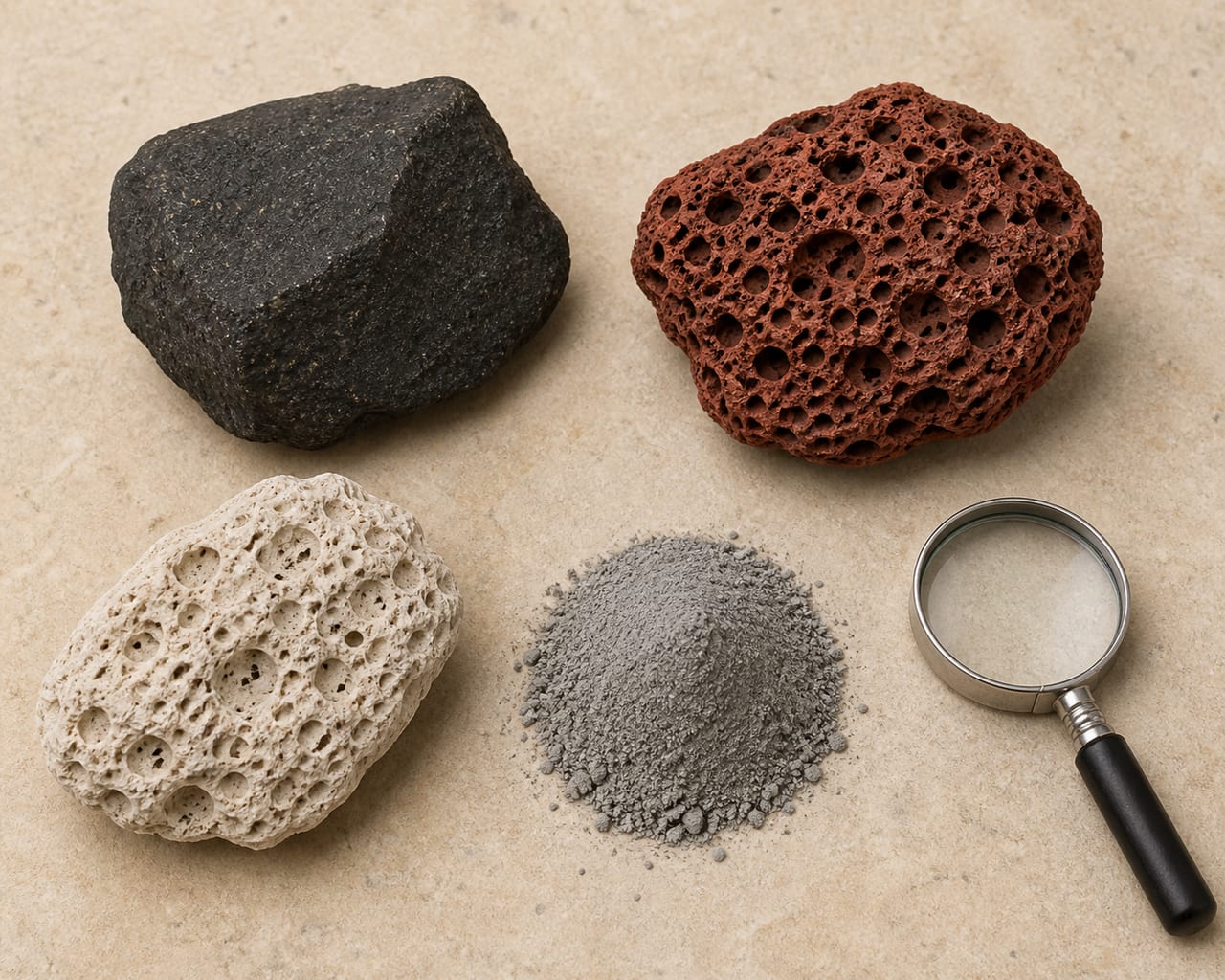
A mafic volcanic rock poor in silica and rich in iron and magnesium. It is the most abundant rock in the Canaries and produces very fluid lava flows.
A fragment of magma, lava or rock ejected during an explosive eruption. By size it is classified as bomb, lapilli or ash.
A vesicular fragment of solidified lava, usually dark in colour, that accumulates in cones around vents.
Two surface textures of basaltic flows. Pahoehoe has a smooth, undulating surface; aa is fragmented into angular, rough blocks.
Channel created by flowing lava, whose emptying can form caves, galleries and jameos.
A horizon of reddish clays produced by the alteration of iron-rich volcanic materials. It separates eruptive episodes and allows pauses in activity to be read.
Partial melting of mantle peridotites by heat input, volatiles or decompression.
Magma rises through fractures and may stall in chambers where it partially crystallises and differentiates.
Part of the magma reaches the surface as lava; another part solidifies underground forming dikes and intrusive bodies.
Effusive lava advances over the surface; its solidified skin can form a tube that channels the internal flow.
During explosive eruptions, fragments of different sizes are deposited forming strata that record each phase of the event.
The pause between eruptions allows weathering to form almagres and paleosols that separate episodes in the geological sequence.
At the bottom of the Caldera de Taburiente, rocks that record the submarine stage of La Palma edifice outcrop. Among them, pillow lavas stand out, formed when magma cools rapidly on contact with seawater. Their morphology is characteristic: rounded masses of black lava with a glassy skin that resemble stacked pillows.[1]
These lavas are accompanied by hyaloclastite breccias and marine sediments that allow the depth at which the edifice formed before emerging to be reconstructed. Their presence in the current part of the island, more than a thousand metres above sea level, demonstrates the volume of material that has been dismantled by erosion since the shield stage.[1]
Institutional tools for consulting maps, monitoring and planning.
Reference mapping by sheets from IGME-CSIC.
Catalogue of geo-resources of the Canary Islands maintained by IGME-CSIC.
Outreach material on volcanism, materials and geological heritage of Lanzarote.