
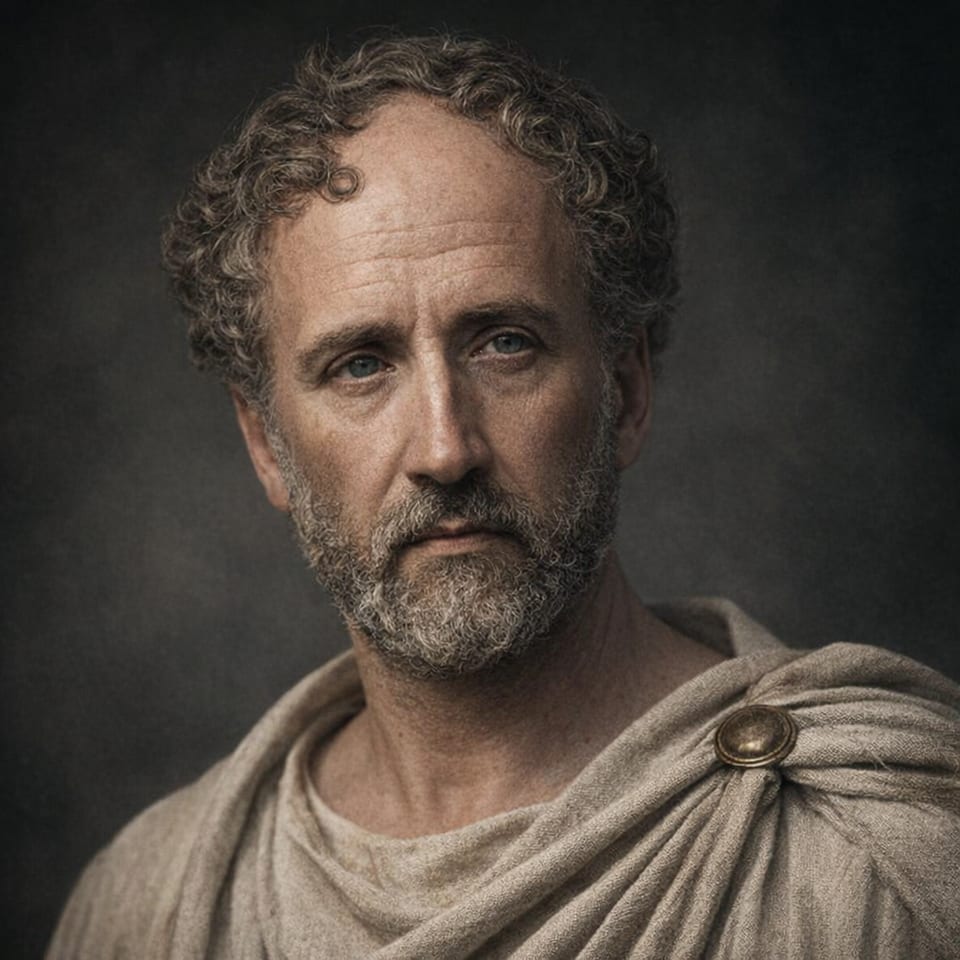
Plinio el Viejo
Pre-HispanicHistory20th CenturyThe chronicler who saved the name of the Fortunate Isles

Roman naturalist and author

Gaius Plinius Secundus, Roman naturalist. His Natural History (37 books, presented to Titus in AD 77) summarises the knowledge of his age and preserves, in Book VI, the lost report of Juba II's expedition to the Canary Islands, with the six names of the 'Fortunate' Isles. He never visited the archipelago: his role was that of transmitter. He died in AD 79 at Stabiae during the eruption of Vesuvius.
Early life

Gaius Plinius Secundus was born in AD 23 or 24 at Novum Comum, modern Como, in Transpadane Gaul, into a family of the equestrian order. He studied rhetoric in Rome under Publius Pomponius Secundus and, at twenty-one, began a military career in Germany as a tribune, rising to command a cavalry unit at Castra Vetera on the Lower Rhine. He took part in Domitius Corbulo's campaigns against the Frisii and Chauci and later served in the expedition against the Chatti. His earliest works, now lost, date from these years: a treatise on throwing the javelin from horseback, a life of his teacher and a twenty-book history of the Germanic wars.

Historical role

Back in Italy in AD 59 he began the administrative career typical of equites: procuratorships in Gallia Narbonensis, in Africa and in Hispania Tarraconensis, followed by the prefecture of the aerarium Saturni at Rome. Under Vespasian he reached his last and most famous post, command of the fleet at Misenum, the Tyrrhenian naval base. That double role as administrator and naval commander gave him access to first-rank imperial archives and to a web of informants, travel and reading that would feed his great work.

That work is the Natural History, dedicated to the emperor Titus and published in AD 77: thirty-seven books ranging through astronomy, geography, ethnography, zoology, botany, medicine and mineralogy. Pliny compiled at a fierce pace — he read, he confessed, even while being shaved —, compared sources, flagged what he had not seen with his own eyes, and organised scattered knowledge into thousands of entries. His method mixes autopsy, interviewing and critical reading; it is not free of error, but no other ancient work condenses so much knowledge.

For the Canaries, Pliny is the essential chronicler, not an actor: nothing suggests he ever visited the islands. In Book V he records the expedition of the proconsul Suetonius Paulinus, who crossed the Atlas in AD 41 and described peoples such as the Canarii; and in Book VI (201–205) he reproduces — in all likelihood through an intermediary — the report that Juba II of Mauretania wrote on his Atlantic expedition. There, for the first time, the six names of the archipelago are read — Canaria, whose name the account derives from the dogs of great size that his men captured for the king; Nivaria, from the snow of its great mountain; Pluvialia, Capraria and the two Junoniae, with their temple built of a single stone —, together with distances, bearings and news of their inhabitants. Without Pliny, this chapter of Canarian history would have been lost entirely.

Legacy

He died as he had lived, in harness. On 24 or 25 August AD 79, while commanding the fleet at Misenum, the eruption of Vesuvius caught him sailing towards the stricken coast to rescue a friend and observe the phenomenon; he perished at Stabiae, suffocated by the gases, according to the account his nephew, Pliny the Younger, left in his letters. His nephew inherited his memory too: thanks to that double transmission — the Natural History and the letters —, the name Juba II gave the islands reached the medieval and modern tradition of the Canaries intact.

Timeline

  1. 23 d.C.Born at Novum Comum (Como), in Transpadane Gaul.
  2. 41 d.C.He records in Book V of his work Suetonius Paulinus's expedition across the Atlas.
  3. 77 d.C.He presents the Natural History, his work in thirty-seven books, to Titus.
  4. 79 d.C.He dies at Stabiae during the eruption of Vesuvius, in command of the fleet at Misenum.

Sources and verification