
Introduction
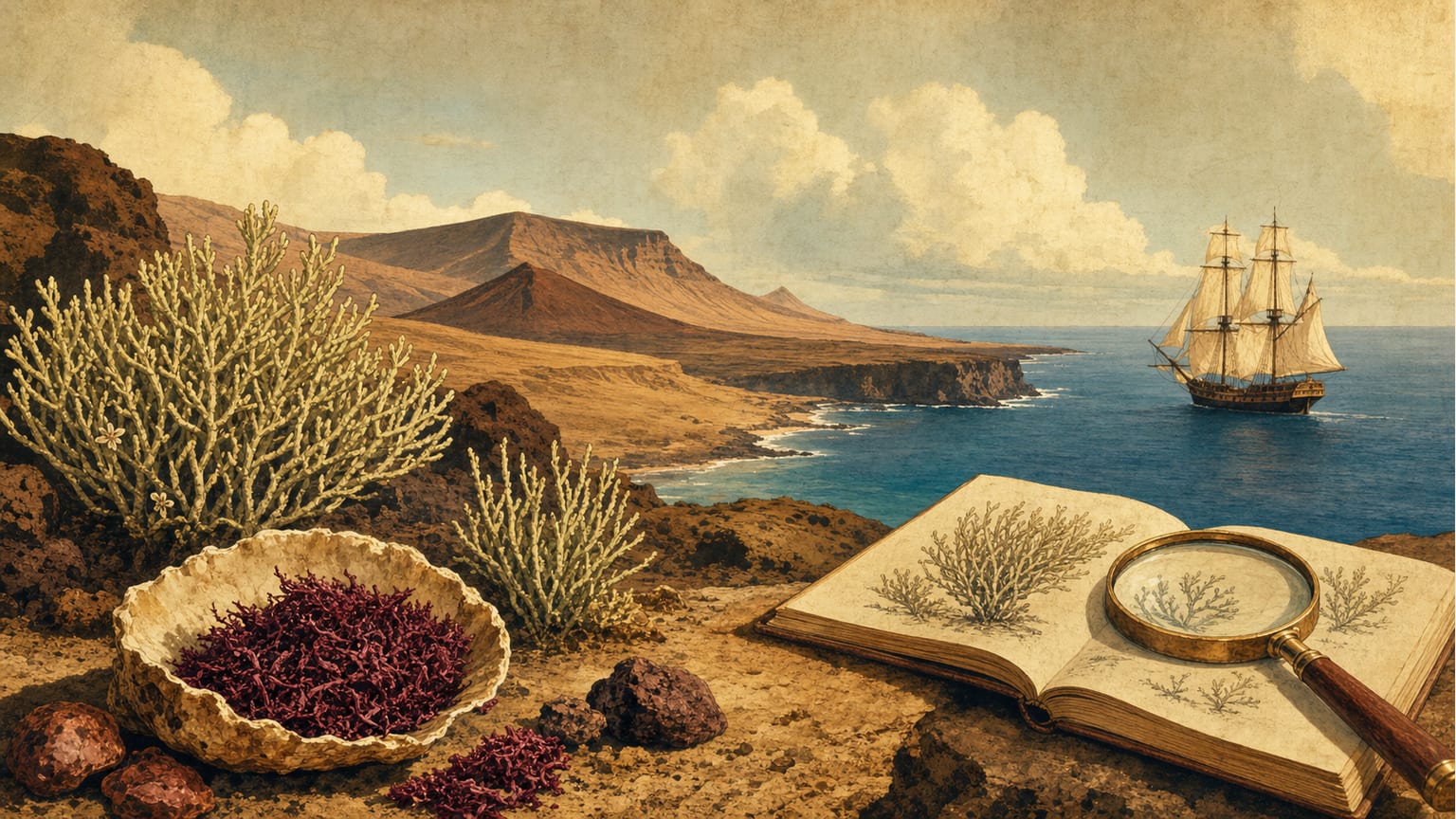
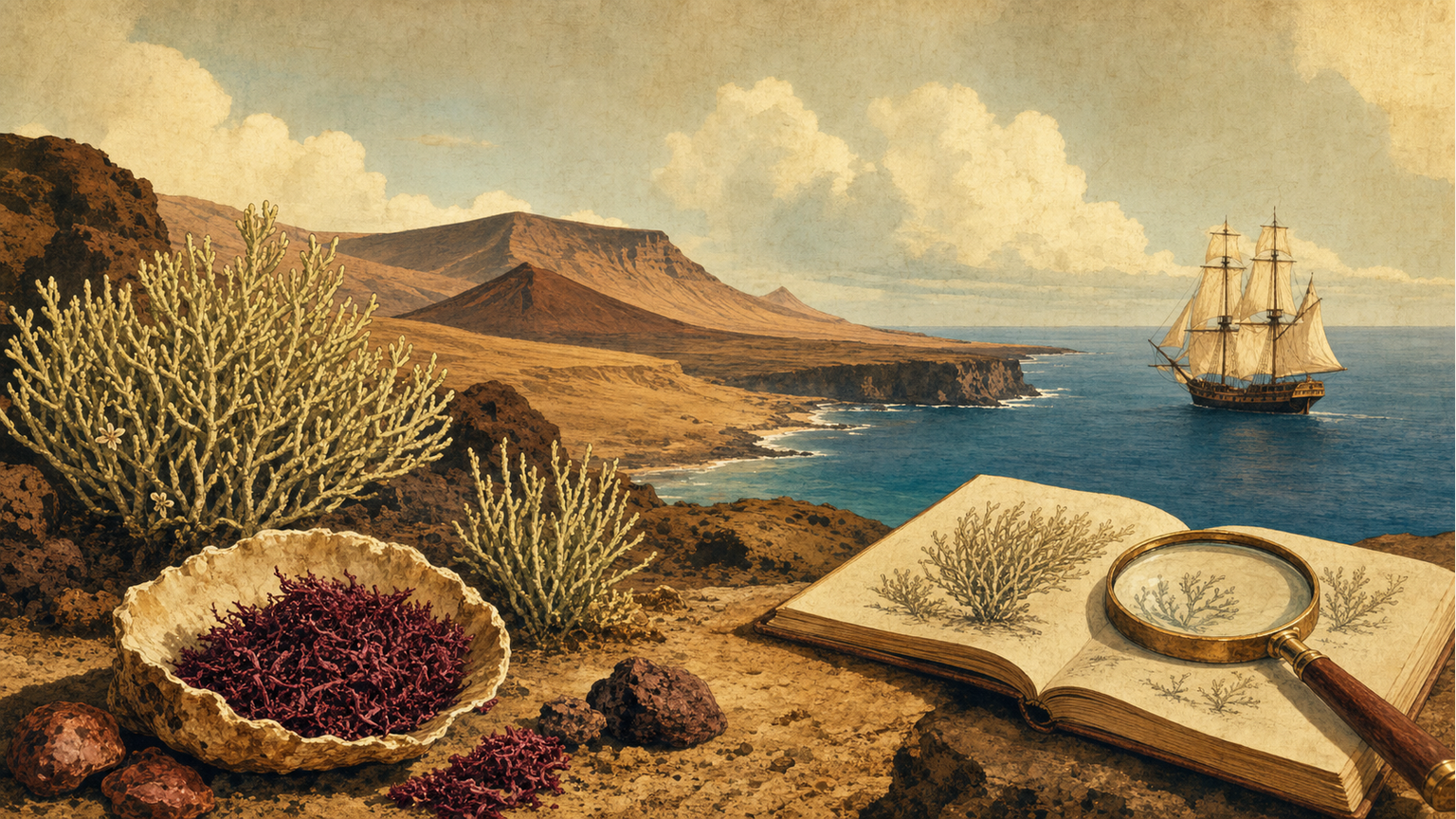
In the first half of the nineteenth century, Philip Barker Webb and Sabin Berthelot devoted several pages of their Histoire naturelle des îles Canaries to locating the ancient names of the archipelago. One of their most debated proposals was to identify Lanzarote and Fuerteventura with the Purpurariae Islands mentioned by Pliny the Elder[1]. At the time, the idea carried weight because it fitted the interpretation of the geographers Gosselin and d’Anville and the abundance of orchil in the eastern Canaries. Today, however, modern scholarship has challenged that identification and placed the Purpurariae somewhere else: the islets off present-day Essaouira (Morocco).
Webb and Berthelot’s Hypothesis
Webb and Berthelot followed Gosselin and d’Anville in arguing that the Purpurariae were Lanzarote and Fuerteventura. Their most explicit statement reads: “nous partageons l’opinion de ce savant commentateur qui, à l’exemple de d’Anville, a rapporté cette ancienne dénomination à Lancerotte et à Fortaventure”[1]. Their argument rested on two pillars: the reading of classical texts and the presence of a valuable dye in those islands.
To explain the name, the authors cited Bory de Saint-Vincent: the substance sought was not mollusc purple but orchil (Roccella), a lichen highly prized for dyeing. The abundance of this plant in Lanzarote and Fuerteventura seemed to confirm the hypothesis: “L’abondance de cette plante dans les îles de Lancerotte et Fortaventure semblerait confirmer les assertions de M. Bory”[1].
What Pliny Actually Says
The Canarian identification runs into difficulty when one returns to Pliny the Elder’s text (Natural History, 6.201-205). Pliny reproduces the report that King Juba II of Mauretania compiled on his Atlantic expeditions. There, two groups of islands are clearly distinguished:
- The Purpurariae, located “opposite the Autololes”, where Juba had set up purple-dye workshops.
- The Fortunatae Insulae, that is, the Canary Islands, lying beyond the Purpurariae[2][3].
The distance given by Pliny — 625,000 paces from the Purpurariae to the Fortunatae — and the direction of the voyage (first westward, then eastward) fit poorly with the idea that both names refer to the same pair of islands[1].
The Modern Interpretation: Mogador and Essaouira
From the mid-twentieth century, archaeologists Jean Desjacques and Paul Koeberlé identified the Purpurariae with the islets off Mogador, modern Essaouira (Morocco). Their argument rests on the fact that these islets lie directly opposite the territory of the Autololes and that excavations have revealed remains of purple-dye workshops active from the fourth century BC to the fourth century AD[3][4].
Enrique Gozalbes Cravioto and José María Blázquez Martínez later reviewed the debate and noted that most modern critics reject the identification of the Purpurariae with Lanzarote and Fuerteventura. Blázquez points out that H. Treiller already favoured Mogador and dismissed the Canarian identification[3].
What about the Orchil of Lanzarote and Fuerteventura?
Orchil remains a real chapter in the economic history of Lanzarote and Fuerteventura. Chroniclers of the Béthencourt expedition already mentioned in the fifteenth century a “graine… qu’on appelle orsolle” used for dyeing[1]. Yet the fact that these islands produced orchil does not prove that they were Pliny’s Purpurariae. At most, it explains why Webb and Berthelot found their hypothesis plausible.
Conclusion
The identification of Lanzarote and Fuerteventura as the Purpurariae Islands is a nineteenth-century proposal reflecting the state of Webb and Berthelot’s scholarship, not an archaeological verification. Today, classical research and the finds at Mogador point to the Purpurariae lying on the Atlantic coast of Morocco, while the Canaries corresponded to the Fortunatae Insulae. The article should therefore be read as an example of how ancient sources are reinterpreted over time: what seemed a reasonable identification in 1839 is now considered a hypothesis rejected by most specialists.