

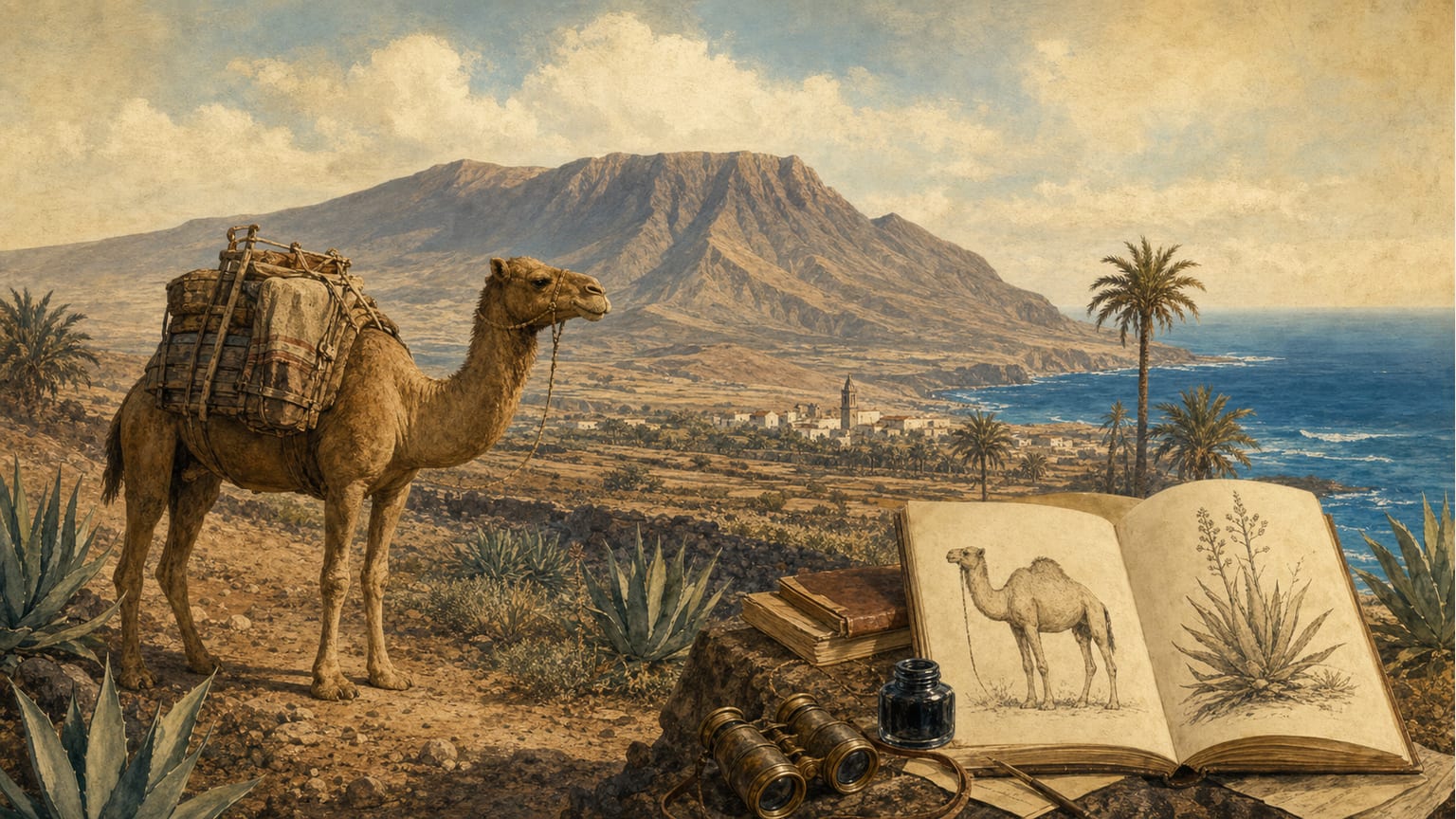
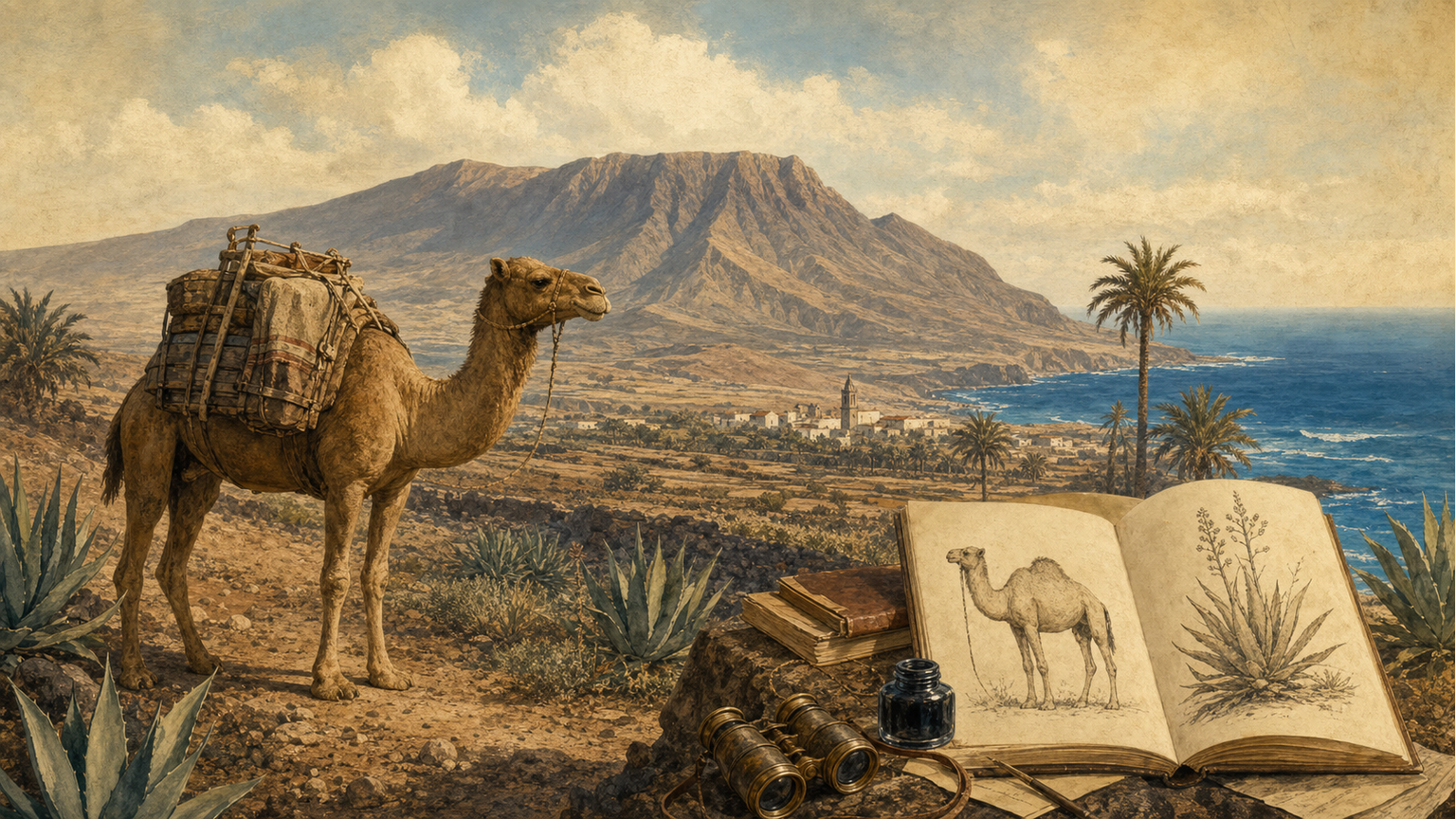
The introduction of the camel to the Canary Islands is a significant event in the archipelago’s natural history, thoroughly documented by Webb and Berthelot in the 19th century. According to their account, the camel was brought to the islands by the first conqueror, Jean de Béthencourt, from the nearby African continent[1]. The species adapted perfectly to the islands’ climate and terrain, with Fuerteventura being the main center for camel herds, and a notable herd also present in Tenerife, on the estate of the Marquis of Belgida in Adeje[1].
During their stay in the Canary Islands in February 1829, Webb and Berthelot observed the breeding and habits of these animals in detail. At that time, the Adeje herd consisted of eighteen males and forty-seven females, kept separate. The camels’ coats ranged from whitish-yellow to dark brown[1].
The authors describe the behavior of male camels during the rutting season, when they become dangerous, making a characteristic gurgling sound and displaying a bladder that is an extension of one of their stomachs. In this state, they may attack anyone, even their handler, knocking them down and crushing them with the callus on their chest. Males also fight among themselves, biting and dodging with remarkable speed until the strongest prevails and becomes the dominant male of the herd[1].
Female camels have a gestation period of a full year. The young, called “Belfinos” in their first year and “Majululos” until fully grown, take three days to stand and are fed on their mother’s milk for two years, or up to four if the mother is not impregnated again. Thus, reproduction generally occurs every three years[1].
Camels eat all kinds of vegetation, even the leafy branches of the spiniest opuntias, and can fatten during droughts when other animals die of hunger. However, their manure is of little value as fertilizer compared to that of oxen[1].
In the Canary Islands, camels do not have the speed of the Arabian dromedary and are used mainly as pack animals, notable for their strength. Webb and Berthelot recount the case of a camel in Fuerteventura that carried a load of eighteen hundred pounds from the island’s interior to the port of Las Cabras[1].
Camel milk was considered excellent, very similar to cow’s milk but a bit thicker, and the female would only allow herself to be milked if her calf was suckling at the same time. It was rare for females to be used for work. Camel meat was rarely consumed in the Canary Islands, although it was more common in Morocco, as observed by the authors[1].
This detailed account by Webb and Berthelot offers a precise view of the camel’s importance and adaptation to Canarian rural life in the 19th century, based on direct observation and testimony from local inhabitants of the time[1].