

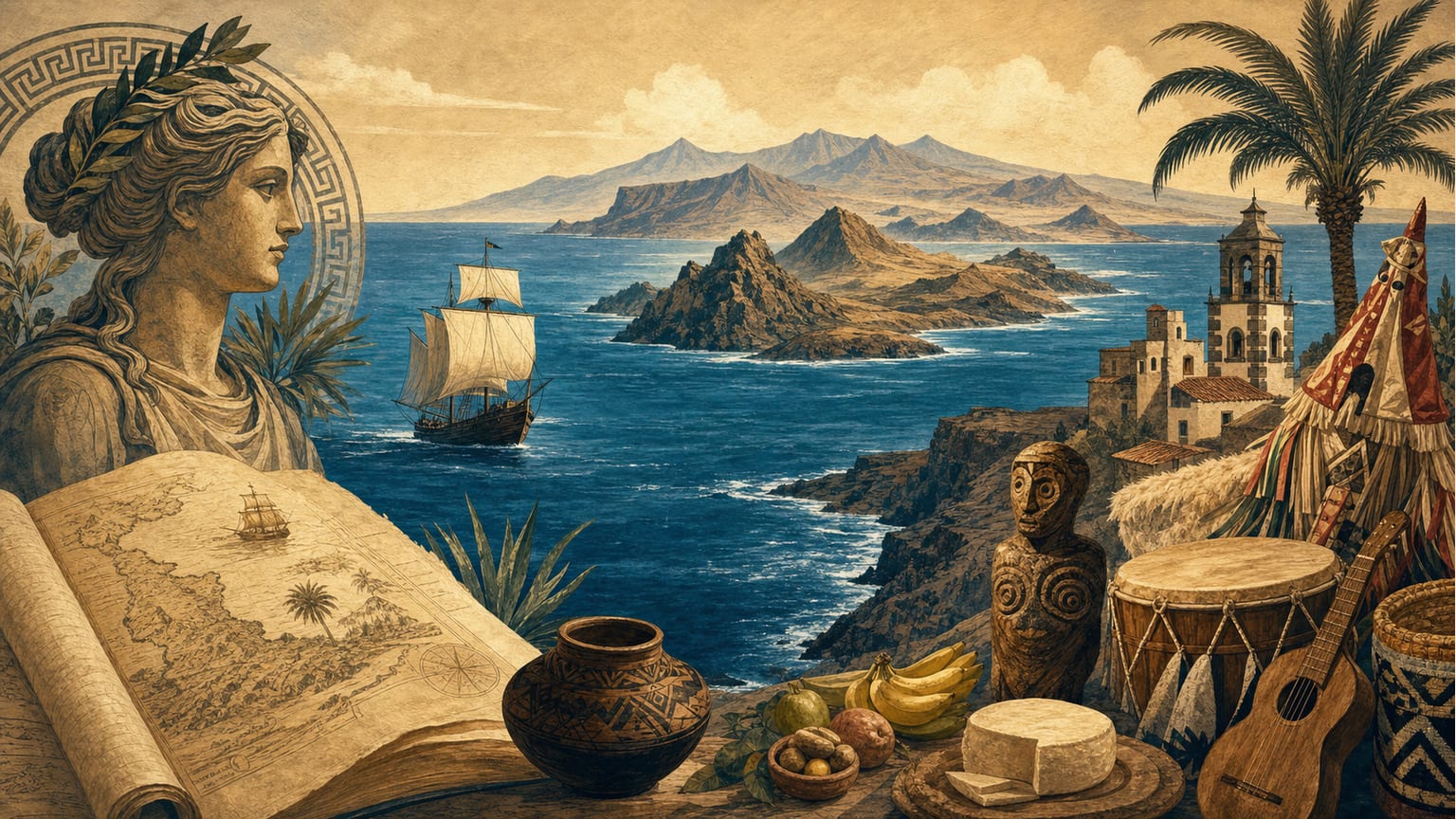
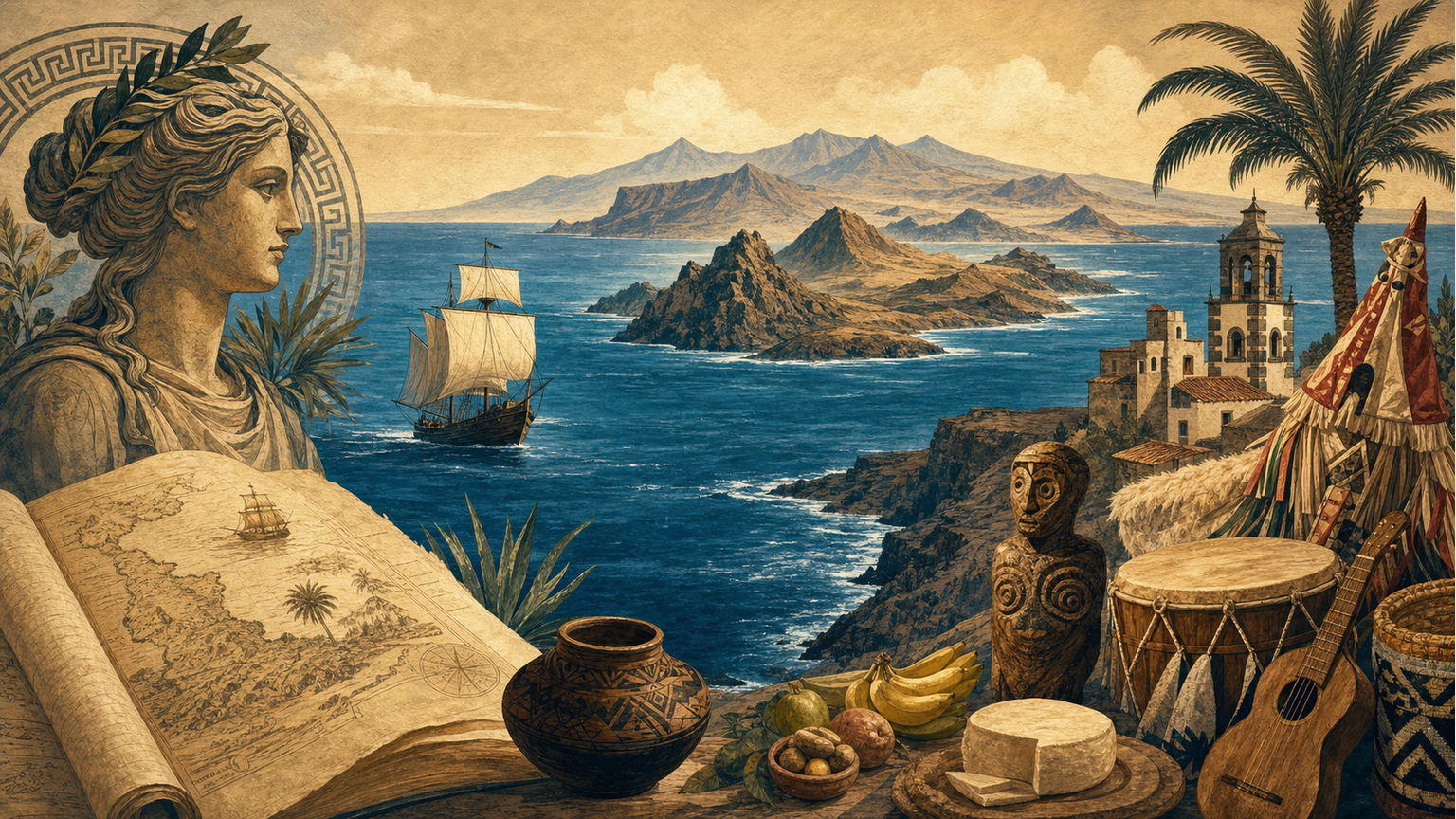
Since antiquity, islands have been seen as privileged spaces for the imagination and myth-making. Among the many legends surrounding the Canary Islands, the myth of the Isles of the Blest (Makáron nêsoi in Greek) stands out for its enduring influence on how these islands are perceived[1].
The earliest reference to the Isles of the Blest appears in Hesiod’s Works and Days (c. 700 BC), describing a place reserved for heroes rewarded by the gods—a land of eternal happiness, gentle climate, fertile nature, and freedom from war or toil. This myth is closely linked to the Elysian Fields and the Golden Age, symbolizing the ultimate utopia[1].
Over time, the concept evolved. By the 5th century BC, the poet Pindar reimagined the Isles of the Blest as the abode of righteous souls, not just heroes. Thus, these islands became associated with the afterlife, echoing similar beliefs in Celtic and Egyptian traditions[1].
From the 3rd century BC onwards, mythical elements were transferred to real Atlantic islands. Greco-Roman authors like Strabo, Plutarch, Pomponius Mela, and Pliny the Elder began to identify the Isles of the Blest with archipelagos such as the Azores, Madeira, Cape Verde, and especially the Canary Islands. This was reinforced by the fact that, until the Age of Discovery, the Canaries marked the western edge of the known world, surrounded by the mysterious Atlantic Ocean[1].
The term “Fortunate Islands” comes from the Latin Fortunatae Insulae, first used by Plautus and later adopted by other writers. During the Middle Ages and into the modern era, this name became firmly established and remains a symbol of Canarian identity and tourism today[1].
Even in medieval Arabic literature, the Canaries appear under mythical names such as “Eternal Islands” or “Islands of Happiness,” reflecting the Greek concept. This universality suggests that the idea of a paradise island is a constant in human imagination, representing the search for happiness and perfection in distant, mysterious places[1].
Ultimately, the myth of the Isles of the Blest has been central to the Atlantic Greco-Roman imagination and the identity of the Canary Islands. It has inspired poets, travelers, and scholars for centuries and remains alive in the islands’ culture and collective memory. As Canarian poet Bartolomé Cairasco de Figueroa wrote, “there is no place on earth that so closely approaches heaven”[1].