
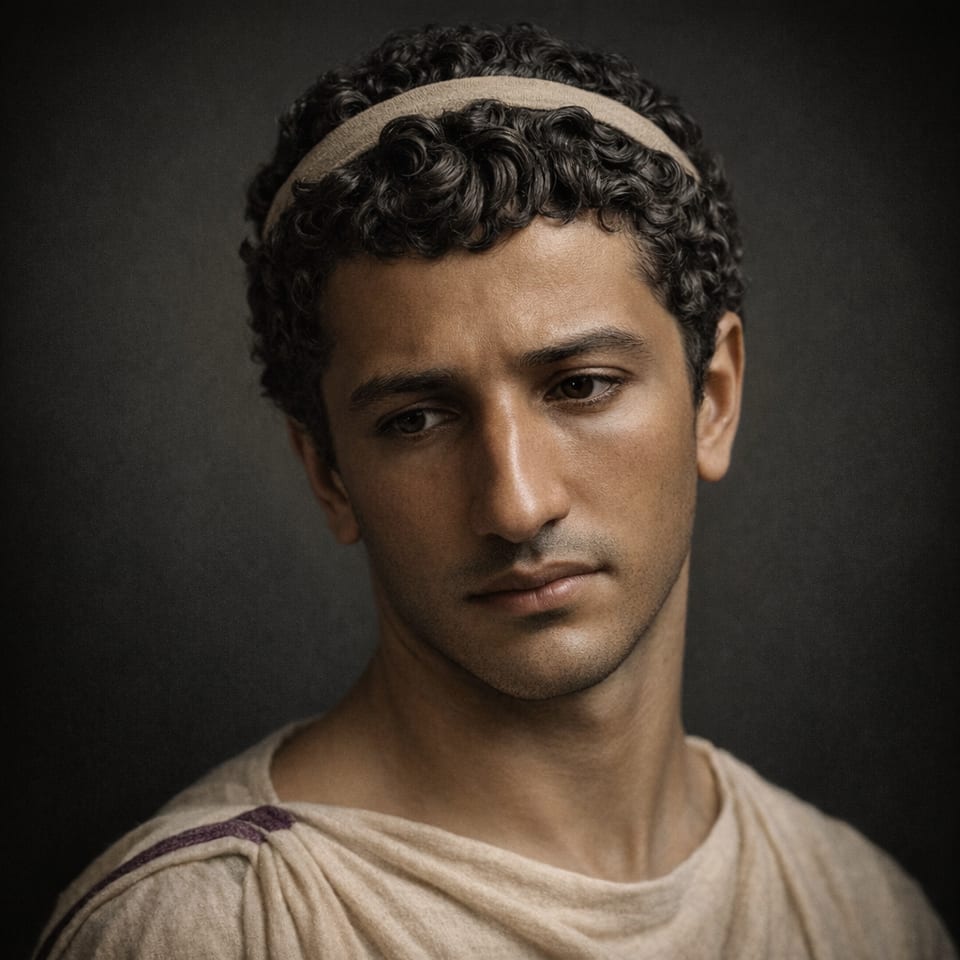
Juba II de Mauritania
Pre-HispanicHistory20th CenturyThe king who named the Fortunate Isles

King of Mauretania and scholar

King of Mauretania installed by Augustus in 25 BC. Raised in Rome after the defeat of his father Juba I, he married Cleopatra Selene and made Caesarea (Cherchell) his capital. Around 20 BC he sent an expedition to the Canary archipelago whose report, transmitted by Pliny, first named six islands as the 'Fortunate' Isles. There is no evidence that he ever visited the islands himself.


Early life

Juba II was born around 52 BC into the Numidian royal family, the son of King Juba I. His father's defeat and death at the battle of Thapsus in 46 BC, at the hands of Julius Caesar's legions, changed the boy's fate entirely: he was taken to Rome under the victor's protection and, according to the historiographical tradition, displayed in Caesar's triumph. Educated in the household of Octavia, Octavian's sister, in a milieu of Hellenistic refinement, he became one of the best-educated young men of the Roman elite, trained in arms as in letters, with a command of Greek, Latin and the Libyan and Punic languages of his childhood.

Historical role

In 25 BC Augustus restored him as client king of Mauretania, a territory Rome had administered directly since the death of Bocchus II in 33 BC, and folded his kingdom into the imperial sphere under an equestrian prefect. Juba established his court at Iol, renamed Caesarea in honour of Augustus — modern Cherchell in Algeria — and, with his wife, turned it into a Graeco-Roman capital with a theatre, a forum and a lighthouse modelled on Alexandria's. That wife was Cleopatra Selene, daughter of Cleopatra VII and Mark Antony, a marriage that joined Ptolemaic memory to the new Mauretanian dynasty. Juba ruled as a true Hellenistic-style vassal king: patron of Gades and Carthago Nova, close friend of Augustus, whom he accompanied on campaign, and companion to Gaius Caesar on the eastern expedition.

The aspect of his reign that travelled furthest is the scholar-king. Writing in Greek, he produced a series of treatises — On Libya, On Arabia, On Assyria and a history of the theatre — of which only fragments survive, quoted by Pliny, Plutarch and Athenaeus. He kept a great library, partly inherited from the kings of Numidia. Within that world of learning he organised the expedition that gives him his starring role in Canarian history: presumably sent with Augustus's authorisation — according to the interpretation of Mederos Martín and Escribano Cobo — to fix the position of the islands at the western edge of the world, an expedition surveyed the archipelago around 19–10 BC — the dating proposed by those same authors —, possibly with Roman naval support. The results were set down in his treatise On Libya and, through it, in Pliny's Natural History (VI, 201–205), which names six islands for the first time: Canaria — so called, the account says, from the multitude of dogs of great size, two of which were captured for the king —, Nivaria, Pluvialia, Capraria and the two Junoniae, with their temple hewn from a single stone.

Legacy

It is worth stating precisely what can and cannot be claimed: no source documents that Juba ever set foot on the islands himself; what we know is the expedition he sent and the report it produced. Nor is there evidence of any lasting exploitation after the visit. He died in AD 23 or 24 and was succeeded by his son Ptolemy, whom Caligula executed in AD 40; with him the dynasty ended and Mauretania became a Roman province. His bond with the Canaries is essential: thanks to Pliny's transmission, the name 'Fortunate' applied by his expedition survived antiquity and fed the medieval and modern tradition of the archipelago. The hypothesis, defended among others by Álvarez Delgado, that the expedition settled the islands with Gaetuli or that the Indigenous Canarians descended from Romano-Mauretanian deportees, remains a debated proposal and not an established fact.

Timeline

  1. c. 52 a.C.Birth of Juba II into the Numidian royal family, son of Juba I.
  2. 46 a.C.Defeat and death of Juba I at Thapsus; the young Juba is taken to Rome under Caesar's protection.
  3. 25 a.C.Augustus restores him as client king of Mauretania; he marries Cleopatra Selene and establishes his court at Iol-Caesarea.
  4. c. 19-10 a.C.He sends the expedition that surveys the Canary Islands and names six of them the 'Fortunate' Isles.
  5. 23/24 d.C.Death of Juba II; he is succeeded by his son Ptolemy.

Sources and verification