

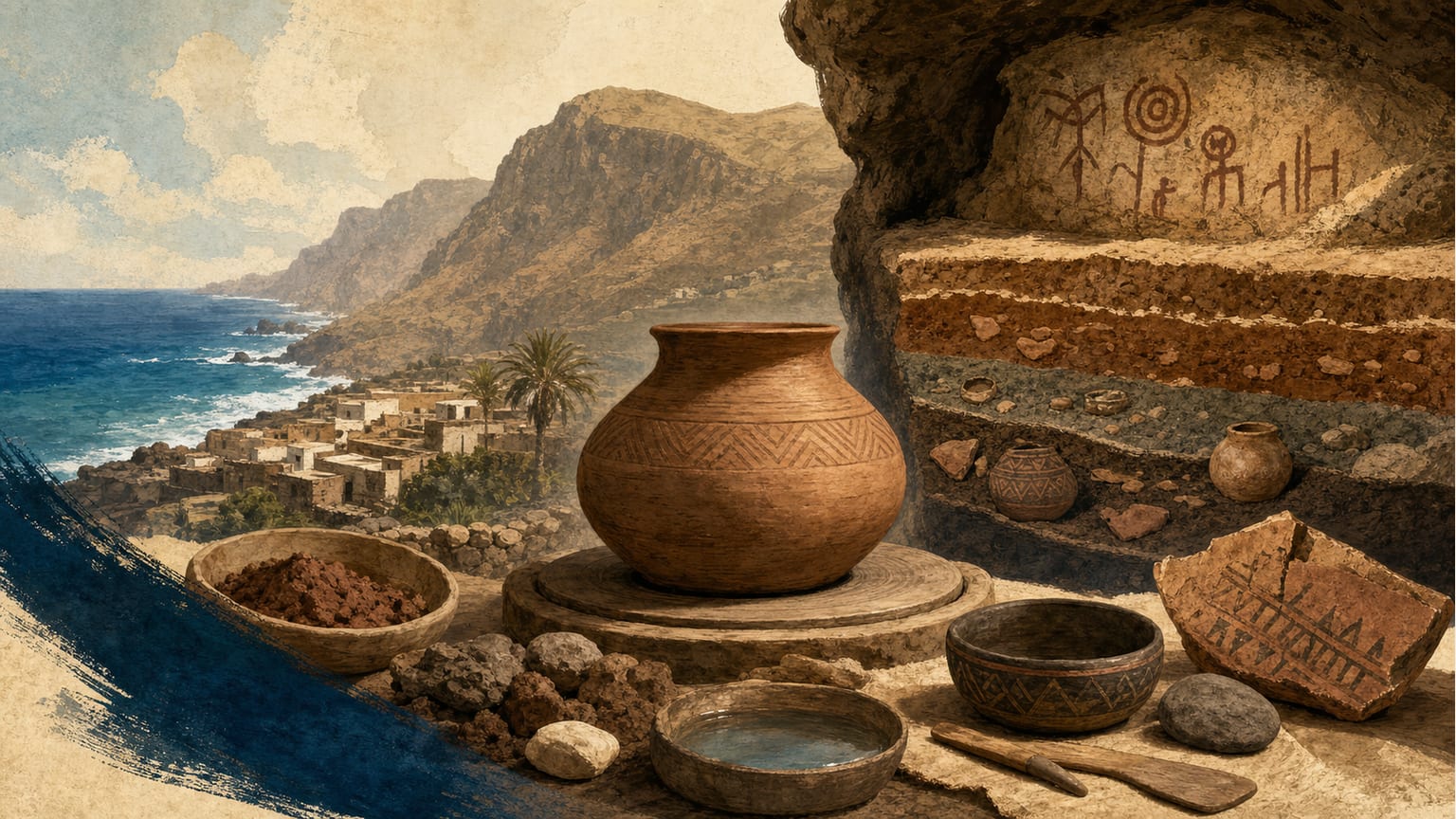
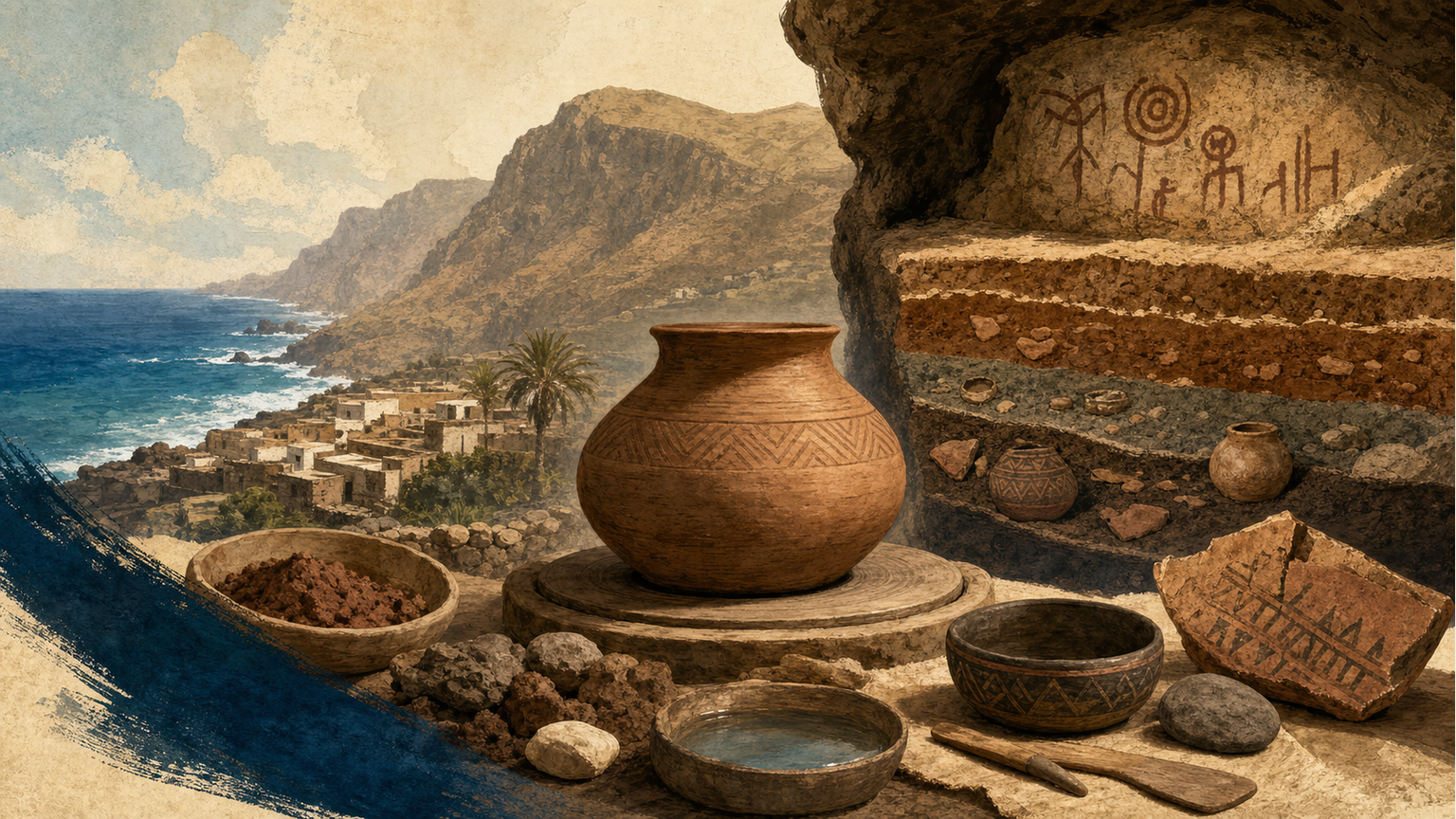
Traditional pottery in Moya, Gran Canaria, stands as a notable example of the persistence of ancestral techniques in the crafting of clay objects, passed down through generations and adapted to local conditions[1]. According to Romero Roque, Francisco, the process of pottery making in Moya is defined by several key features: manual construction of pieces, no use of a wheel, rudimentary tools, and the simplicity of form and decoration[1].
The process begins with sourcing the raw materials. Clay, the main component, is extracted from nearby veins such as Tierras Blancas, using simple tools like picks and hoes. Sand, used as a temper, is collected from nearby ravines, with care taken to avoid impurities. Almagre, a clay rich in iron oxide, is used for decoration or waterproofing and is ground and mixed with water until the desired consistency is achieved[1].
Clay preparation involves sun-drying, crushing, sieving to remove stones and roots, and soaking in water for 24 hours. After draining, the clay is mixed with sand at a ratio of three parts clay to one part sand, with the sand’s grain size chosen according to the vessel’s intended use: fine sand for liquid containers, coarse sand for pieces meant for fire[1]. The mixture is kneaded by foot until homogeneous, then divided into “pellas” (lumps) and stored in damp cloths or containers[1].
To create a vessel, a lump of prepared clay is shaped on a hard surface, usually a stone slab or wooden board. The “churro” technique is used, adding coils of clay to the base and fusing them by hand to build up the vessel’s walls. Hands are the main tool, but stones called “saltona” and “raspona” are used to shape and thin the walls, while cane splinters or barrel hoops are used for exterior smoothing[1].
Once the vessel is shaped and any appendages such as handles or spouts are attached, it is left to dry so the additions set. The piece is then burnished with smooth stones and coated with a slip. Finished pieces are dried in a cool, draft-free drying area for two to four weeks before firing[1].
Firing can be done in two-chambered Arab-type kilns or by the traditional “bonfire kiln” method, which involves a pit in the ground covered with wood. In both cases, the temperature reaches about 700°C. After five or six hours, the pieces are carefully removed, and some may be smoked with sawdust or sand to create unique decorative effects[1].
As documented by Romero Roque, traditional pottery in Moya is marked by its adherence to pre-Hispanic techniques, the importance of manual labor, and the use of local materials, giving each piece a unique character within Gran Canaria’s cultural heritage[1].