

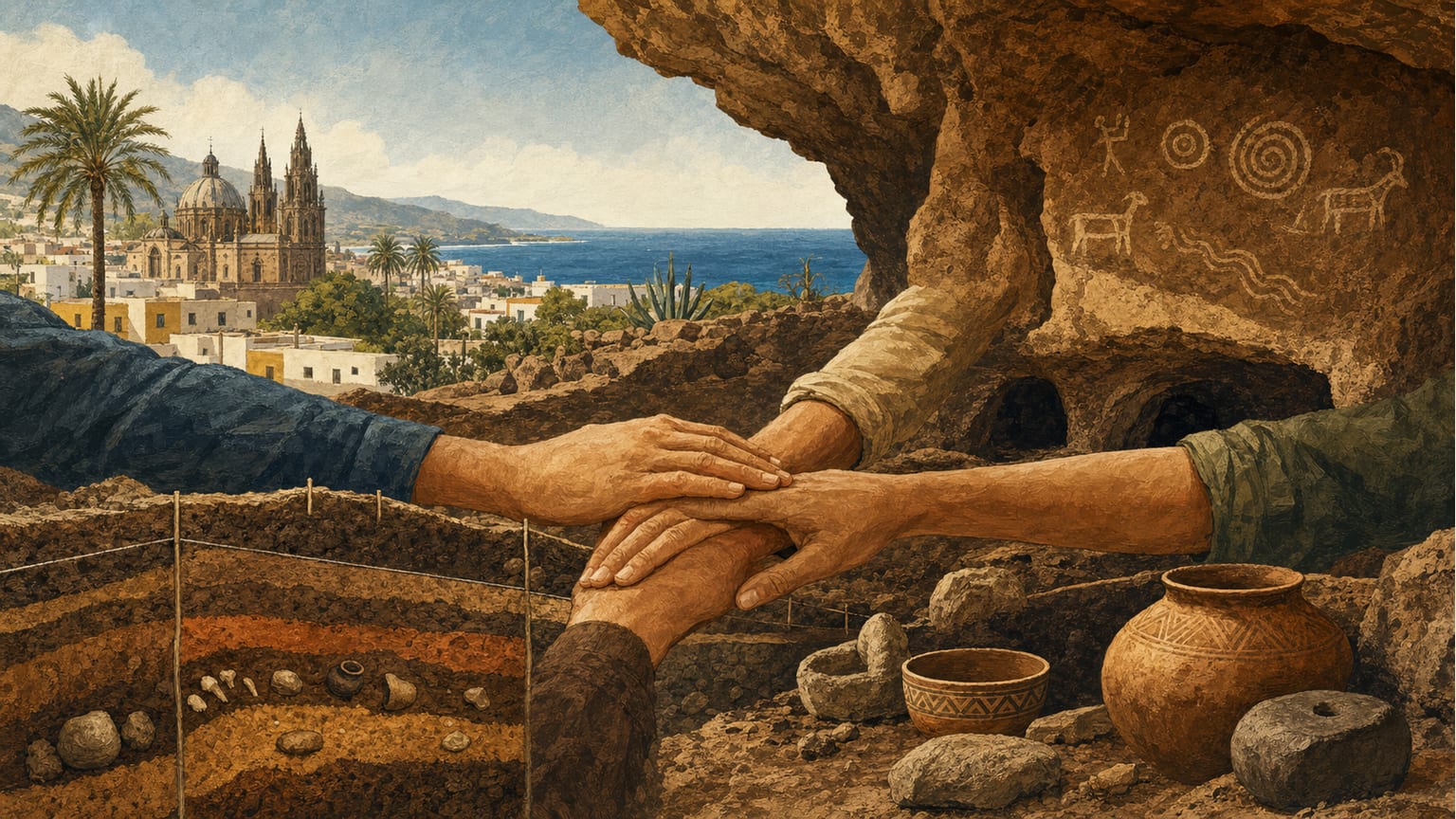
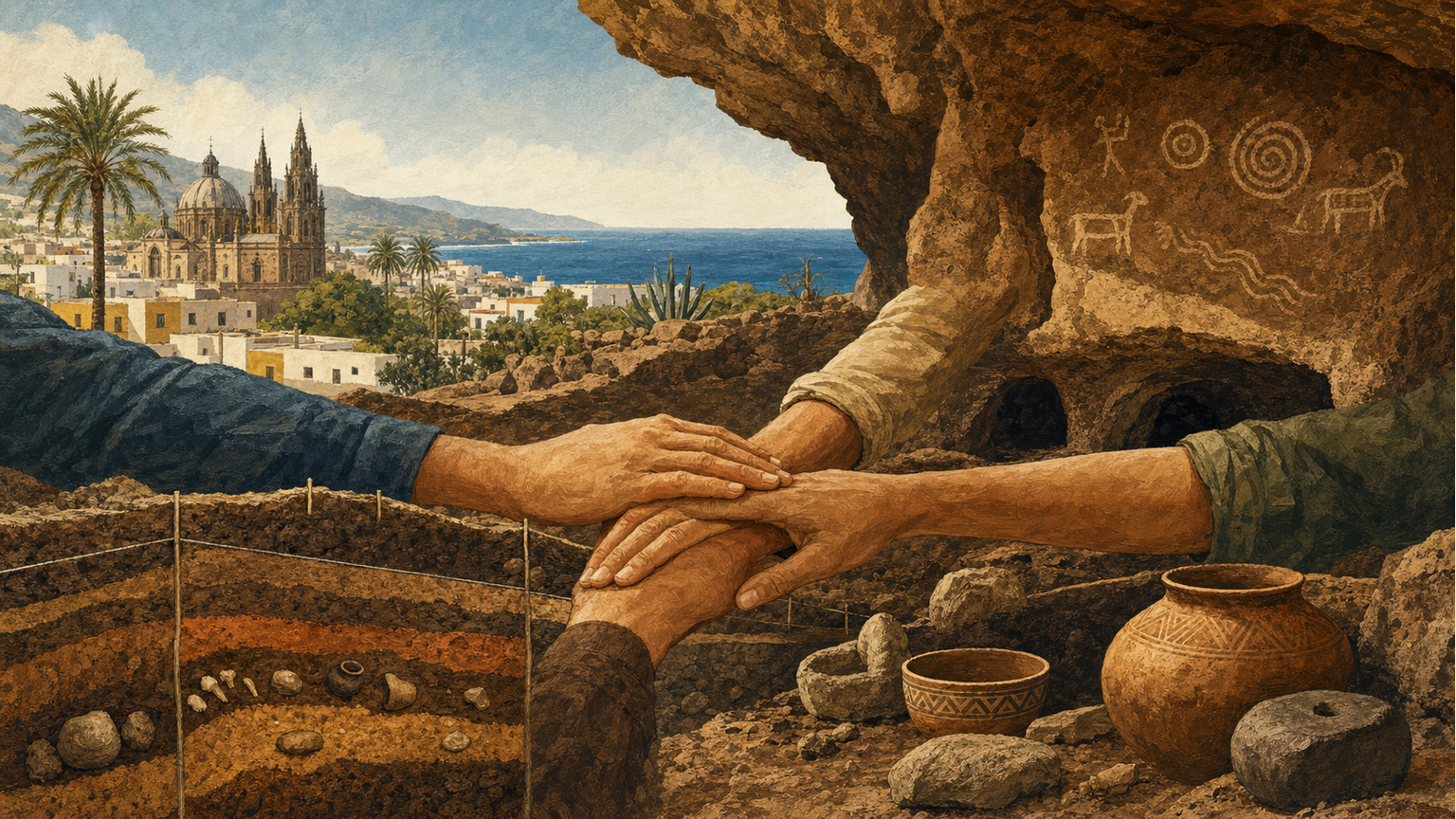
The archaeological site of La Cerera, located in Arucas, Gran Canaria, is a notable case of how collaboration among public institutions, companies, and the local community can be decisive in protecting and promoting archaeological heritage[1]. The site was discovered during the construction of the Guanche Neighborhood Association headquarters, and its scientific and heritage value was quickly recognized, identifying it as a habitat occupied by pre-Hispanic communities in the ancient territory of Arucas[1].
According to Pedro González Quintero, Marco A. Moreno Benítez, and Antonio M. Jiménez Medina (eds.), institutional, business, and community collaboration was essential to harmonize the demands of the different groups involved. The interests of neighbors seeking a social center were combined with those of researchers, who obtained new documentation to reconstruct Arucas’s past, and with those of the general public, who could access the site and learn about their historical heritage[1].
The archaeological intervention at La Cerera was made possible by the support of entities such as the Arucas Town Hall, the Cabildo of Gran Canaria, the Government of the Canary Islands, and the company UNELCO, as well as coordination from the University of Las Palmas de Gran Canaria[1]. This collaboration enabled not only the excavation and historical documentation of the site but also its musealization and public opening, demonstrating that integrating heritage assets into everyday environments is an added value for society[1].
The excavation process involved the active participation of the Guanche Neighborhood Association, which allowed unconditional access to the cave area for archaeological work, even when this meant temporarily halting the construction of the social center[1]. The neighbors showed great patience and collaboration, aspects that the authors of the study explicitly highlight and appreciate[1].
The experience at La Cerera demonstrates, according to the editors, that the preservation of cultural heritage cannot be an isolated task but requires the involvement of all social groups[1]. The participation of graduates, students, and doctoral candidates in excavation and material study tasks was also fundamental to the project’s success[1].
In summary, the case of La Cerera shows that collaboration between institutions, companies, and residents is key to protecting and disseminating archaeological heritage, allowing these spaces to be recovered and enjoyed by society as a whole[1].