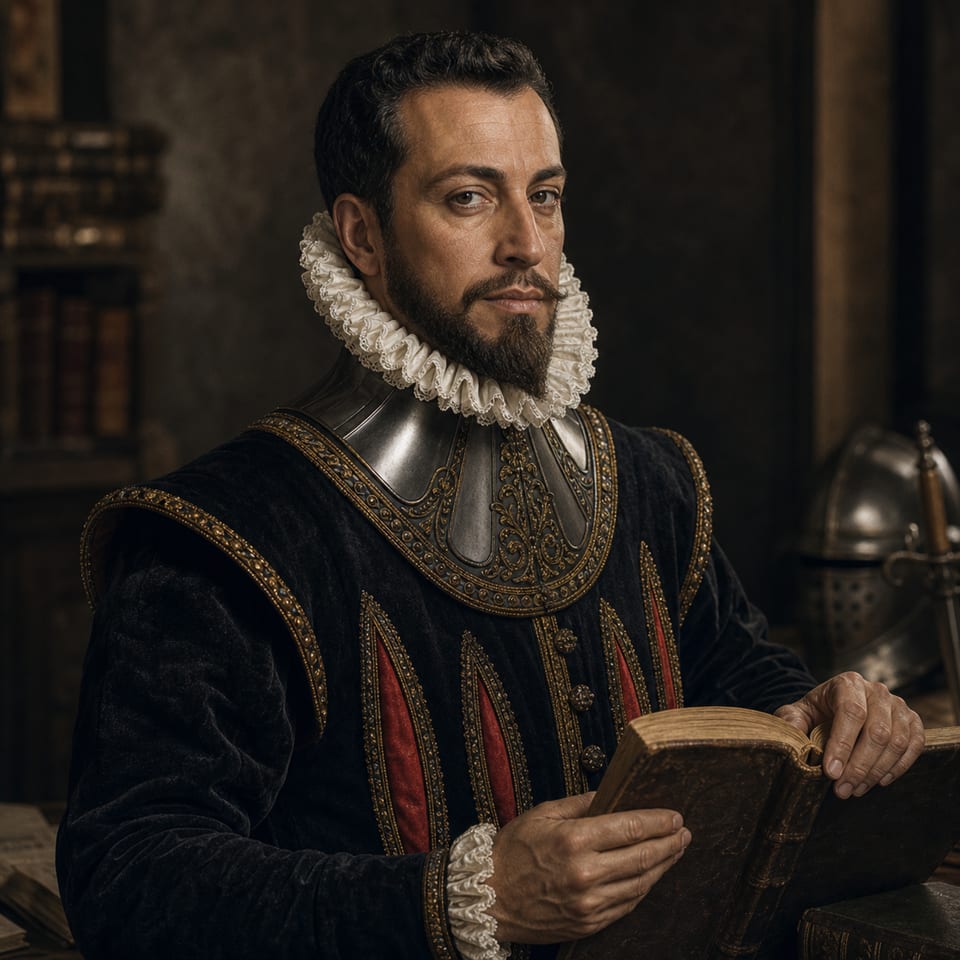

Lanzarotto Malocello
Pre-HispanicHistory20th CenturyNamesake of Lanzarote

Genoese navigator

Genoese navigator linked to the medieval European rediscovery of the Canary Islands in the 14th century. His surname remained durably attached to Lanzarote, which Angelino Dulcert's 1339 nautical chart depicts as 'insula Lanzaroti Maroxelli'. His birth and death dates are unknown.
Early life

Lanzarotto Malocello was a Genoese navigator about whom scarcely any reliable biographical information survives. He was probably born in the early 14th century into the orbit of the Malocelli, one of the oldest and noblest families of Genoa, with interests as merchants and bankers documented from the first half of the 13th century in Seville, Lisbon and Ceuta. Curiously, none of the Genoese genealogical repertories that deal with that house mentions him or his enterprise, and the official records of the Republic are silent about him, which has turned his biography into an exercise in reconstruction from scattered clues.

Historical role

His name became attached to the European return to the Canary Islands after centuries of oblivion. Historiography places his expedition between 1325 and 1339, most probably around 1336, during the reign of Afonso IV of Portugal, within the Lusitanian Atlantic programme that relied on Genoese officers and pilots gathered around Admiral Manuel Pessagno from 1317. The traditional date of 1312 comes from later, interested testimonies, in particular a 1632 pamphlet of the Maloisel family of Normandy, and is now considered untenable. The island he reached, called Titeroygatra by its inhabitants, took from him the name of Lanzarote, which it still bears; there he built a castle that the Norman chronicle Le Canarien found still standing in 1402 and whose ruins have been tentatively identified near the Guanapay volcano in the south-east of the island.

The most solid documentary proof of his existence and of his link with the archipelago is cartographic: the nautical chart drawn by Angelino Dulcert in 1339 shows, off the African coast, an 'insula Lanzaroti Maroxelli' decorated with the Genoese flag, a sheet preserved in the Bibliothèque nationale de France. Later cartography repeated the name in the forms Malozella, in 1374, and Maloxella, in 1385, and the Castilian compilation of the Libro del Conocimiento, from the mid-14th century, also remembers him. The Genoese notarial records offer more fragile clues: an act of 1330, now lost, would name him as a witness, and two acts of 1384 and 1391 preserved in the Archivio di Stato of Genoa mention Eliana Fieschi as the widow of one Lanzaroti Marocelli; if the identification were correct, Malocello would already have died before 1384.

Legacy

His legacy demands caution. A Norman presence in the Atlantic in the early 14th century is highly improbable; the diploma that Ferdinand I of Portugal would have granted in 1370 to a 'Lanzarote de Franqua' is of suspect authenticity and can hardly be identified with him; and the tradition that has him dying at the hands of the islanders lacks documentary support. What does endure is the testimony of a renewed contact between Europe and the archipelago in the Late Middle Ages, within the sequence that the expedition of Nicoloso da Recco in 1341 and the Mallorcan licences of 1342 would continue, and an island name that still recalls the Genoese navigator centuries after the conquest.

Timeline

  1. c. 1330A Genoese notarial act, now lost, names him as witness to a sale.
  2. c. 1336Probable date of his expedition to the Canary Islands, placed by historiography between 1325 and 1339.
  3. 1339Angelino Dulcert's nautical chart depicts the island as 'insula Lanzaroti Maroxelli' under a Genoese flag.
  4. 1384-1391Two Genoese notarial acts mention Eliana Fieschi as the widow of Lanzaroti Marocelli.
  5. 1402The Norman chronicle Le Canarien remembers an old castle that Lancelot Maloesel had built on Lanzarote.

Sources and verification

  • MALOCELLO, Lanzarotto · Dizionario Biografico degli Italiani, vol. 68 (2007), Treccani
  • Mallorquines y Canarias · Bierehite 6 (2019), Museo de Historia y Antropología de Tenerife
  • Carta náutica de Angelino Dulcert (1339) · Bibliothèque nationale de France, Cartes et plans, GE B 696 (Rés.)
  • Libro del conosçimiento de todos los rregnos et tierras et señorios que son en el mundo · Edición facsímil de M. J. Lacarra, M. Lacarra Ducay y A. Montaner (Zaragoza, 1999), códice hisp. 150 de la Bayerische Staatsbibliothek