

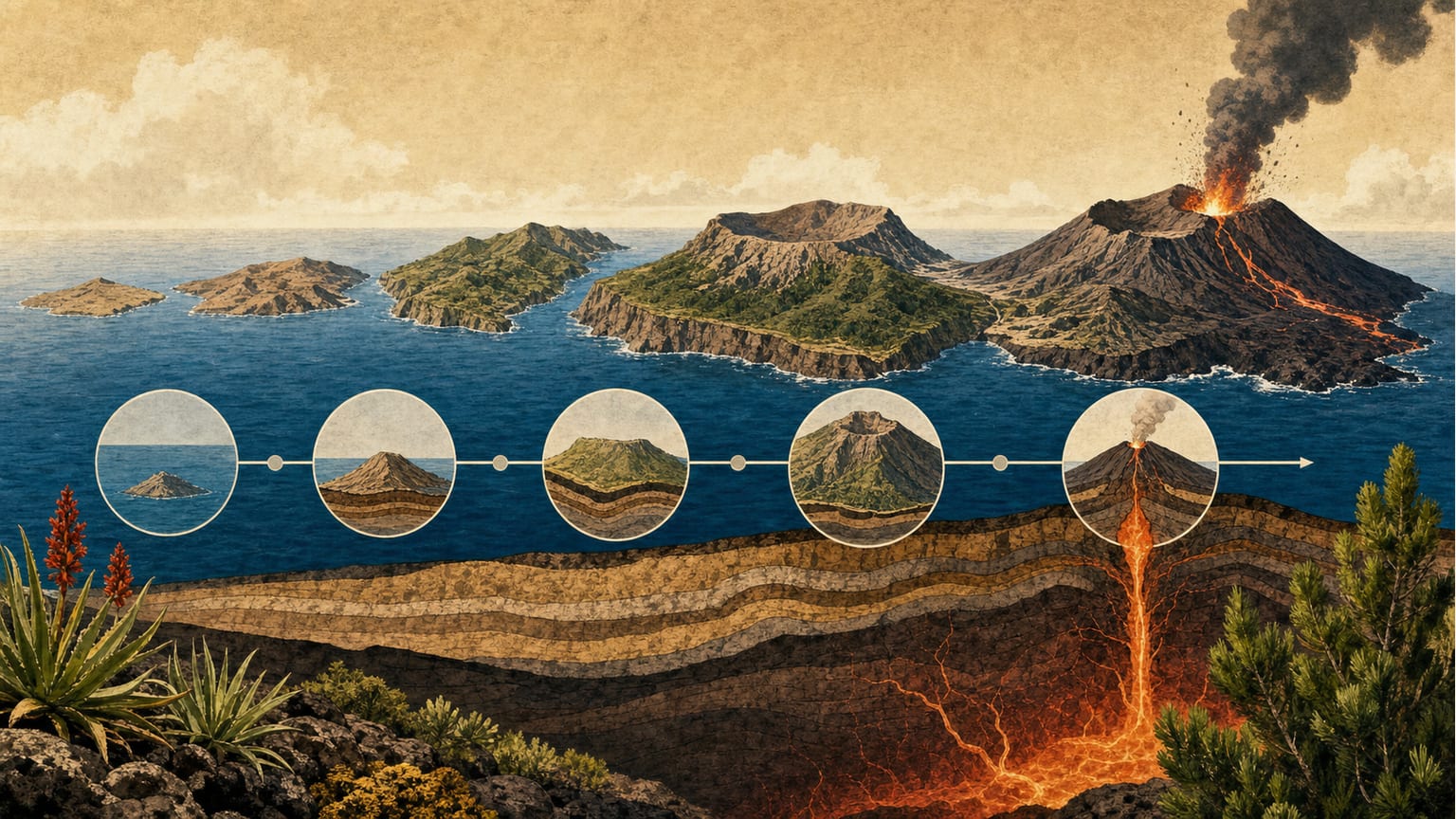
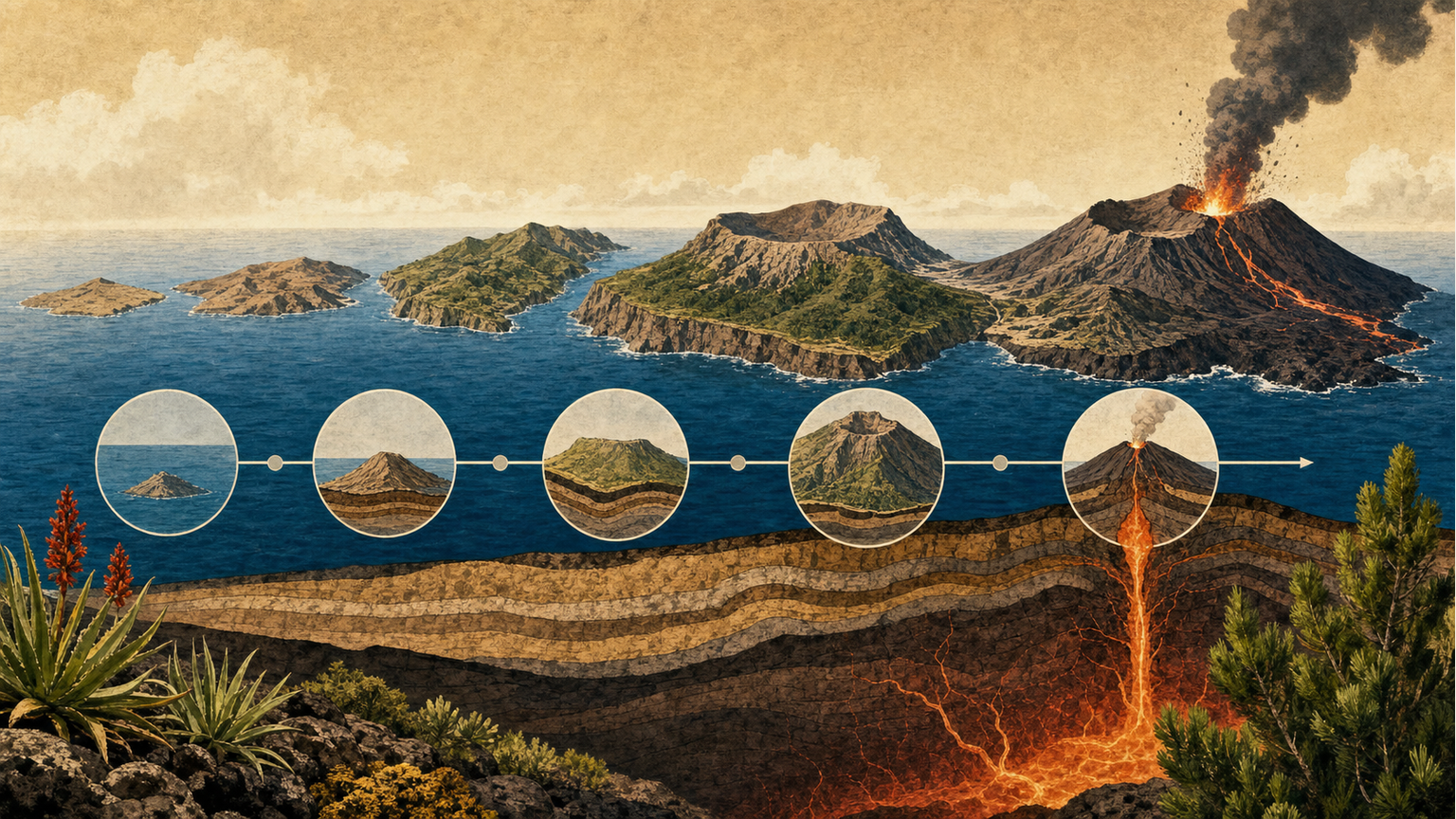
The volcanic history of the Canary Islands is marked by a notable temporal progression of ages and eruptive stages, as detailed by Carracedo and colleagues[1]. According to these authors, the subaerial volcanism of the Canary Islands is among the best dated in the world, with over 400 published K-Ar ages, allowing for a precise analysis of each island’s evolution[1].
A fundamental aspect is the existence of two clearly differentiated groups of islands based on the age of their emerged volcanism and the continuity of their eruptive activity. Fuerteventura, Lanzarote, Gran Canaria, and La Gomera have emerged volcanism of 12 million years (Ma) or more, with well-marked interruptions in volcanic activity. In contrast, Tenerife, La Palma, and El Hierro show emerged volcanism of less than approximately 7.5 Ma and essentially continuous eruptive activity[1].
The analysis of radiometric ages reveals a west-to-east progression in the aging of volcanism, consistent with the hypothesized movement of the African plate over a fixed hotspot, with the youngest island, El Hierro, located above the current hotspot[1]. This progression is key to understanding the geological dynamics of the archipelago and its relation to island formation models by hotspots.
Another notable element is the presence of prolonged interruptions in eruptive activity, known as “gaps.” These pauses, far from indicating the definitive volcanic death of an island, are part of the typical evolutionary cycle of hotspot island chains, as also observed in Hawaii[1]. They allow for the distinction between the shield-building stage, responsible for most of the island’s volume, and the post-erosional stage, characterized by reduced volcanism after a long period of inactivity and erosion.
The temporal and stratigraphic classification proposed by Carracedo and colleagues is more precise than the traditional geographic division into eastern, central, and western islands. Thus, La Gomera, although inactive for millions of years, could be in a resting phase prior to possible future volcanic rejuvenation, while Lanzarote and Fuerteventura, despite recent historical eruptions, are actually in a terminal phase of activity[1].
This evolutionary view, based on the progression of ages and the alternation of eruptive and resting stages, is essential for understanding the current distribution of volcanic risk in the Canary Islands and the complex geological history of the archipelago[1].