

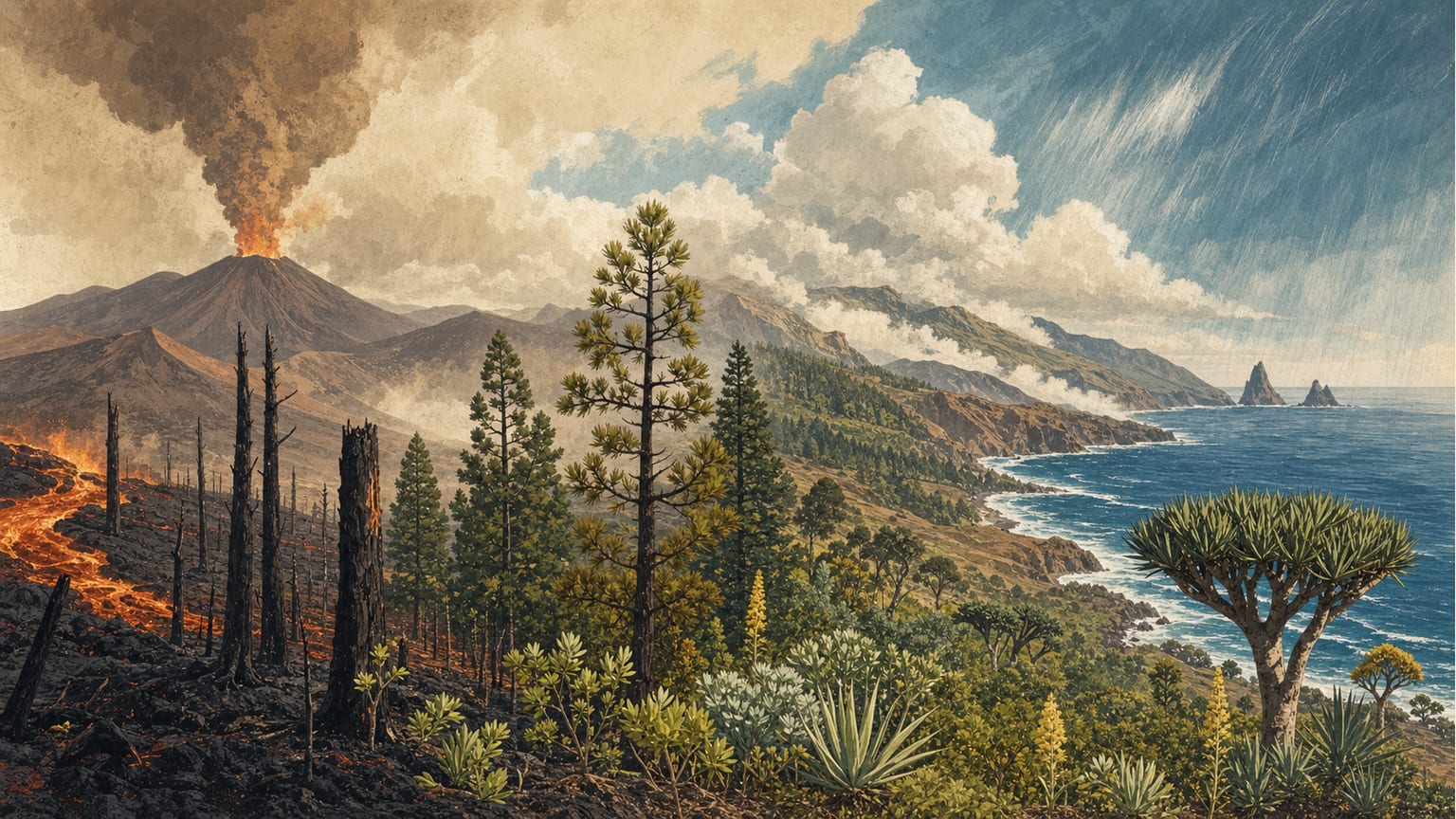
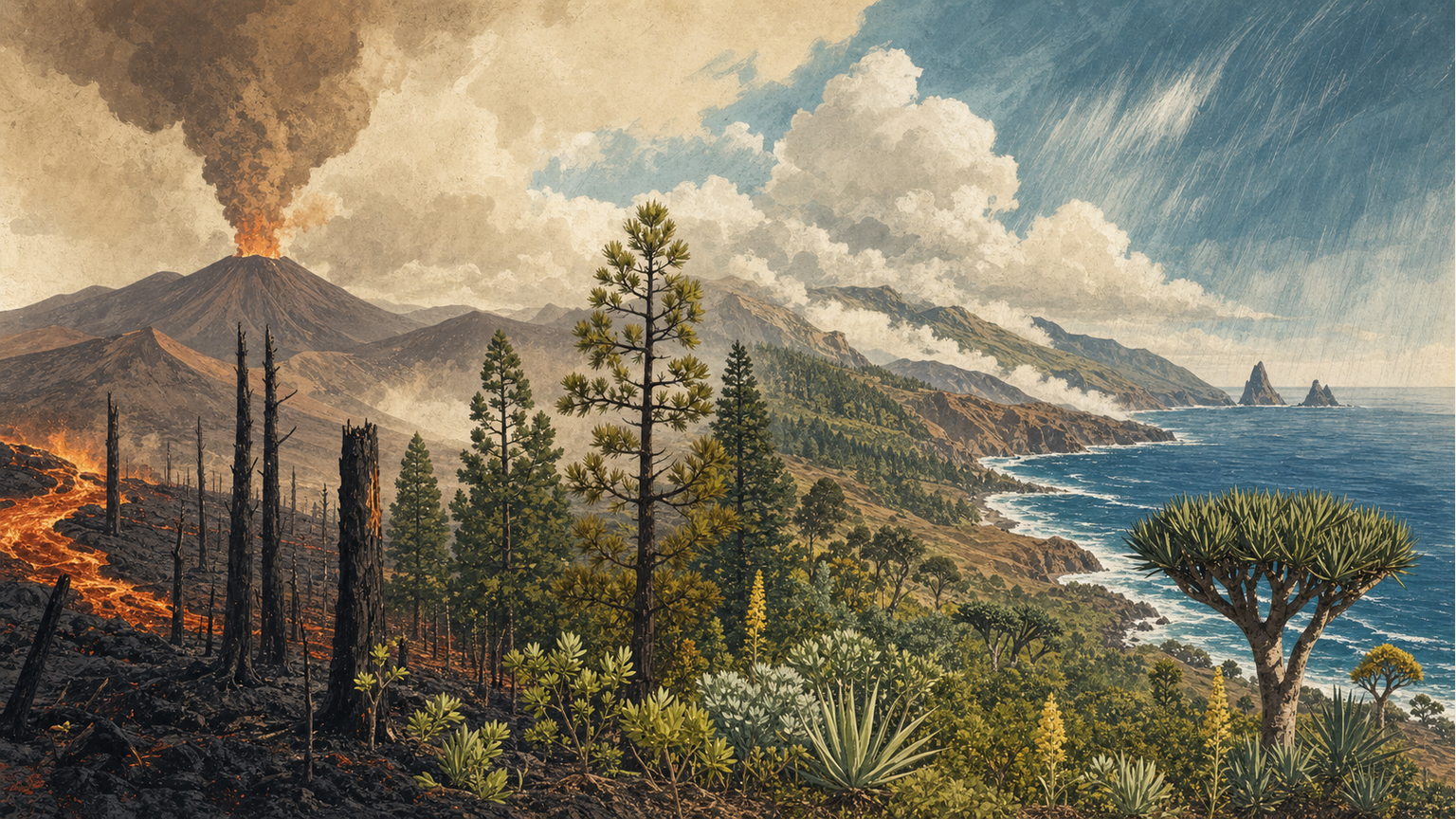
The forest history of the Canary Islands has been deeply shaped by natural extreme events, especially volcanic eruptions and severe weather, which have influenced the distribution and composition of forests over the centuries[1].
According to Fernando Pardo Navarro, Ángel Velasco Sánchez, and Luis Gil Sánchez, volcanic activity is one of the most notable features of Canarian nature, making it the only Spanish territory with active volcanism. In the last five hundred years, sixteen eruptive episodes have been recorded on La Palma, Tenerife, and Lanzarote, with special mention of the Timanfaya eruption in Lanzarote (1730-1736), which covered more than a third of the island and forced part of its population to relocate[1].
The impact of volcanism on forests is evident in the number of trees buried under ash and pyroclastic materials, as documented in the pine forests of Gáldar (Gran Canaria) and in the pumice deposits of southern Tenerife. Explosive eruptions have destroyed large areas of vegetation, leaving tree molds and charred remains that allow these events to be dated. Additionally, the selective pressure from these disasters has favored the evolution of species like the Canary Island pine, which developed the ability to sprout after fires and wounds—a trait absent in other species of the genus[1].
Not only volcanism has been decisive. Storms and torrential rains have also caused major changes in the forest landscape. The 1826 storm in Tenerife, described by Álvarez Rixo, dragged materials from the summit to the coast, altering ravine courses and destroying fortifications and forests, with severe consequences for both population and vegetation[1].
Another impactful phenomenon is gravitational landslides, such as the El Golfo event in El Hierro about 20,000 years ago, which decapitated the summit region and formed a large amphitheater, changing the island’s relief, hydrology, and vegetation distribution. The materials generated by these landslides, locally known as “mortalón,” contain fossilized trunks of pines, laurels, and heathers, witnesses of the pre-existing vegetation[1].
The combination of these extreme events has contributed to the fragmentation and reduction of the original forests, but it has also allowed the selection of species adapted to adverse conditions. Today, most Canarian forests are protected under designations such as the Natura 2000 Network, and emblematic sites like Garajonay and Caldera de Taburiente have been internationally recognized for their natural value[1].