

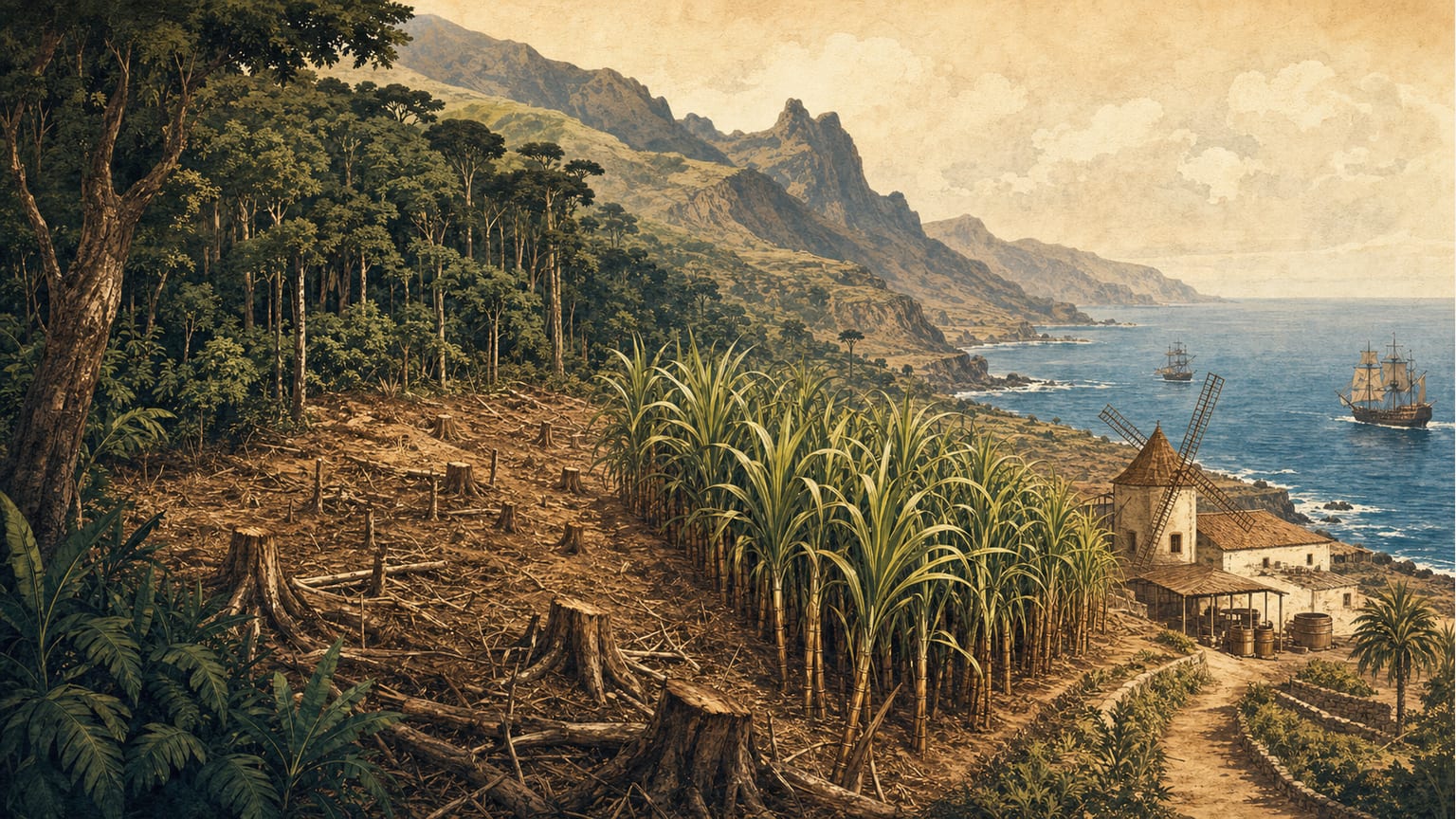
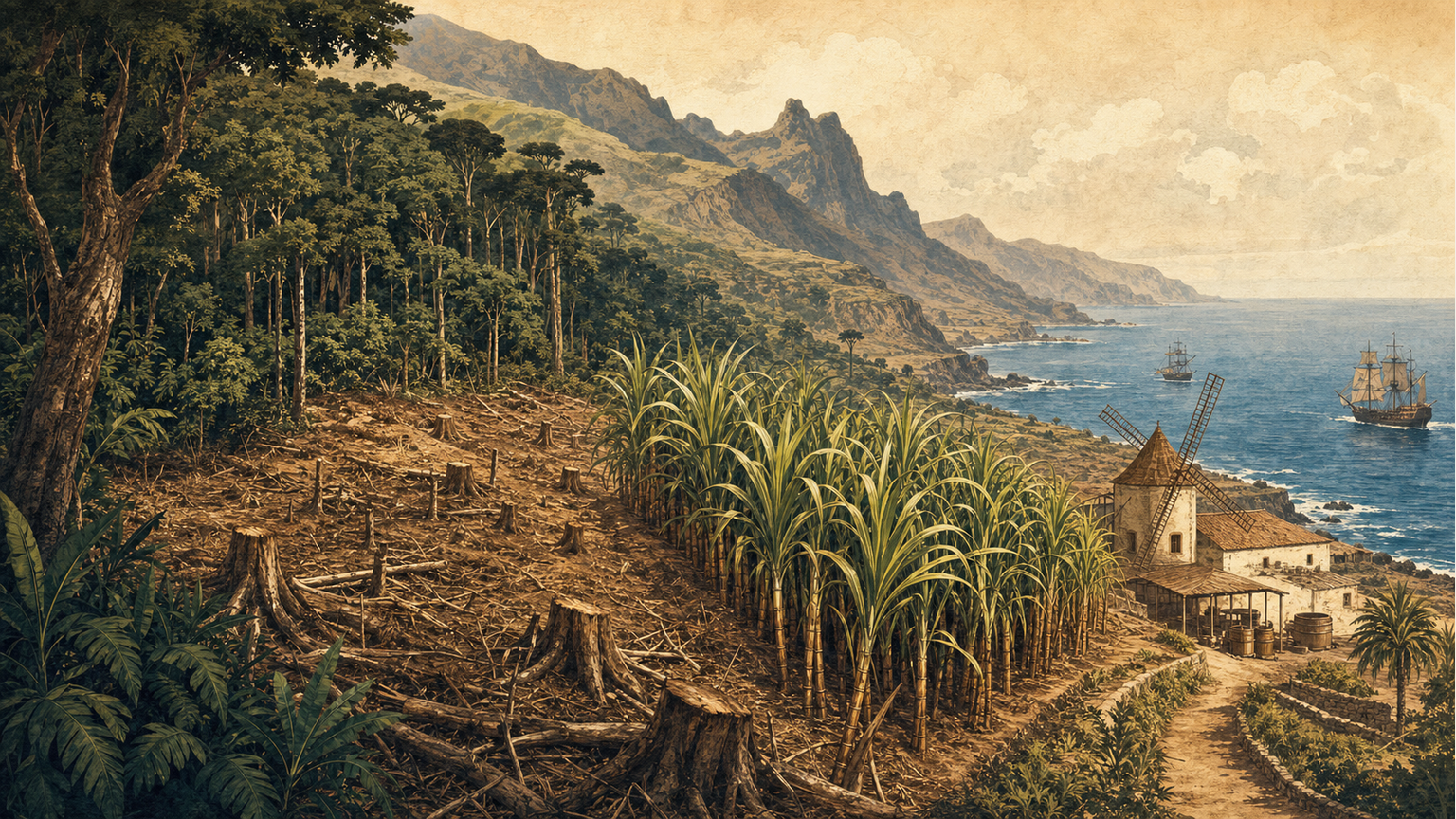
The arrival and rapid expansion of sugarcane (Saccharum officinarum) cultivation in the Canary Islands during the 16th and 17th centuries marked a turning point in the islands’ forest history. Sugar mills, or “ingenios,” were established mainly in the low, humid regions of Tenerife, Gran Canaria, La Palma, and La Gomera, and required vast amounts of wood and firewood for both construction and as fuel for the boilers used in sugar production [1].
The demand for wood was so great that, within a few years of the conquest, the western islands had to export timber and firewood to Gran Canaria, where the pressure on forest resources was particularly intense [1]. The process of sugar production involved crushing the cane, extracting the juice, and boiling it in large vats, all of which required a constant supply of fuel from the surrounding forests. This led to the disappearance of large areas of laurel forest (laurisilva) and thermophilous woodland, which survived only in the steepest and most inaccessible ravines [1].
The sugarcane cycle was thus a major driver of historical deforestation in the Canary Islands. The source states: “la obtención de pez en las pegueras fue la principal causa de desaparición de los pinares canarios en muchas zonas, en particular las más cercanas a la costa y de más fácil extracción hasta los lugares de consumo. Pero, se debe a la caña de azúcar (Saccharum officinarum), y su transformación en los ingenios, la causa fundamental de la deforestación de los bosques más singulares y destacados” [1].
The location of sugar mills depended on the availability of water and wood, which explains why the most fertile and humid areas were the first to lose their forest cover. In Tenerife, Gran Canaria, La Palma, and La Gomera, sugarcane cultivation spread through the low, humid windward zones with deep soils near population centers. In these regions, laurel and thermophilous forests survived only on the steep walls of ravines or in places far from the sugar mills [1].
Although the exact number of mills is unknown, it is estimated that there were nearly thirty in Gran Canaria alone, highlighting the scale of the phenomenon. The pressure on forest resources was so intense that, by the mid-17th century, the sugarcane cycle collapsed due to rising firewood costs and competition from American producers who used Caribbean forests as their fuel source [1].
The end of the sugar era did not immediately restore the forests, as demographic pressure and agricultural expansion continued to affect the islands’ ecosystems. However, the deforestation caused by sugarcane left an indelible mark on the Canary Islands’ landscape, irreversibly altering the distribution and composition of its forests [1].