
The Role of the Sea of Clouds in Shaping Canary Islands Ecosystems
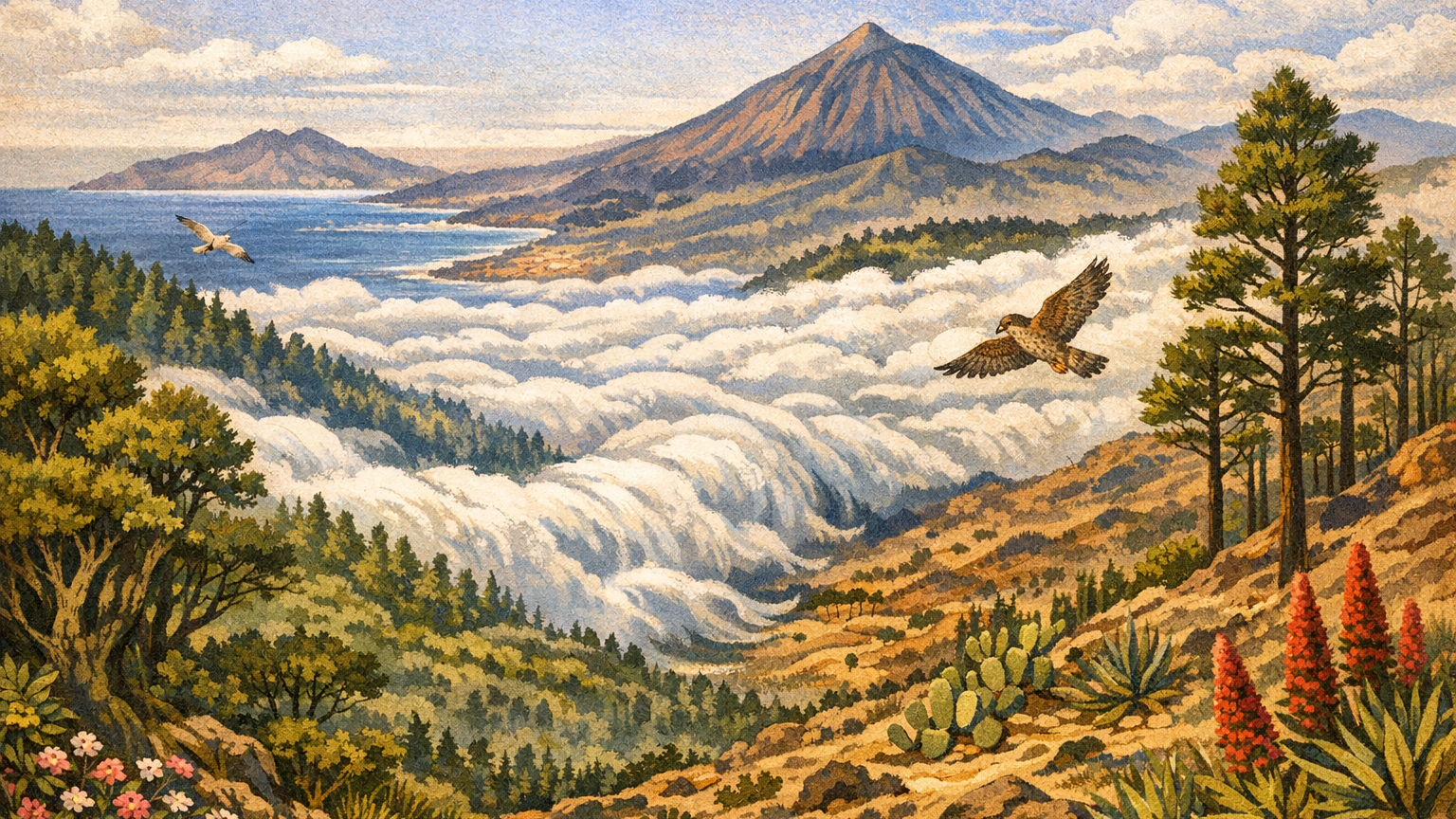
One of the most remarkable and influential natural phenomena in the Canary Islands is the “sea of clouds.” Created by the trade winds carrying moist air that collides with the islands’ mountains, this cloud layer typically forms between 500 and 1,200 meters above sea level1.
The sea of clouds is not just a visual wonder—it acts as a crucial climate regulator. Its presence creates a distinct stratification on the northern slopes of the islands: a basal zone below the cloud layer, an intermediate zone within the clouds, and an upper zone above them. This stratification determines the distribution of the main terrestrial ecosystems in the archipelago.
In the basal zone, with higher temperatures and intense sunlight, drought-adapted plants such as euphorbias and cacti dominate. These species have evolved mechanisms to survive with little water and withstand heat and salinity. The animal life here is also specialized for these harsh conditions, including reptiles and certain birds1.
The intermediate zone, within the sea of clouds, is home to the laurel forest (laurisilva)—a humid, shaded woodland that is among the richest and oldest ecosystems in the Canary Islands. The high humidity, resulting from mist condensation, supports lush vegetation and a diverse fauna, with many endemic species. Laurisilva is especially prominent in La Gomera, where it is protected as a national park1.
Above the cloud layer, in the upper zone, the environment becomes drier and colder, favoring the growth of pine forests and, at the highest elevations, shrublands adapted to mountain conditions. The Canary Island pine dominates these landscapes, showing remarkable resistance to both drought and cold. The fauna here is more limited but includes unique species such as the blue chaffinch of Teide1.
The sea of clouds also plays a vital role in water availability, as “horizontal rain”—condensation on tree leaves—helps recharge aquifers and sustain forests. The presence or absence of this phenomenon in certain islands, such as Lanzarote and Fuerteventura, explains the lack of laurel and pine forests there, restricting their vegetation to more arid-adapted species1.
Thus, the sea of clouds is far more than a meteorological curiosity: it is the driving force behind the Canary Islands’ ecosystem diversity, shaping plant and animal life and making the islands a unique natural mosaic.