

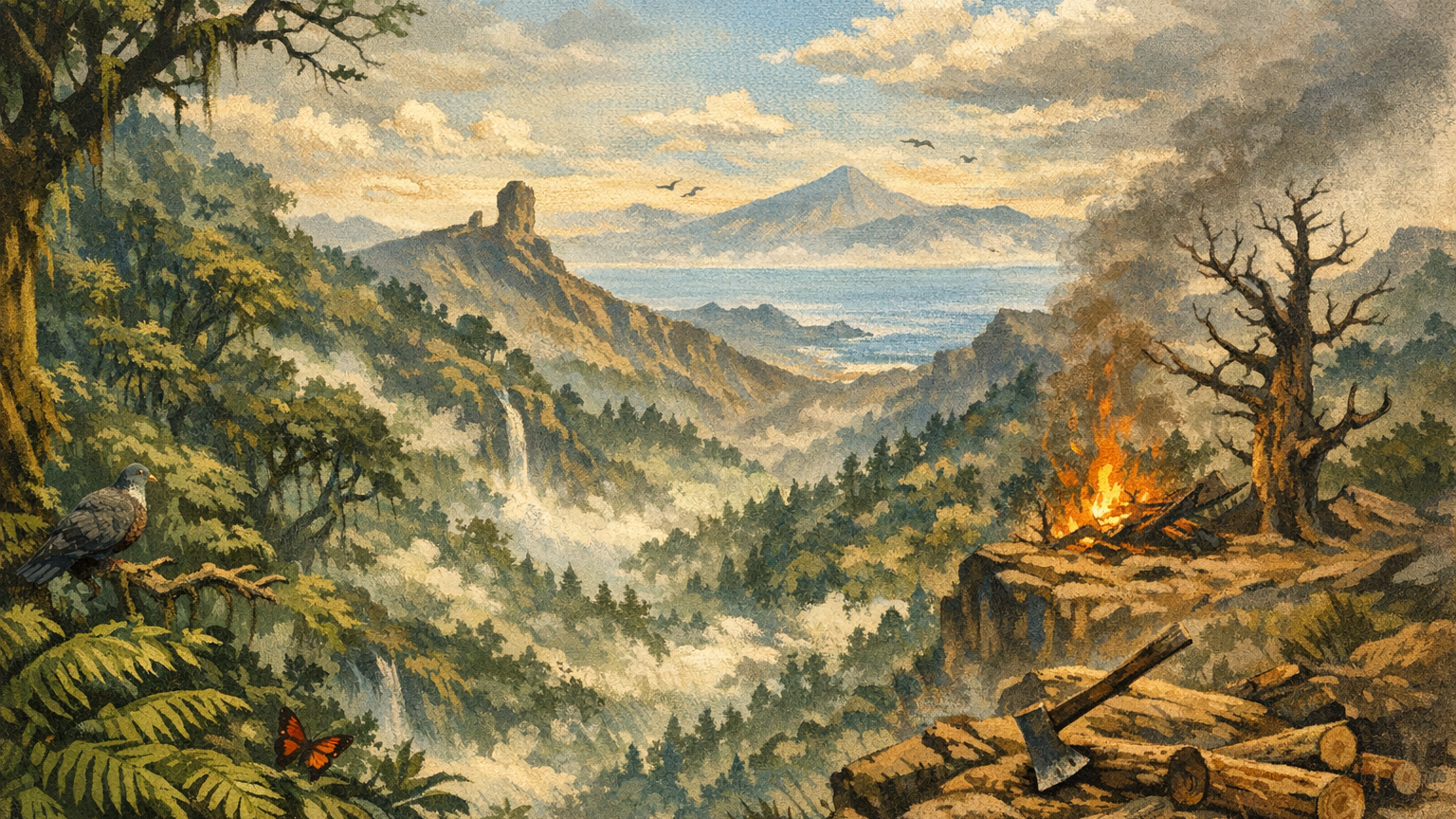
An Ancient Forest in the Heart of Gran Canaria
Laurisilva, a type of evergreen subtropical forest, is among the oldest and most valuable ecosystems on Gran Canaria. Once covering vast areas of the island, today it survives only in small pockets such as Los Tilos de Moya, Barranco Oscuro, and Barranco de Azuaje. These sites are the last remnants of the great Doramas forest, once described by early Spanish settlers as so dense that sunlight barely reached the ground[^el-medio-natural-terrestre-de-gran-canaria].
A Refuge for Unique Biodiversity
Despite its limited extent, Gran Canaria’s laurisilva shelters a unique array of flora and fauna. Over 50 plant species and several hundred endemic invertebrates live here, some critically endangered, such as the chahorra (Sideritis discolor) and the cresta de gallo (Isoplexis chalcantha). Iconic trees include the til (Ocotea foetens), laurel (Laurus azorica), barbusano (Apollonias barbujana), and viñátigo (Persea indica)—species found only in the Canary Islands and the Macaronesian region[^el-medio-natural-terrestre-de-gran-canaria].
The forest floor is rich in ferns, mosses, and lichens, providing habitat for beetles and mollusks. Among the birds, laurel pigeons (Columba bollii and C. junoniae) are exclusive to these forests on other islands of the archipelago.
A History of Decline
The arrival of European settlers in the 16th century marked the start of intensive exploitation. Agriculture expanded, and the demand for wood for houses and tools led to the forest’s decline, worsened by grazing, logging, and the introduction of crops like sugarcane and maize. By the late 20th century, only small fragments such as Los Tilos de Moya remained, now a Special Natural Reserve[^el-medio-natural-terrestre-de-gran-canaria].
A Fragile and Vital Ecosystem
Laurisilva plays a crucial role in soil protection and aquifer recharge, thanks to “horizontal precipitation”—the condensation of trade wind mists on the dense canopy. This forest depends on high humidity and is found on the island’s northern slopes, between 400 and 1500 meters above sea level.
Conservation Challenges and Hope
Today, Gran Canaria’s laurisilva is protected by the Canary Islands Network of Natural Spaces and environmental laws. Its survival, however, relies on public awareness, environmental education, and scientific research. Initiatives by the Cabildo of Gran Canaria and the Viera y Clavijo Botanical Garden aim to foster appreciation and conservation of these forests for future generations[^el-medio-natural-terrestre-de-gran-canaria].
The laurisilva is a living testament to the island’s natural history and a reminder of the importance of preserving our ecological heritage.