

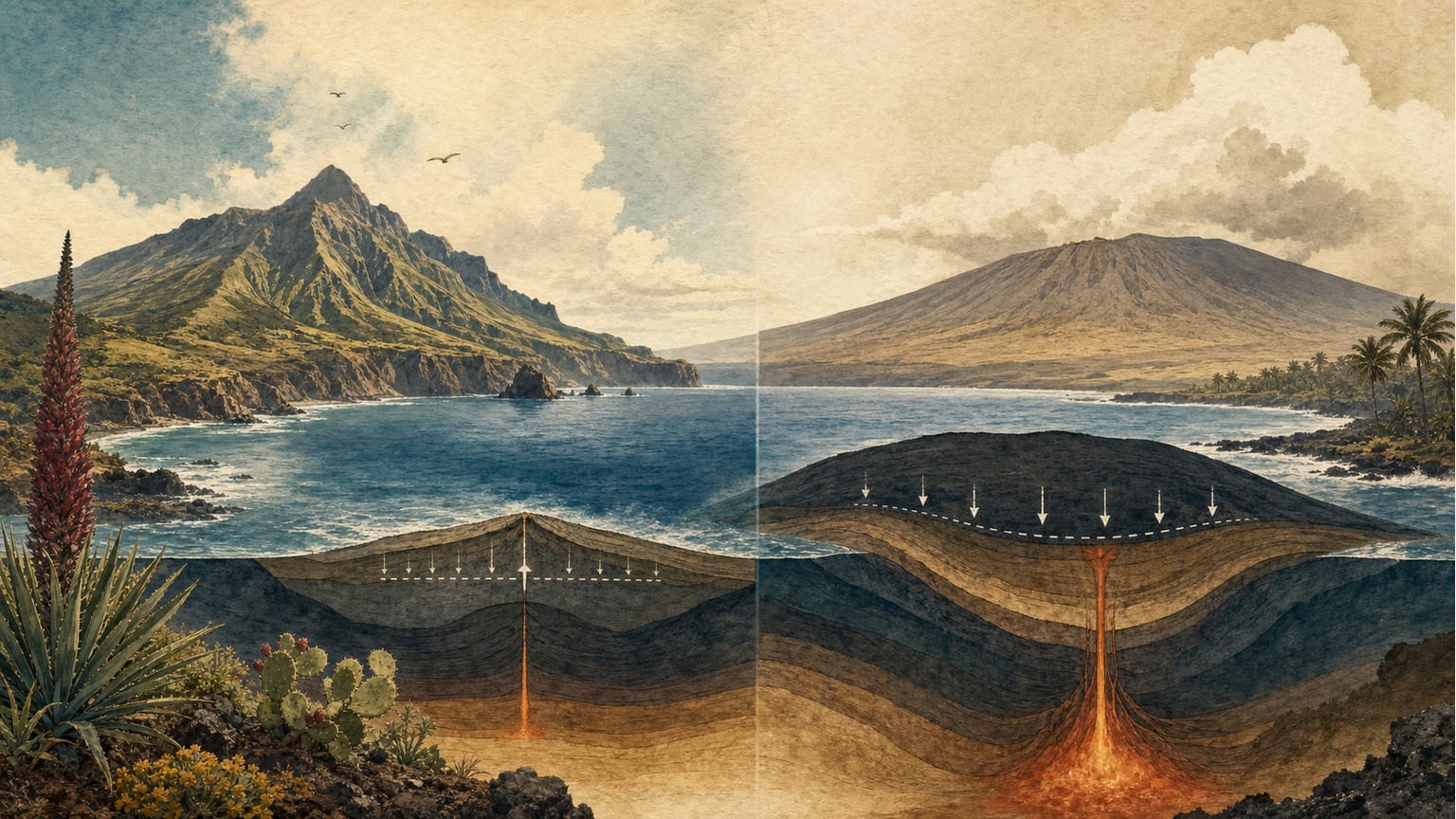
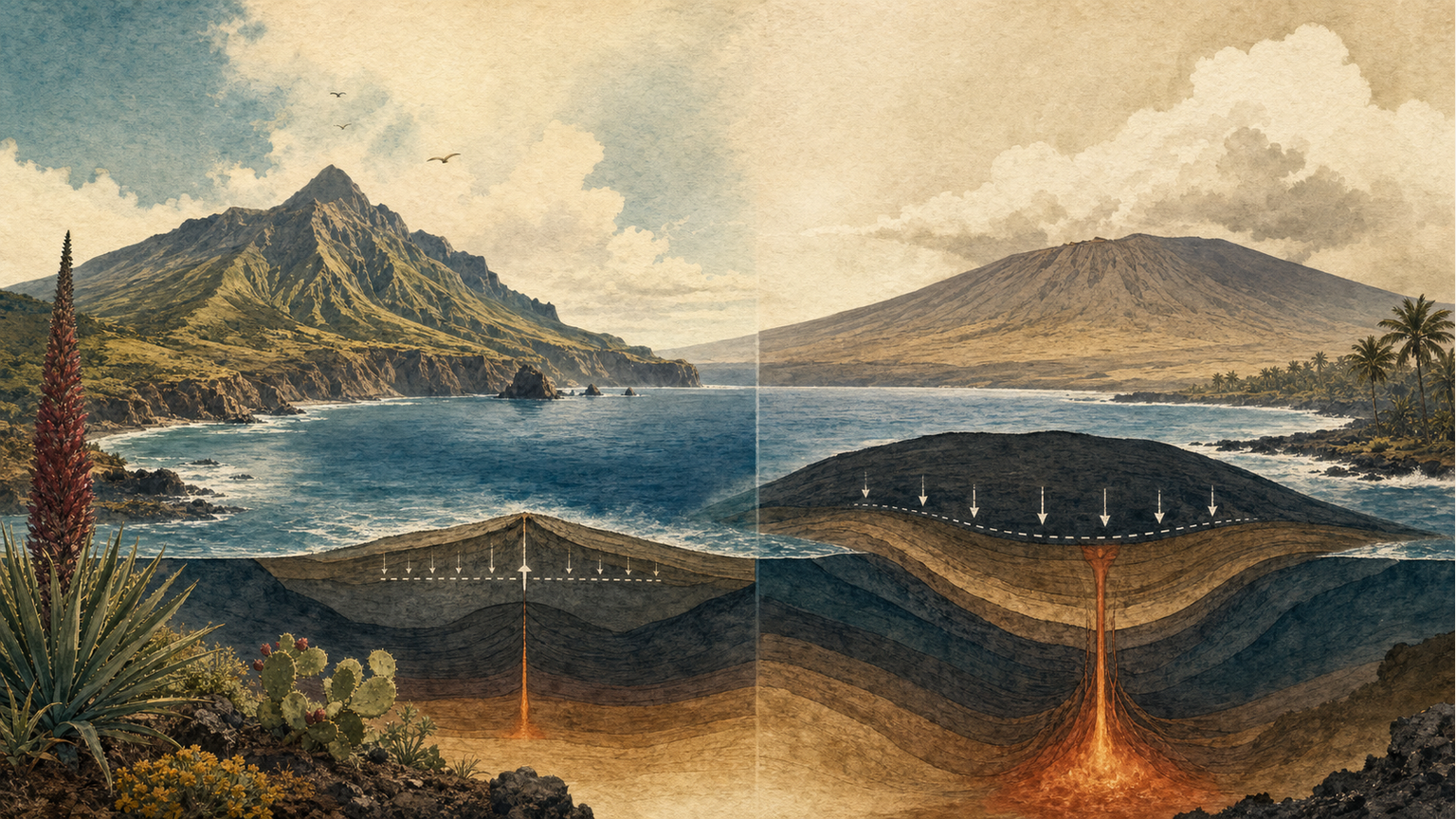
Subsidence in the Canary Islands: A Key Difference from Hawaii
One of the most distinctive features of the volcanic evolution of the Canary Islands is the minimal subsidence experienced by their volcanic edifices, in stark contrast to the Hawaiian archipelago, often considered the model for hotspot volcanic islands[1].
In Hawaii, subsidence—the gradual sinking of islands due to the isostatic adjustment of the oceanic crust under the load of volcanoes—can reach between 2 and 4 kilometers, especially during the shield-building stage. This process transforms islands into guyots and, eventually, into submerged seamounts as they move away from the hotspot[1]. In contrast, in the Canary Islands, simple observation of the coasts of the oldest islands, such as Fuerteventura and Lanzarote, shows that there has been no significant subsidence in the archipelago[1].
Geological evidence supports this: marine abrasion platforms, beach and coastal marine sediment deposits, volcanic coastal formations, and marine paleo-cliffs up to 14 million years old have been found at levels very similar to the current sea level, consistent with eustatic oscillations during glaciations[1]. Additionally, on the north coast of Tenerife, pillow lavas and breccias about 2.6 million years old have been found at heights of 5 to 25 meters above sea level, while in La Palma, marine phreatomagmatic cones up to 1 million years old and beach deposits 0.5–0.2 million years old appear at the same level as the current sea[1].
This vertical stability of the islands since their emergence contrasts with the rapid subsidence seen in Hawaii. The difference is attributed to factors such as the greater age, thickness, and strength of the oceanic lithosphere beneath the Canaries, located on a passive continental margin, compared to the younger, thinner lithosphere beneath Hawaii, which is situated within an oceanic plate[1].
The lack of significant subsidence in the Canaries means that the reduction in island volume during the post-erosional stage is not due to sinking, but rather to erosion and frequent giant gravitational landslides affecting the volcanic edifices[1]. This also explains the presence of raised beaches up to 100 meters above the current sea level in the eastern islands and the preservation of ancient marine platforms at levels similar to the modern sea[1].
In conclusion, the minimal subsidence of the Canary Islands is a fundamental difference from Hawaii and other hotspot archipelagos, shaping the morphological evolution, stability, and geological history of the Canarian archipelago[1].