

Volcanic Origins of the Canary Islands: Processes and Structures
The Canary Islands are the result of a complex geological history dominated by volcanism. Their origin is mainly explained by plate tectonics theory, which helps us understand the forces responsible for the genesis of Canarian magmas and the construction of the archipelago [1].
Formation of the Archipelago
The most widely accepted theory about the origin of the Canaries is based on plate dynamics. The process starts with the creation and destruction of crust in the North Atlantic, where the Mid-Atlantic Ridge plays a crucial role. Forces acting on the African plate favor the emergence of magmas that, as they rise, form the islands [1].
The evolution of the oceanic crust in the Canary region can be seen in maps and schematic diagrams showing how, over millions of years, volcanic materials have emerged and accumulated to form the present-day islands [1].
Island Building: Eruptions and Erosion
Volcanism has been the main constructive agent of the islands, alternating with periods dominated by erosion. Historical eruptions and the superposition of cones and lava flows allow us to estimate the constructive capacity of volcanism over a million years [1].
The Caldera de Taburiente in La Palma is a prominent example of how erosion can modify volcanic relief, enabling the reconstruction of the island’s eruptive and erosive history through the observation of its structures [1].
Types of Eruptions and Volcanic Products
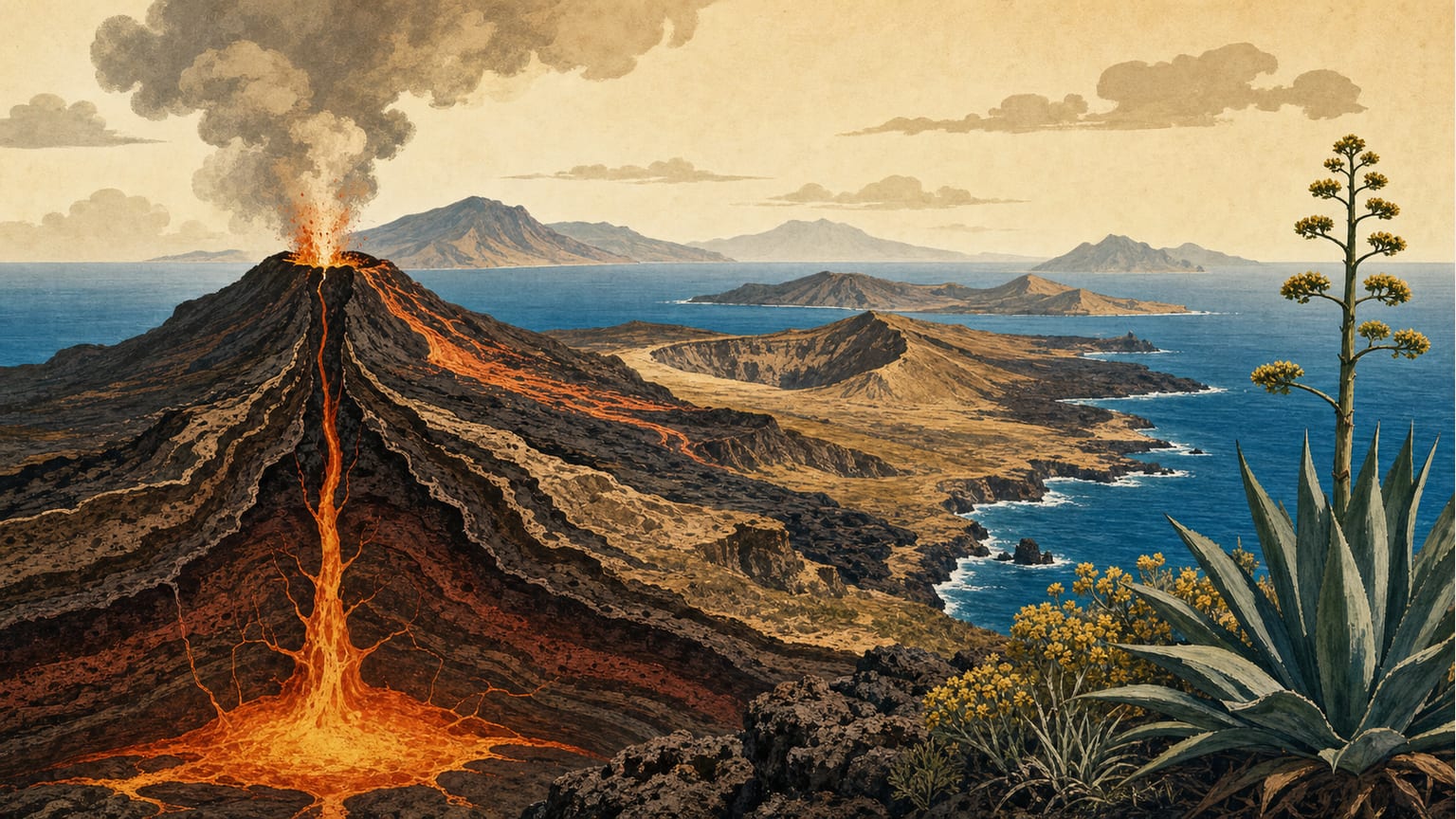
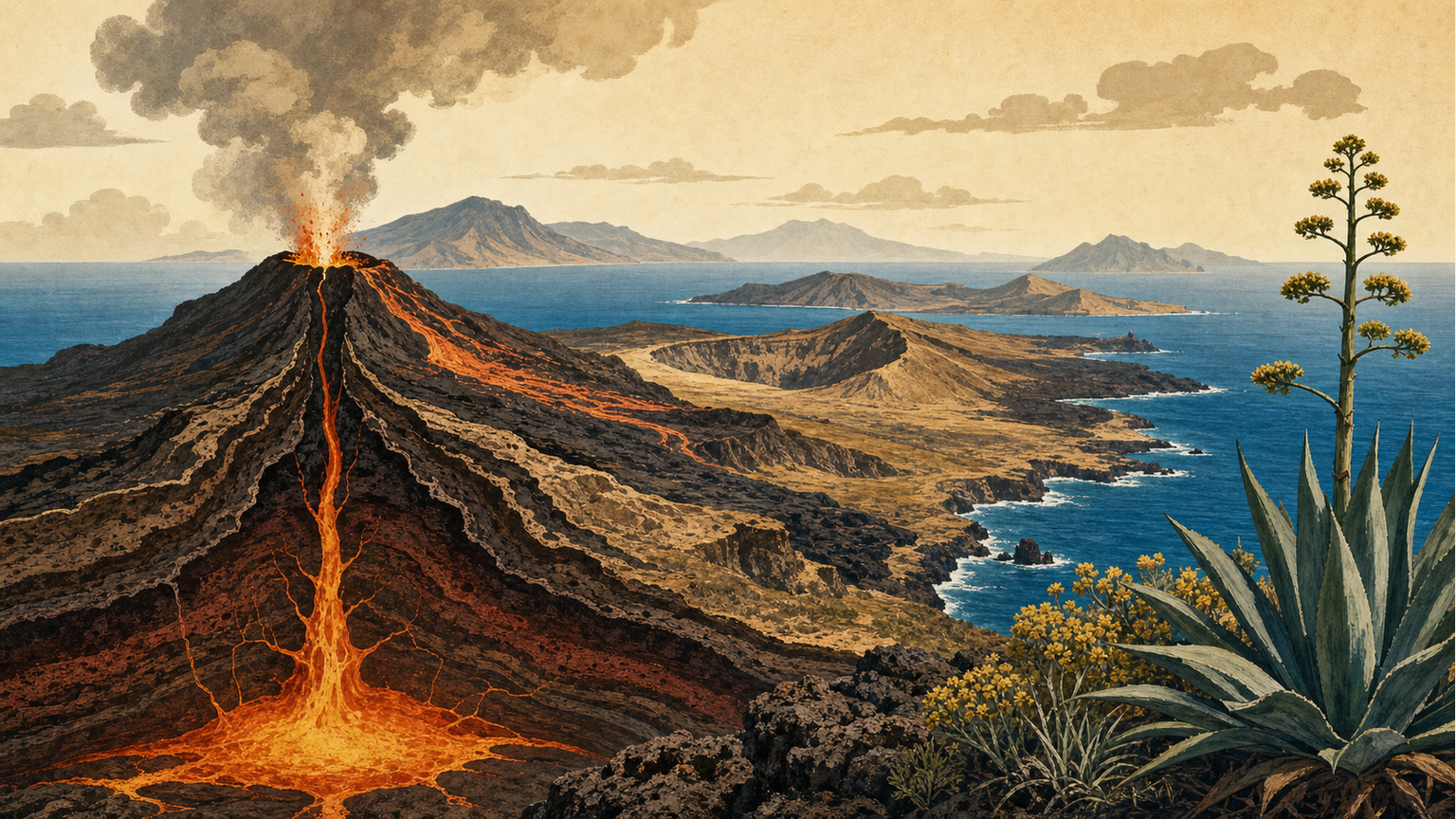
Basaltic eruptions predominate in the Canaries, generating structures such as volcanic cones, lava flows, and volcanic tubes. These eruptions often occur through fissures, forming alignments of cones and dikes visible in cliffs and characteristic landscapes of the archipelago [1].
Silicic or viscous eruptions, more frequent in Gran Canaria, Tenerife, and La Gomera, are characterized by the emission of very thick flows and the formation of large volcanic chimneys, known as “roques.” When these eruptions are rich in gases, they can produce violent explosions and deposits of pumice or pyroclastic flows [1].
Visible Volcanic Structures
Among the most representative structures are symmetrical and asymmetrical volcanic cones, hornitos, dikes, “aa” and “pahoehoe” lava flows, as well as volcanic tubes and columnar disjunctions. These forms can be observed in places such as Timanfaya (Lanzarote), Los Gigantes (Tenerife), or the Caldera de Taburiente (La Palma) [1].
Erosion has produced cliffs, marine platforms, and the exposure of internal structures such as dikes and chimneys, enriching the landscape diversity of the islands [1].
Use of Volcanic Materials
Volcanic rocks have traditionally been used as building materials, but their exploitation must be planned to avoid the destruction of the landscape, which is a key resource for tourism and the local economy [1].
In summary, the origin and evolution of the Canary Islands are marked by volcanic processes that have produced a great diversity of structures and landscapes, visible throughout the archipelago today [1].