

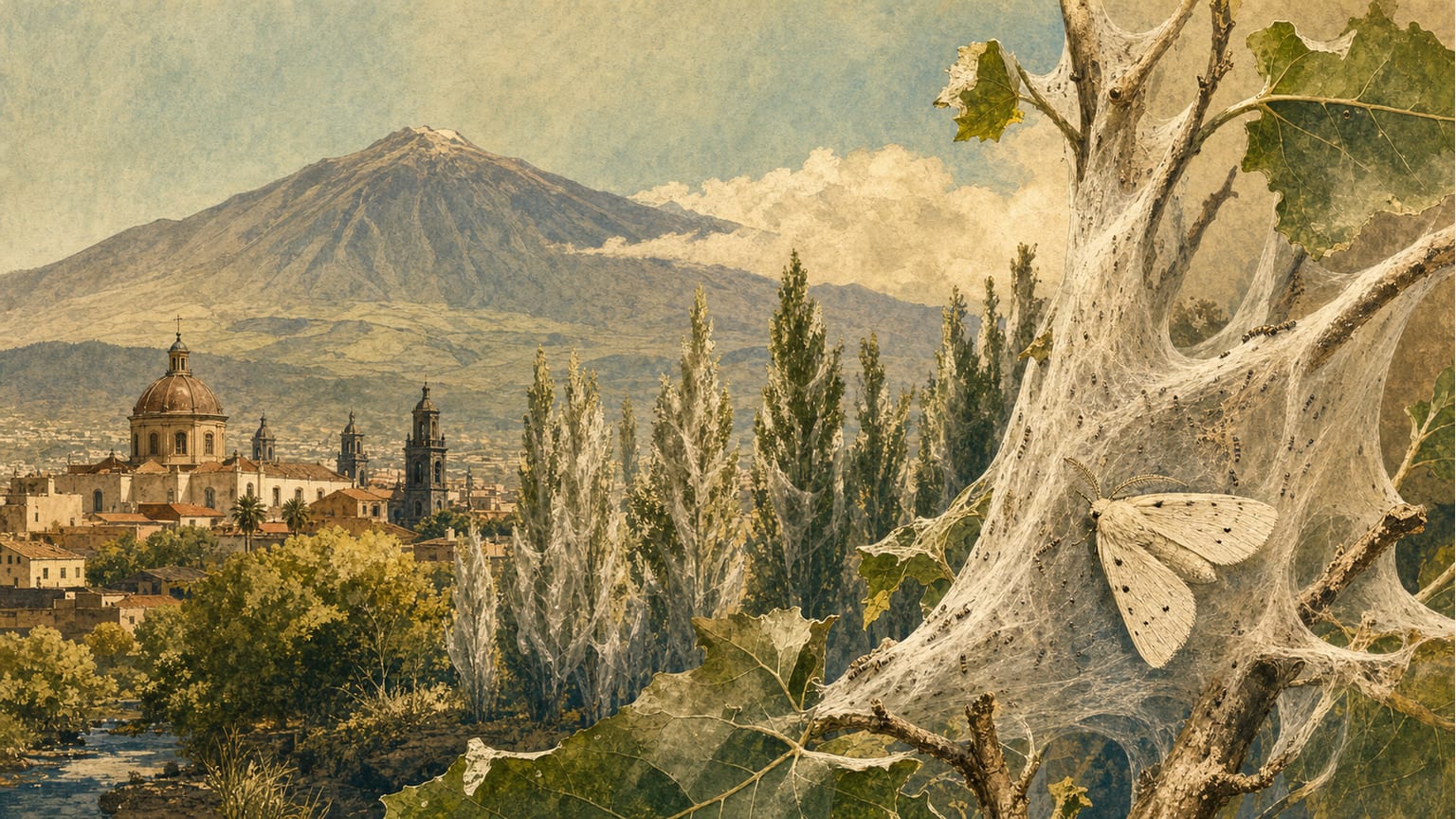
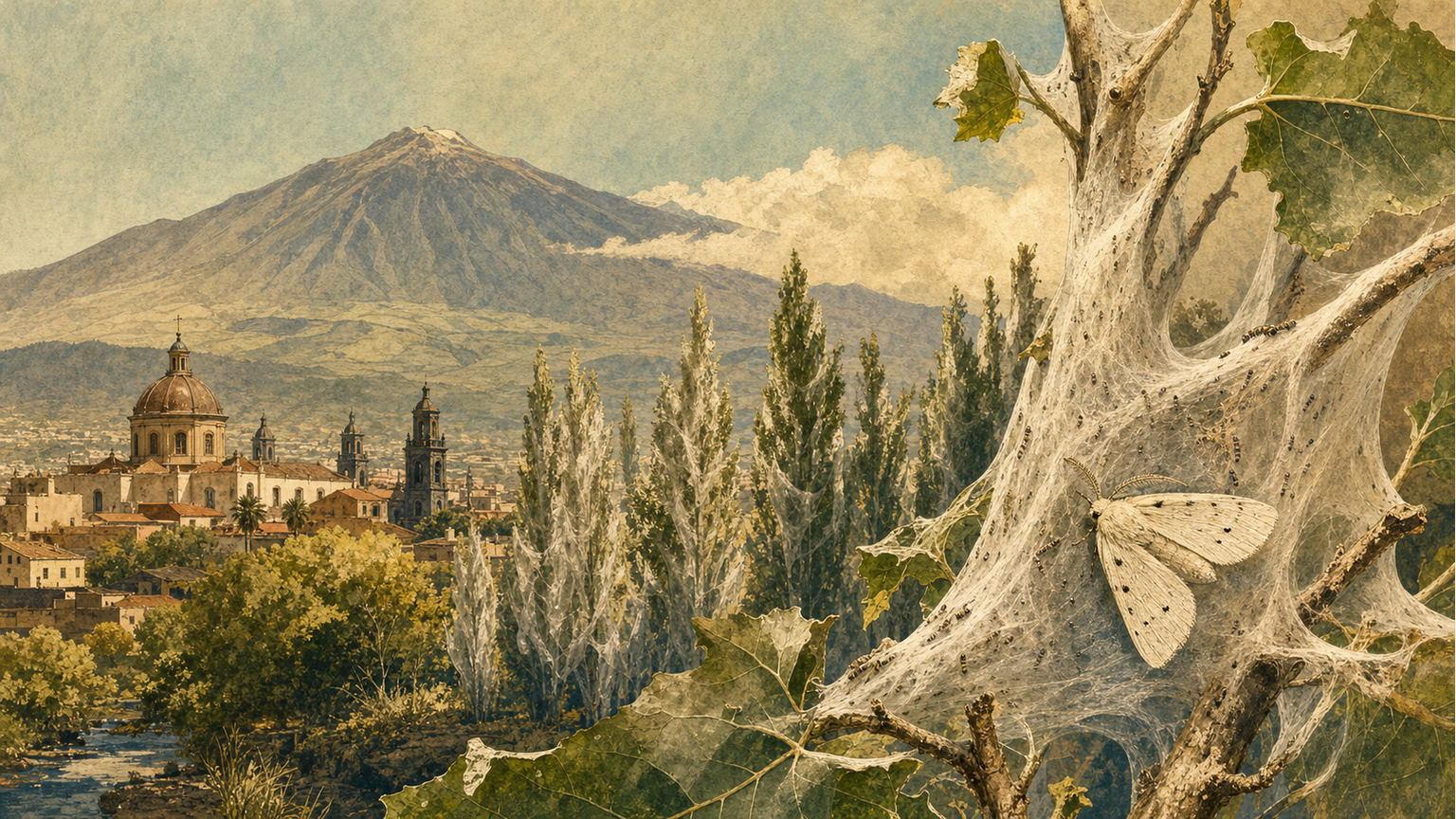
In 1961, as documented by Fernández, José María, a striking biological phenomenon occurred in La Laguna, Tenerife: the poplars lining the road from La Laguna to Las Canteras, near La Glorieta, were enveloped in a silky covering reminiscent of modern nylon[1].
The author recounts that Professor Maynar notified him of the event, enabling him to observe, photograph, and collect samples of the small caterpillars responsible for the silk. Raised in captivity, these caterpillars produced small, pale gray moths with narrow, fringed wings dotted with blackish spots[1].
Fernández published an article in the newspaper “La Tarde” on March 10 of that year, warning about the potential alarm caused by the outbreak but also noting that natural biological control would likely occur. In his laboratory cultures, he observed the emergence of a tachinid fly, still unidentified, acting as a biological controller. However, it was mainly environmental factors—strong winds, cold, and heavy rains—that ended the abnormal cycle of the moth, destroying the silk webs and causing mass mortality among the caterpillars[1].
Some of the collected material was sent to lepidopterist Ramón Agenjo, who identified the species as Yponomeuta gigas Rbl., previously known from Gran Canaria where it typically lives on Salix canariensis (Canarian willow). The novelty, according to Fernández, was its presence in La Laguna, its occurrence on poplars, and the extraordinary number of individuals involved[1].
Agenjo included the Canarian species in his article on poplar pests in the “Boletín de Plagas Forestales”, noting that similar episodes are not unknown on the Spanish mainland, where related moth species sometimes cause comparable phenomena on poplars and other trees[1].
Although initially alarming, the event caused no lasting damage to the trees. Months later, the poplars displayed renewed, healthy foliage. Fernández concludes that natural forces restored balance, and the caterpillars’ voracity acted as a superficial pruning, with no negative consequences for local vegetation[1].