

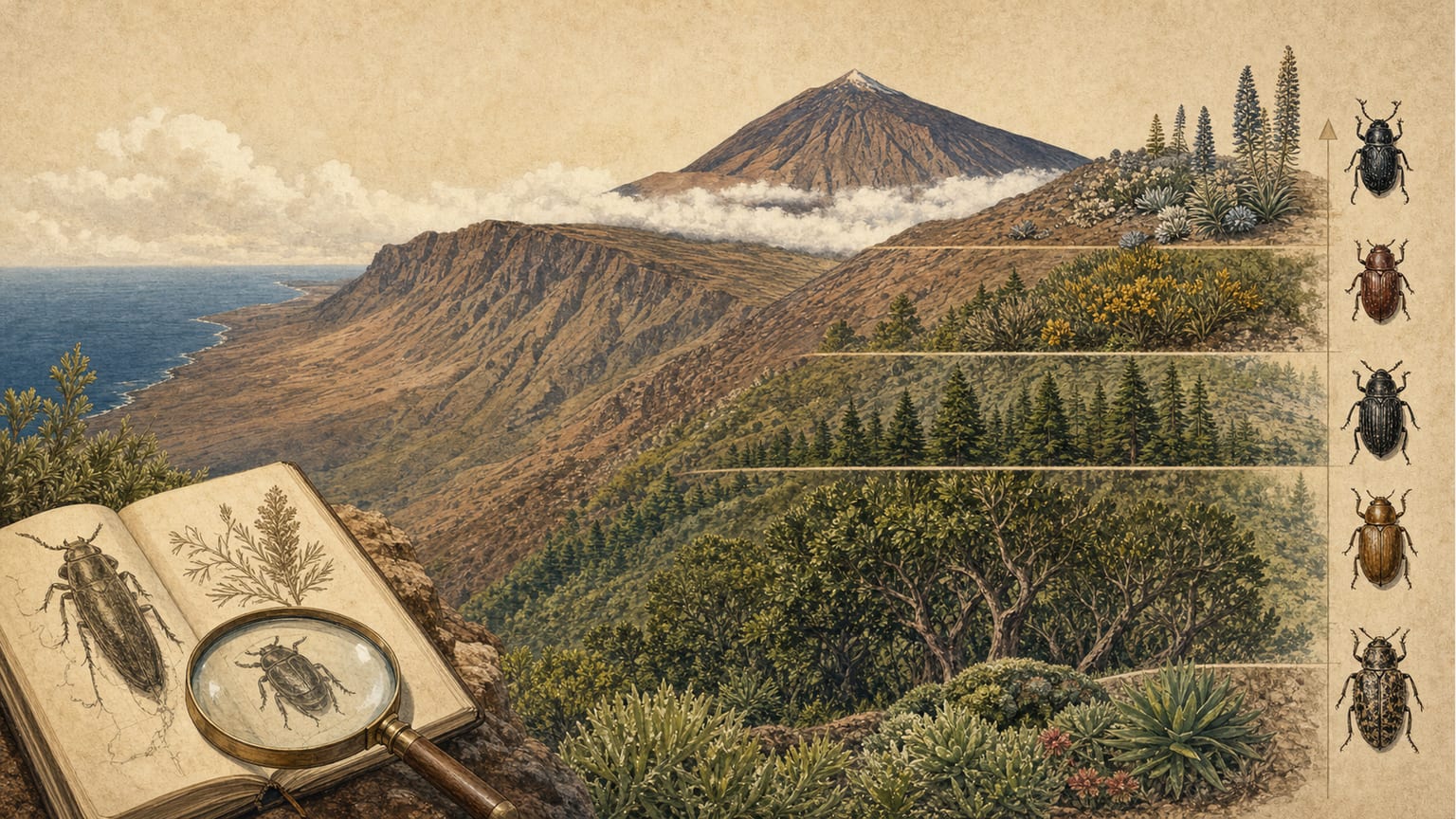
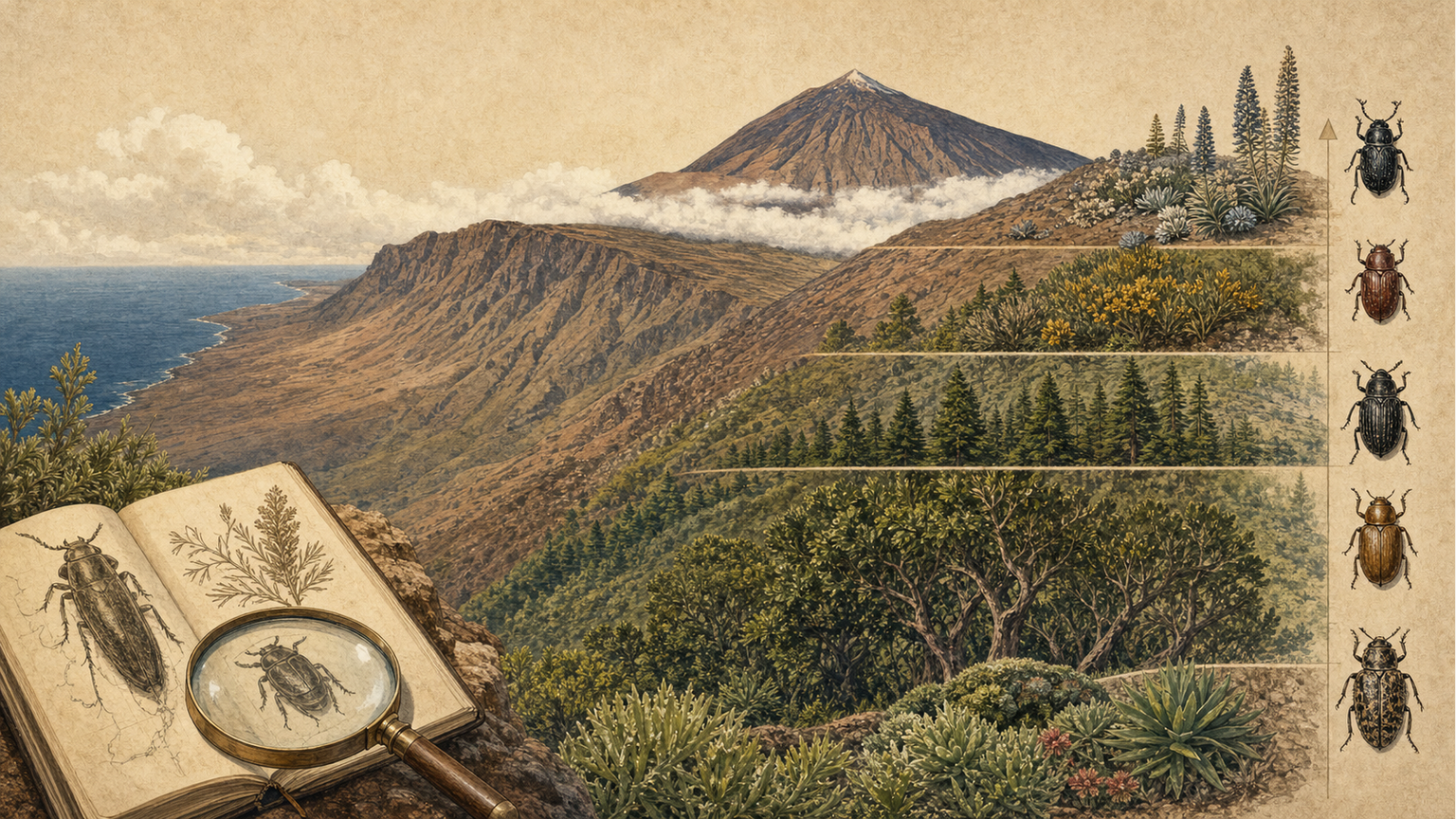
Tenerife, due to its size and altitudinal variety, offers a privileged setting for studying the evolution of beetles, a group especially notable for its diversity and degree of endemism in the Canary Islands[1]. According to Fernández (1955), the distribution of beetles in Tenerife can be analyzed by dividing the island into three altitudinal zones: low (coast up to 600 meters), middle (laurel, pine, and fayal-brezal forests), and high or alpine (Las Cañadas and surroundings, around 1,900 meters)[1].
In the low zone, characterized by vegetation such as tabaibas, cardones, and halophytes, genera like Harpalus, Nesarpalus, and Licinopsis among carabids, and Pimelia, Hegeter, and Zophosis among tenebrionids are found[1]. Fernández highlights the presence of both European and Moroccan origin species and endemics. For example, Harpalus tenebrosus is cited on several islands, while H. schaumi is considered endemic to Tenerife, La Palma, and El Hierro[1].
The genus Nesarpalus, of Atlantic distribution, is present in the Canaries and other Macaronesian islands, with species localized in different islands and habitats, though Fernández notes that distinctions between varieties are imprecise due to morphological and ecological variability[1]. Licinopsis alternans is considered a distinctly Canarian genus, with differentiated species in Tenerife, La Palma, and La Gomera, and its distribution appears influenced by the evolution of the island’s terrain[1].
The middle zone, dominated by forests, is especially rich in endemic species, particularly of the genus Calathus (carabids). According to Fernández, up to eleven Calathus species have been identified in Tenerife, with no duplications with other islands, as well as two species of the genus Calathidius[1]. These species show notable adaptation to different forest environments and a tendency to disappear or shift as forest conditions change, especially due to logging and vegetation change[1].
In the high or alpine zone, where shrub escobón, codeso, and retama predominate, a beetle fauna more independent from lower zones is observed. Here, Pimelia ascendens and Calathus ascendens are abundant, along with Hegeter and other genera associated with alpine flora[1].
Fernández emphasizes that the evolution of beetles in Tenerife is closely linked to changes in vegetation and land use. The disappearance of typical forests and their replacement by introduced species or the expansion of shrubs like brezo have led to the disappearance of ancient species and the emergence of new adaptations, as well as the expansion of cosmopolitan species such as Laemosthenes complanatus[1].
In conclusion, Fernández’s 1955 study provides a detailed view of the complex relationship between beetle evolution and the transformation of the island landscape, highlighting the value of endemism and the importance of conserving original habitats for the preservation of Canarian biodiversity[1].