

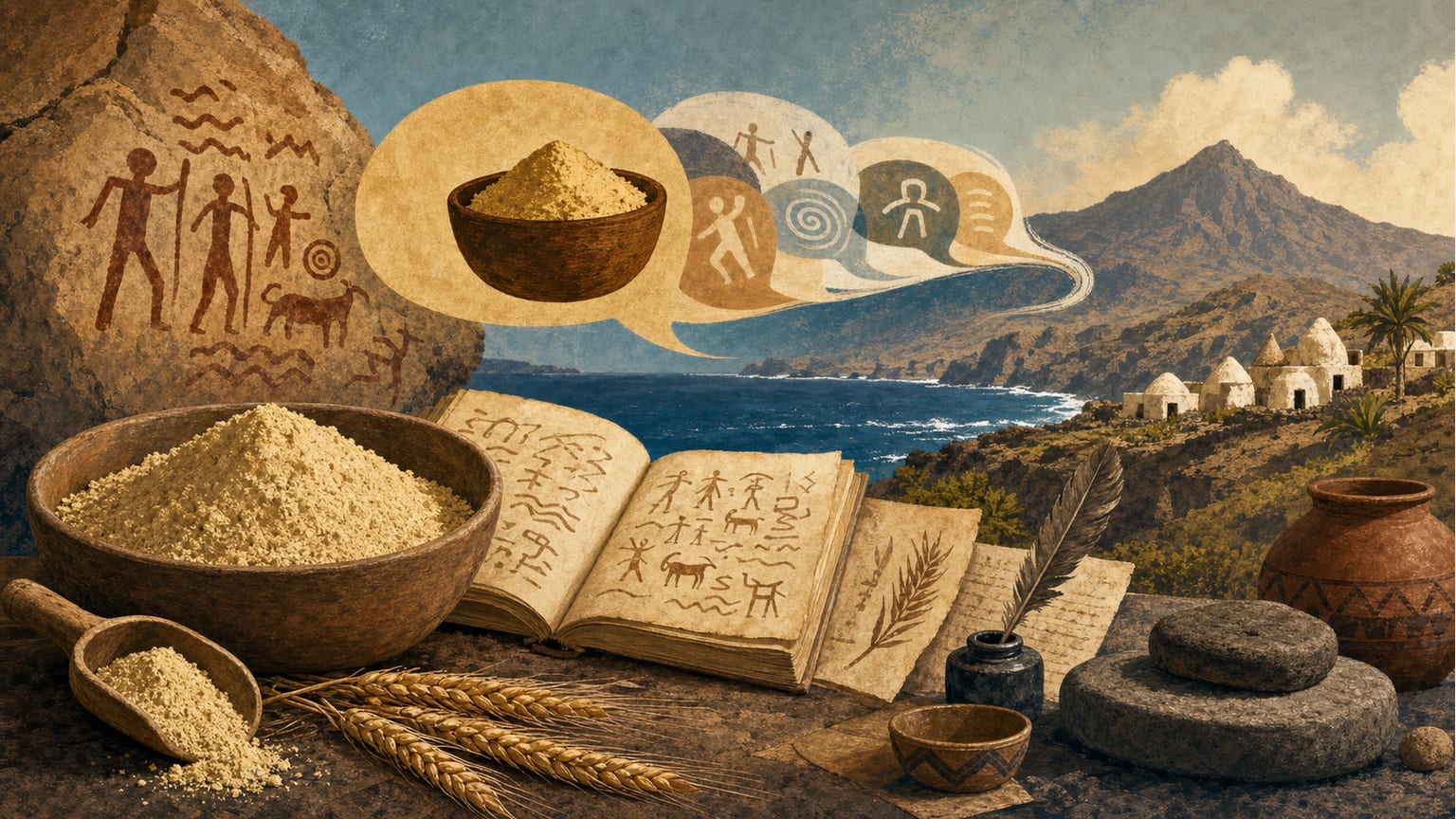
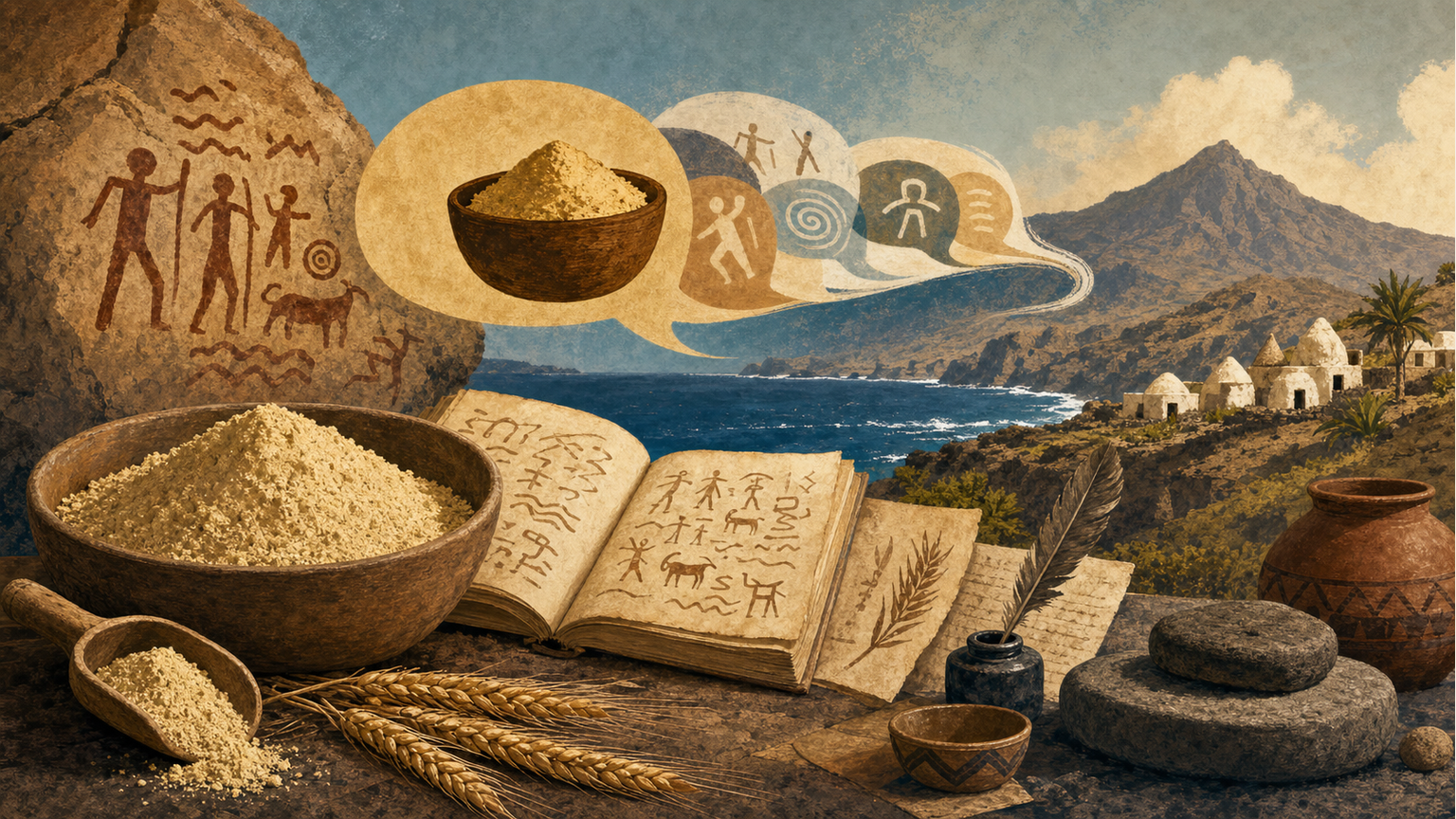
Gofio holds a central place in the food history of the Canary Islands, described as the shining yet never fully appreciated star of Canarian gastronomy[1]. Today it is made as a fine flour of roasted cereals — wheat, barley, rye, corn, or even chickpeas — but its roots go much further back: the indigenous peoples of the archipelago, often called “Guanches” — a name that strictly speaking refers to the ancient inhabitants of Tenerife, although usage extended it to all the islands[2] — already roasted and ground grain, and that flour was their staple food[1]. The word “gofio” itself comes from the Amazigh language the first settlers brought from North Africa, and it is one of the most emblematic indigenous words surviving in Canarian Spanish[3].
José M. Esteban, echoing a widely repeated idea, wrote that those first islanders “only had barley”[1]. Modern archaeobotanical research refines that picture: barley (Hordeum vulgare) was indeed the fundamental cereal and the most widely documented in the archipelago’s pre-Hispanic sites, but the first settlers arrived from north-western Africa with a more varied crop package that also included durum wheat (Triticum durum), lentils, broad beans, peas, and fig trees[4]. The evidence is not identical on every island either: after the initial colonisation, isolation gradually reduced crop diversity on all the islands except Gran Canaria[4]. Only after the conquest were new ingredients added to gofio flour: other cereals and grasses, peas, chickpeas, and even lupins[1].
The basic technique has changed little since then: a very fine flour is obtained from the roasted grain and kneaded with water or mixed with other ingredients[1]. On that ancient foundation, Canarian cooking of recent centuries has multiplied the preparations — blends with cheese or honey and, in contemporary times, gofio desserts and ice creams — later developments that should not be projected back onto the indigenous table[1]. Gofio was also, until recent times, the survival ration of shepherds and people of humble origin who spent long periods far from populated areas, carrying a portion in their zurrón[1].
The vocabulary surrounding gofio is extensive and highlights its importance in daily Canarian life. It is worth noting that most of these words do not come from the indigenous language: they are canarismos that arose in the Spanish spoken on the islands, like those recorded today by the Academia Canaria de la Lengua[2]. Thus “pan de gofio” refers to a ball of gofio kneaded with water and salt, “pella” is a portion of kneaded gofio shaped like a tablet, and “gofiento” describes something that looks like gofio[1]. The “zurrón,” a bag made from kid goat skin, was the traditional container for kneading and carrying gofio[1].
There are also terms for different preparations: “escaldar” means kneading gofio with very hot broth, and “escaldón” — a word recorded in the Canarian academic dictionary — is boiling broth with stirred gofio[1][2]. “Revuelto” refers to gofio kneaded with very hot liquid, “sobado” is gofio kneaded in the zurrón, “berrendo” is a paste of gofio with water and pieces of cheese, and “rala” is wine, milk, or broth with diluted gofio[1]. Other words have a less certain attribution: “gasnais,” a handful of gofio dough taken between the fingers, cannot be confidently assigned an indigenous origin, whereas “ahoren,” ‘barley flour,’ does appear among the words the sources transmit as belonging to the ancient Canarians[1].
Gofio was not only food but also part of Canarian culture and identity. In the contemporary Canarian dinner Esteban evokes, gofio “occupies the throne of the king, of the mencey,” accompanied by bananas and malvasía wine[1]. That image portrays today’s Canarian gastronomy, not the pre-Hispanic table: the banana, of Asian origin, did not reach the Canary Islands until the 15th century, introduced by the Portuguese and Castilians along the Atlantic routes linking the islands with West Africa, and from the archipelago it crossed to the Americas in the early 16th century[5]. The tradition of sharing gofio at gatherings and celebrations does live on in words like “cabrillas,” an appetizer of portions of powdered gofio with sips of wine, or “gasnais” itself[1].
In summary, gofio is much more than a food: it is a bridge between the pantry of the indigenous peoples of the Canary Islands and today’s cooking, a fundamental element of Canarian cultural heritage whose vocabulary testifies to its historical and social significance on the islands[1].