

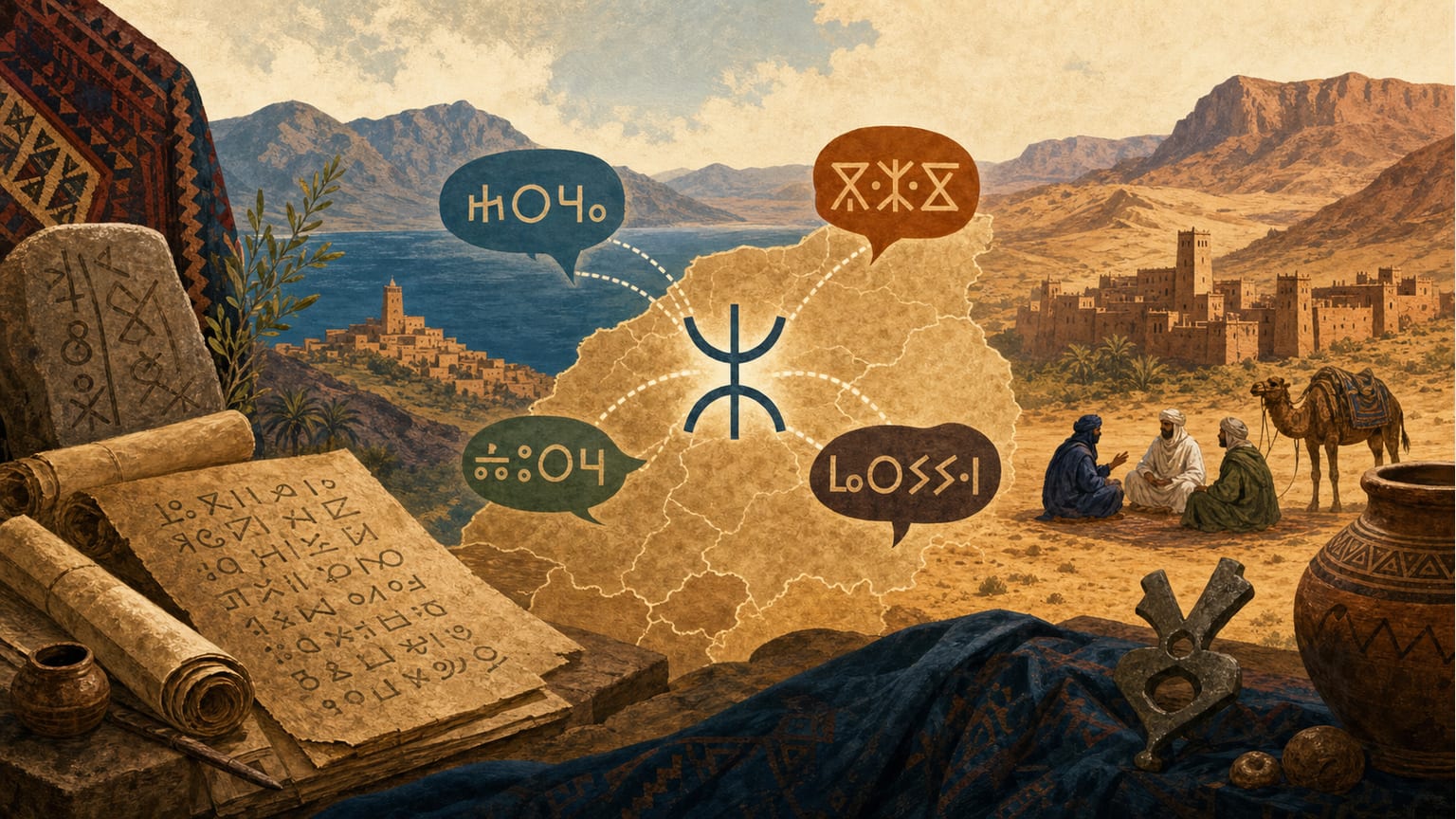
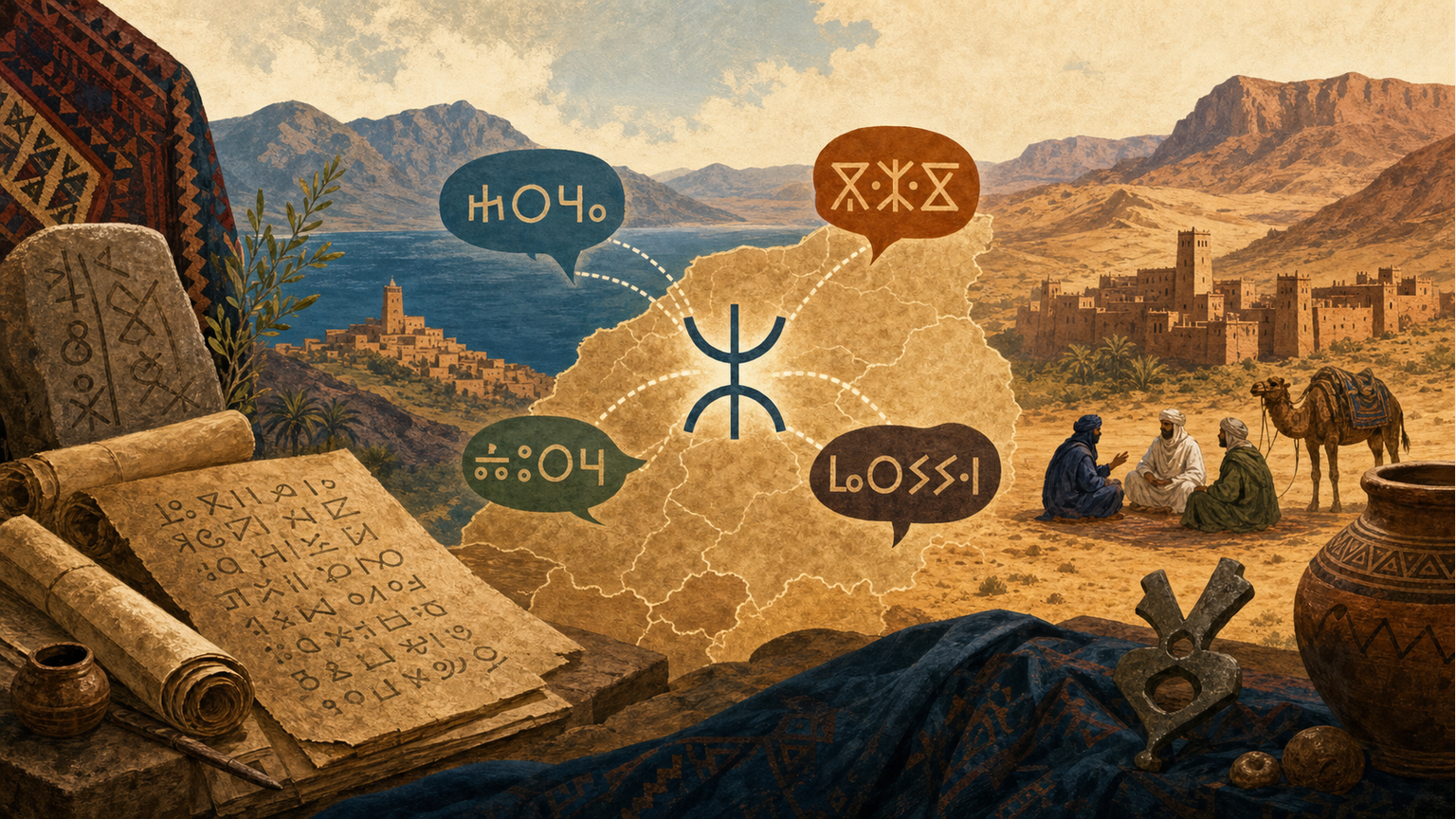
The Amazigh language, also known as Tamazigh by its speakers, is the language of the Imazighen, whose name means ‘free people’[1]. According to GEA (Amazigh Studies Group, Autonomous University of Barcelona), in 2006 there were about 20 million Amazigh speakers, spread across a vast region from the Canary Islands to the western borders of Egypt, and from the Mediterranean to the Senegal and Niger rivers[1].
One of the most notable features of Amazigh is its dialectal diversity, reflecting the broad geographic range and history of the Amazigh peoples. In Morocco, where approximately 12 million Amazighs live (over 40% of the population, according to GEA), three main dialects are identified: Riffian or Tarifit, spoken in the north, especially in the Rif mountains; Tamazigh, which is both the general name for the language and the dialect of the central-east; and Tacelhit, also known as Chelha or Chleuh, spoken in the southwest and recognized for its rich written literary tradition, with texts preserved from the 16th century[1].
In Algeria, GEA estimates around 7 million Amazighs, about 25% of the population. The most widely spoken dialects in Algeria are Kabyle or Teqbailit, which has seen significant modern development through magazines, books, and social advocacy; Taixawit in the southwest; and Tamzabit in the central-north[1].
In the Saharan region, particularly in Niger (about 500,000 speakers) and Mali (about 400,000), as well as parts of Algeria, Libya, Nigeria, and Burkina Faso, the Tamaceq language of the Tuaregs is spoken. According to GEA, Tamaceq is the only Amazigh variety that has preserved the ancient Tifinagh script, probably derived from Libyan writing[1].
Today, Amazigh is mainly written with the Latin alphabet, although there is a growing update of the Tifinagh alphabet, enriched with additional signs to adapt it to modern social uses[1]. However, according to GEA, Amazigh is only official in Niger and Mali. In Morocco, Algeria, Tunisia, Libya, Mauritania, and Chad, it lacks political status, leading to advocacy movements, especially in Morocco and Algeria[1].
The dialectal diversity of Amazigh, as described by GEA, reflects the cultural richness and geographic dispersion of the Imazighen. Each dialect maintains its own phonetic, lexical, and morphological features, while sharing a common base that identifies them as part of the same Afroasiatic family, with Semitic and Latin influences in their historical development[1].