

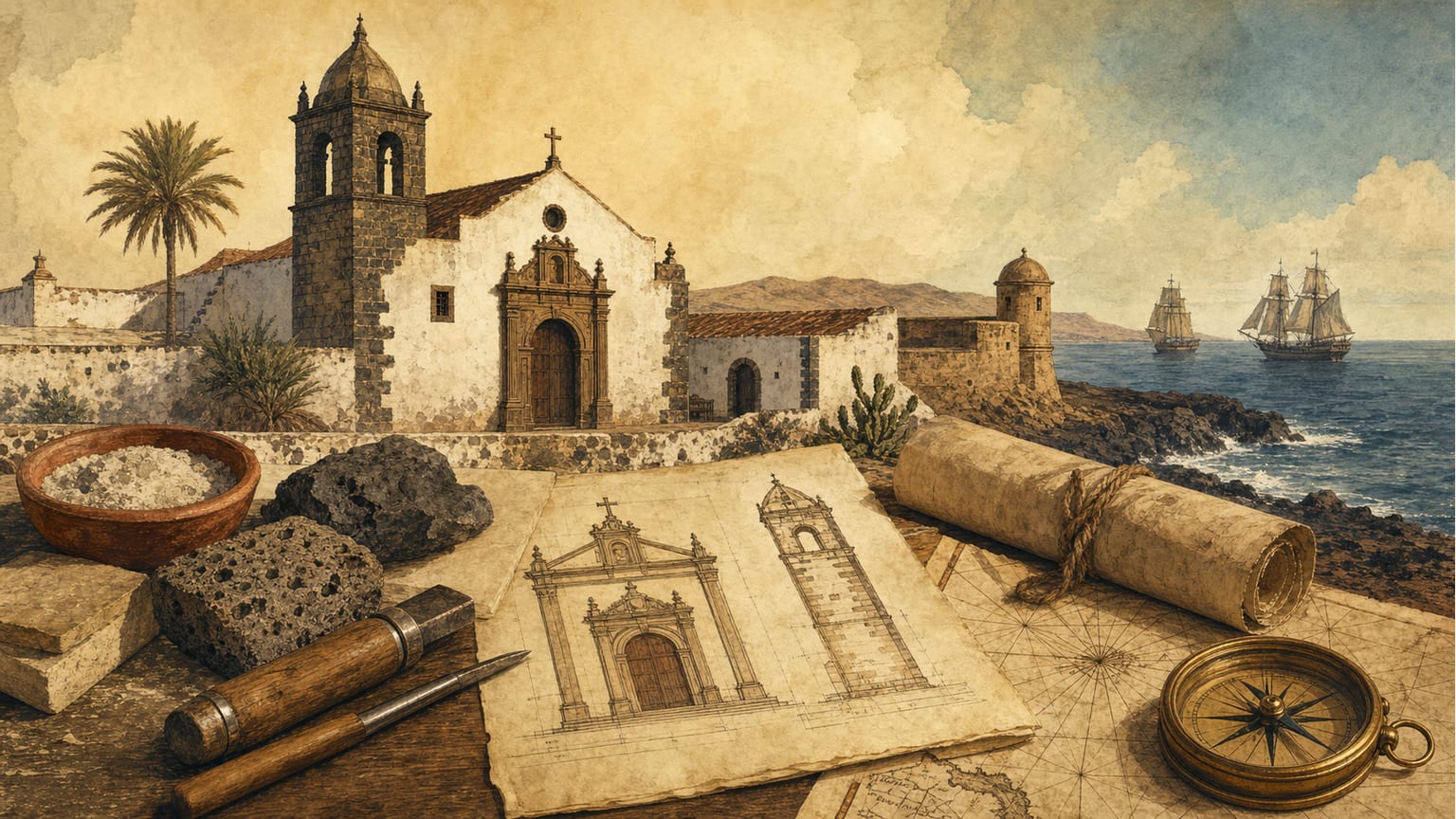
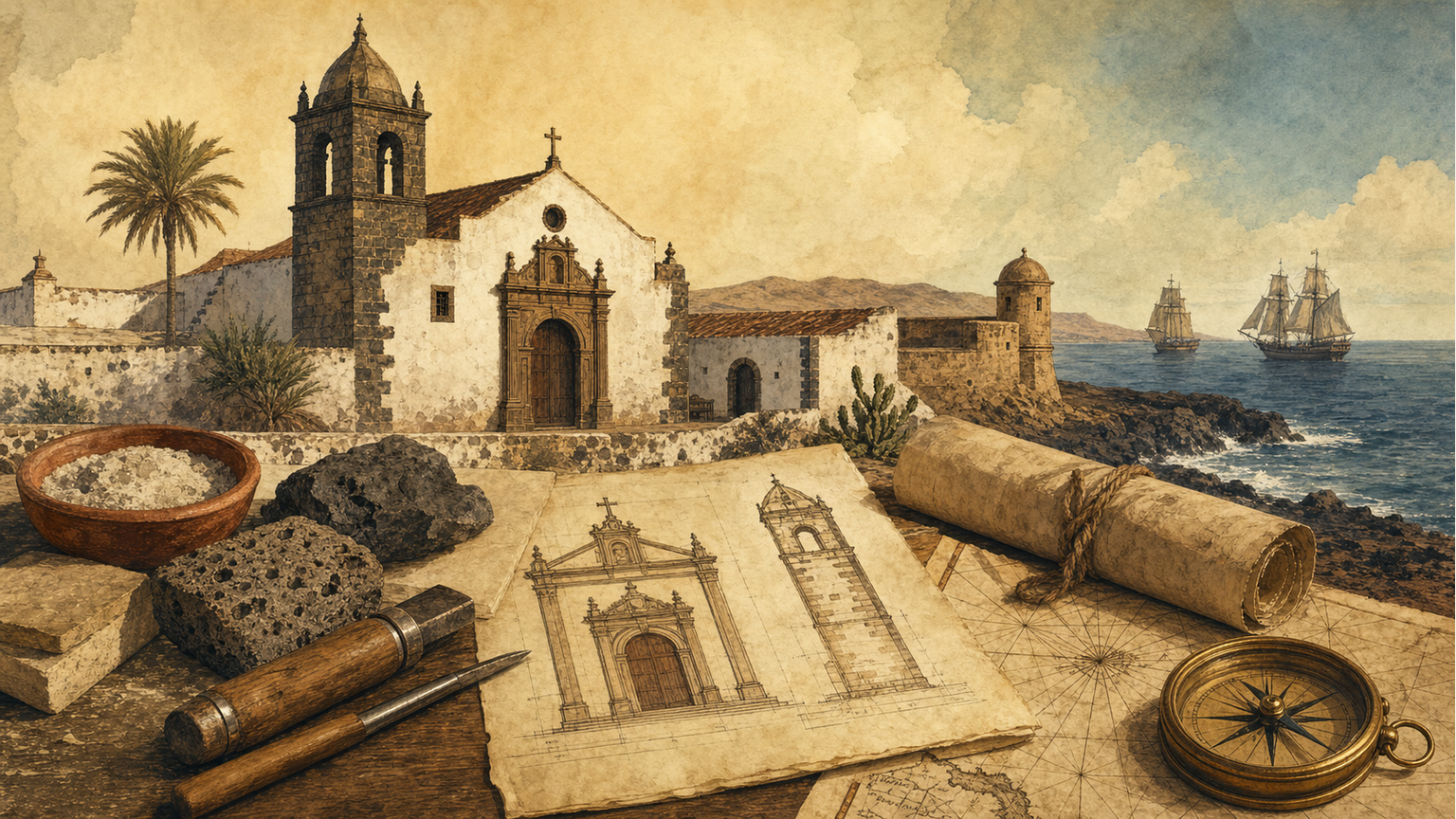
Religious architecture in Lanzarote and Fuerteventura during the Ancien Régime is one of the best-documented and studied fields within the islands’ art history, especially for the 17th and 18th centuries. According to Cabildo de Lanzarote; Cabildo de Fuerteventura (eds.), research has focused on notarial records, church accounts, and diocesan archives, which allow for the reconstruction of the foundation, endowment, and renovation of numerous churches and chapels[1].
There is a notable imbalance in the preservation of documentary sources between the two islands. Fuerteventura retains a greater volume of documentation, while Lanzarote suffered significant losses due to the Algerian attack of 1618 and the fire at the Guadalupe church in 1909, which destroyed much of the parish archives[1].
The study of sacred architecture reveals the importance of local families and community contributions in endowing chapels. For example, the church of Las Mercedes in El Time was funded in 1672 by Manuel de la Trinidad, while the chapel of San Agustín in Tefía was built with 17 fanegadas of land donated by local residents in 1713[1].
The mobility of craftsmen between islands was a recurring phenomenon. Stonemasons and carpenters from Tenerife, La Palma, and Gran Canaria participated in the construction and restoration of churches in Lanzarote and Fuerteventura. Notable figures include Julián Sánchez Carmona, a master stonemason from La Palma who rebuilt the Franciscan convent church in Betancuria and worked on the Guadalupe church in Lanzarote, and Sebastián Álvarez, a carpenter probably from La Laguna, responsible for the woodwork in the Guadalupe church in 1683[1].
The supply of building materials also shows inter-island connections. There are records of timber arriving from Tenerife to roof the Santa Catalina chapel in Betancuria between 1572 and 1576, as well as for the Candelaria church in La Oliva and the Peña chapel in Fuerteventura at different times[1]. In Lanzarote, wood for the marquis’s houses was brought from Gran Canaria in 1618.
Notarial documentation provides details on financing, patronage, and authorship. For instance, the chapel of Ntra. Sra. de Nazaret was built by Antonio de Sosa and María de los Ángeles in 1646, who donated six fanegadas of land and established the patronage for their children[1].
Major renovations and reconstructions of principal churches, such as the Franciscan convent in Teguise and the Guadalupe parish, were often carried out after disasters like fires or structural failures, involving craftsmen from other islands and funding from notable families or local patrons[1].
In summary, the religious architecture of Lanzarote and Fuerteventura during the Ancien Régime is characterized by rich documentation, the movement of craftsmen and materials between islands, and the involvement of local society in the foundation and upkeep of their churches, according to research collected by Cabildo de Lanzarote; Cabildo de Fuerteventura (eds.) in the VIII Jornadas de Estudios sobre Lanzarote y Fuerteventura[1].