

Introduction
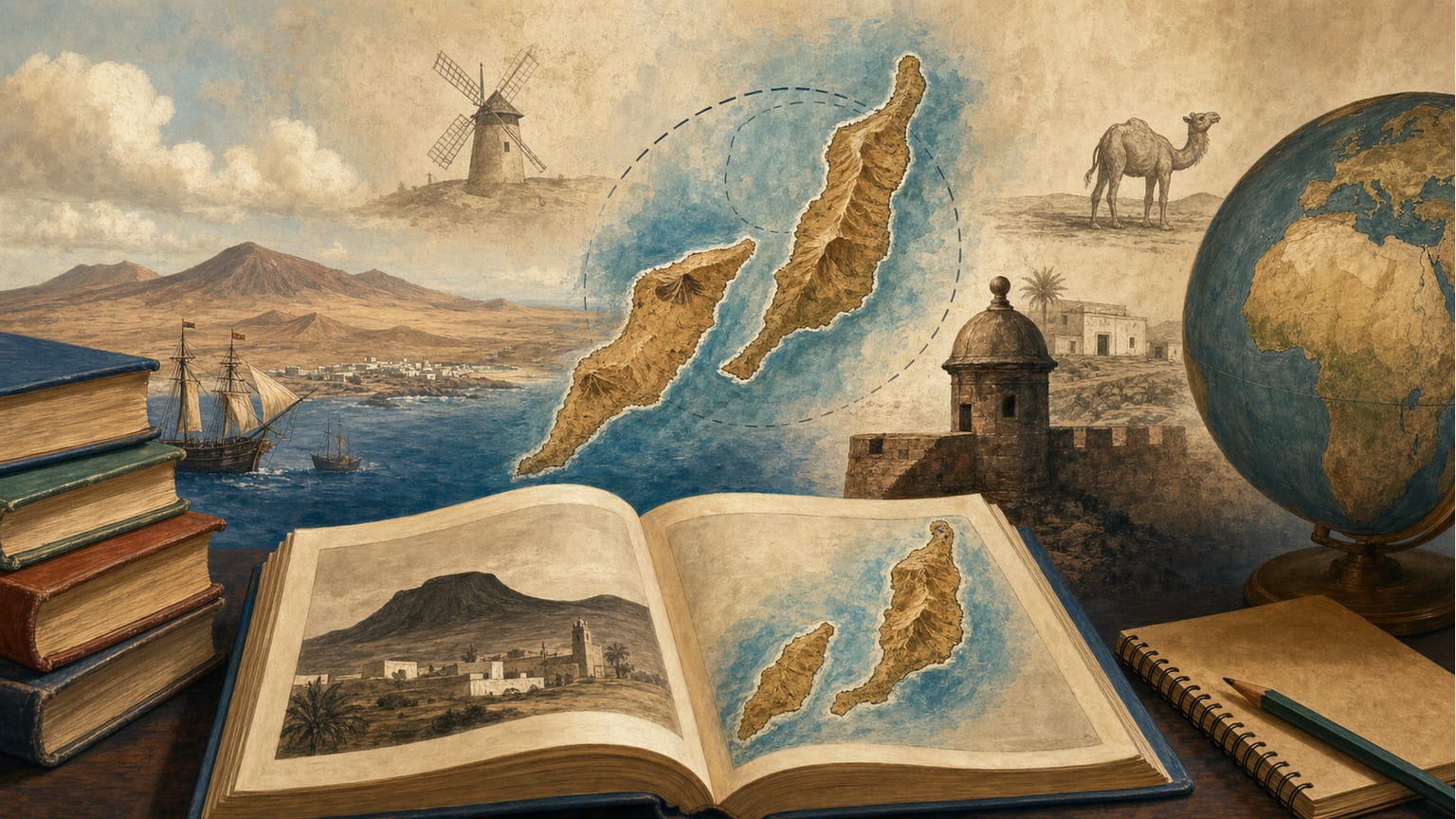
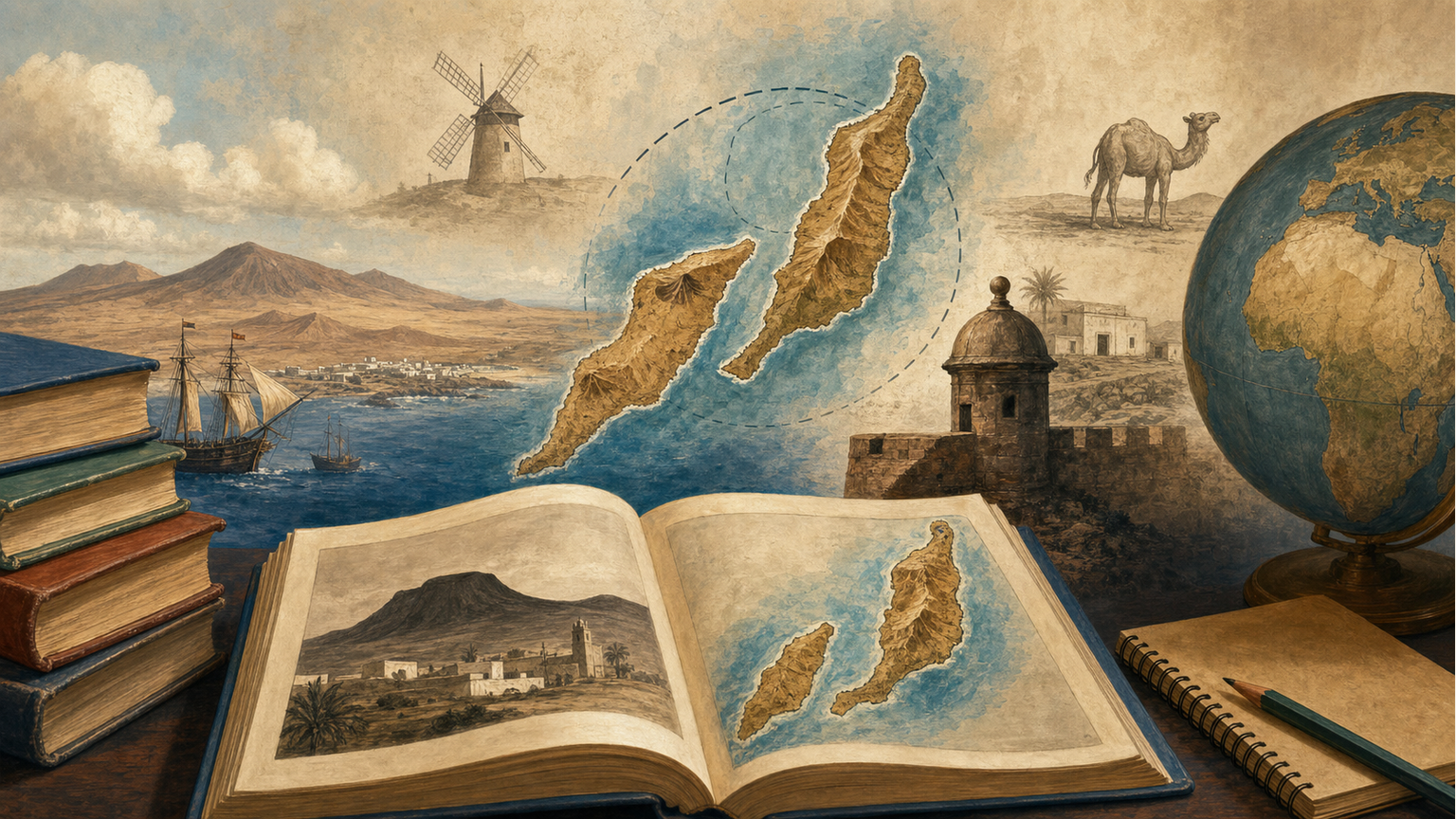
The role of Lanzarote and Fuerteventura in school textbooks and educational materials about the Canary Islands, published between 1978 and 1987, reveals a tendency to treat these islands as secondary and often through stereotypes. This analysis focuses on four representative works: Natura y Cultura de las Islas Canarias (1978), Canarias (Anaya, 1982), Cuadernos de Historia de Canarias (ICSE, 1987), and Canarias (Anaya, 1987), all widely used in Canarian schools after Spain’s democratic transition[1].
Methodology and Aims
These textbooks generally aimed to foster knowledge of the local environment and history as a starting point for understanding Canarian reality. However, the analysis shows that, although they begin with local history, the approach to Lanzarote and Fuerteventura is rarely specific, instead integrating them into the broader concept of “Region” or “Archipelago” and overlooking their unique characteristics[1].
Historiographical Approach
In Natura y Cultura de las Islas Canarias, Lanzarote and Fuerteventura are presented as “peripheral” islands, characterized by dryness, drought, easy conquest, and tourism development. The manual uses a narrative history focused on events and individuals, and applies terms like “Guanche” in a way that homogenizes aboriginal diversity. There is also an environmental determinism and thematic reductionism, with dryness and tourism as the main axes of the narrative about both islands[1].
The Cuadernos de Historia de Canarias seek a more active and updated methodology, but the treatment of Lanzarote and Fuerteventura remains tokenistic. The islands are grouped as “Eastern Islands,” and their conquest is depicted as rapid and unopposed, repeating patterns from earlier studies and lacking relevant insular nuances[1].
The Canarias (Anaya, 1982) textbook allows for local adaptations, but in practice, Lanzarote and Fuerteventura are mainly used as examples of general archipelago phenomena, such as volcanism, tourism, or dry climate. The history is presented linearly and anecdotally, with little depth regarding the specificities of the two islands[1].
Canarias (Anaya, 1987), aimed at older students, also does not give Lanzarote and Fuerteventura a leading role. They appear occasionally, associated with topics like dryness or environmental respect (for Lanzarote), while Fuerteventura is even more overlooked. The generalist approach and transmissive methodology reinforce the lack of specificity in the treatment of these islands[1].
Conclusions
The analysis of these textbooks shows that the evolution in teaching Canarian history has not clearly extended to Lanzarote and Fuerteventura. Stereotypes and reductionist views persist, with little attention to insular particularities and a tendency to integrate them into a generalized regional narrative. Didactic content specific to these islands is usually limited to photographs and graphics of landscapes or economic activities, without a deep development of their own history or culture[1].