

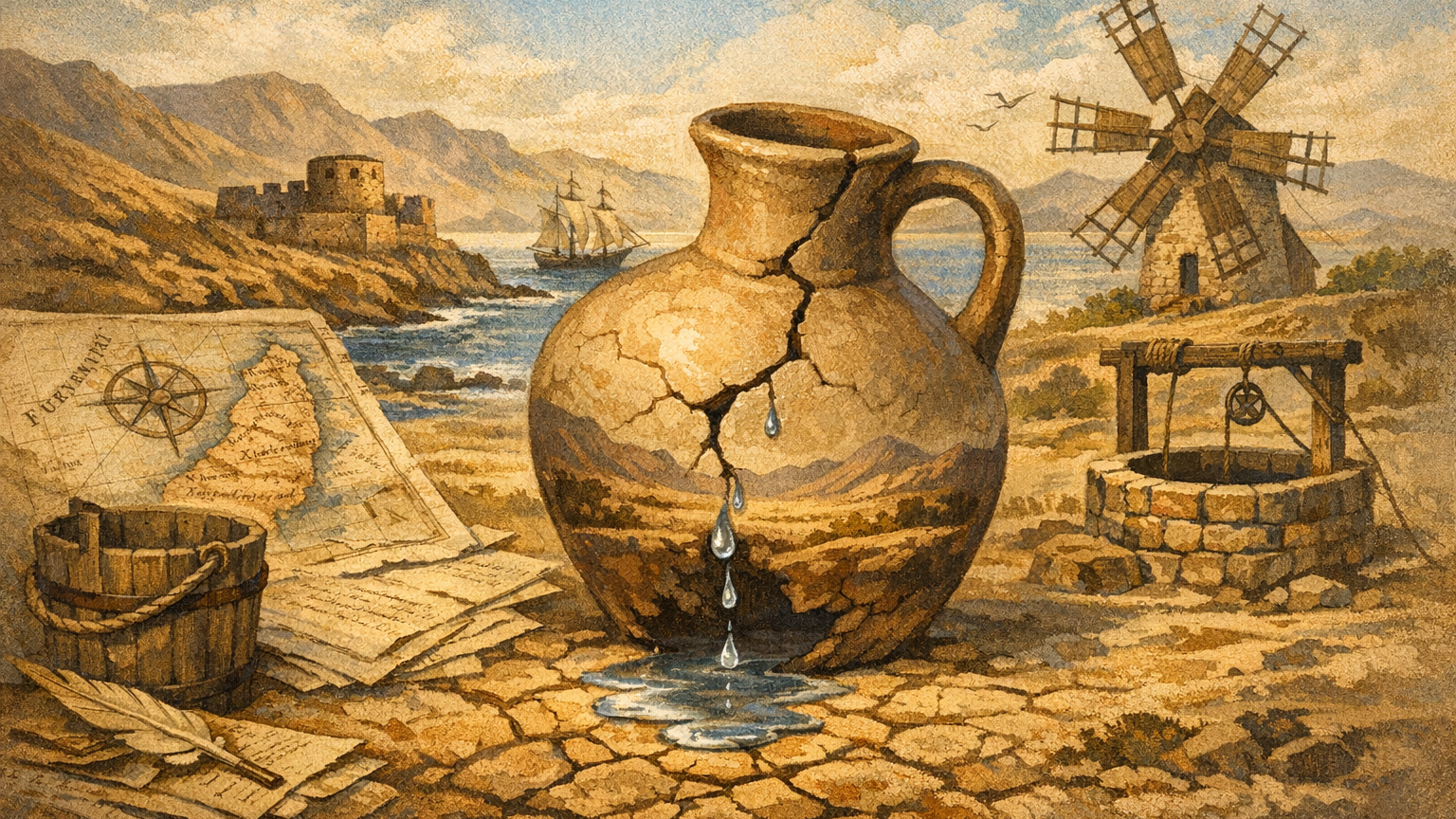
Water in Fuerteventura: A History of Perpetual Thirst
The story of Fuerteventura is, above all, a story of thirst. For centuries, the island’s inhabitants have faced the relentless challenge of water scarcity, which has shaped daily life, economic activity, and even the social structure. As historian Viera y Clavijo put it, the absence of water was a “domestic enemy, infinitely more dreadful than all the enemies of the crown”1.
Life on Fuerteventura revolved around waiting for rain and caring for the island’s few springs. Each year, people prepared the land in autumn and winter, and in spring and summer, they worked to clean and maintain the springs to ensure water for both people and livestock. When rain was abundant, the ravines flowed and harvests were plentiful; but in dry years, famine, desolation, and forced emigration struck the population1.
The island council, or Cabildo, played a vital role in managing water resources. Historical records spanning more than two centuries reveal a constant concern for maintaining and cleaning the springs. There were strict rules: some springs were reserved for human consumption, others for livestock, and some for washing. The Río de Cabras spring, one of the most important, was cleaned regularly by all residents under the supervision of a council member. Failure to participate could result in fines or even jail time1.
Water scarcity also led to conflicts and cunning. Some residents tried to divert springs or claim water sources for themselves, prompting the Cabildo to intervene and restore communal access. Systems were established to separate water use for different animals and for people, aiming to prevent contamination1.
The lack of water affected not only agriculture and livestock but also the culture and identity of Fuerteventura’s people. Emigration, resignation in the face of drought, and hope for rain are themes found in the island’s literature and poetry. As the writer Unamuno lamented during his exile on the island: “Water, water, water! Such is the sorrow that oppresses the chest of these poor people; water, Lord, even if it is brackish: what is the land for, if it lacks water?”1.
Today, thanks to modern technology and water management, the situation has improved, but the memory of thirst remains a defining part of Fuerteventura’s heritage. The island’s history of water is a testament to the resilience and adaptability of its people.