

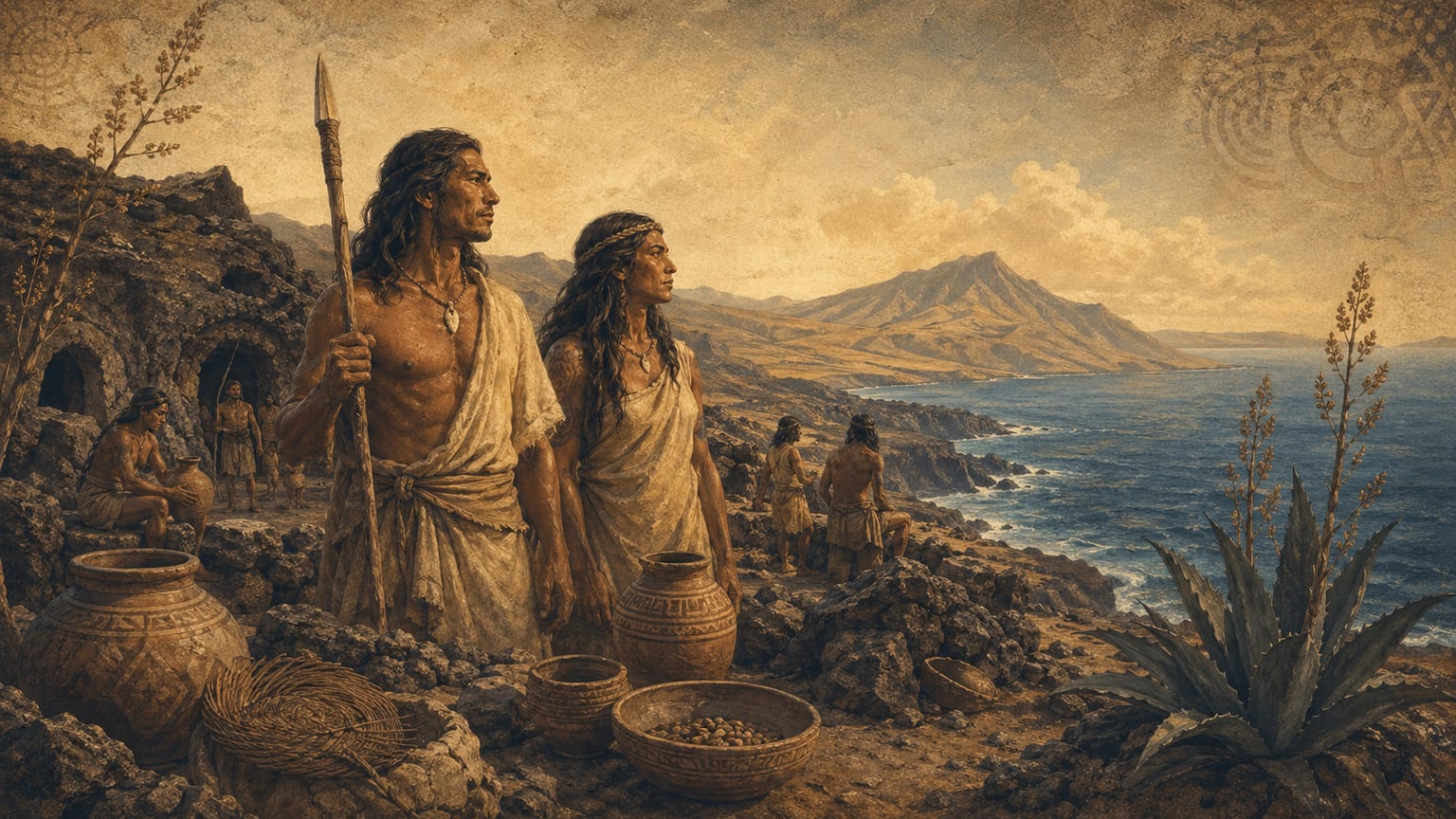

Before European sails first sighted the coasts of the archipelago, the Canary Islands were already inhabited by peoples whose presence dates back several centuries before our era. In strict historical usage, “Guanches” refers to the Indigenous population of Tenerife; for the wider island group, it is more accurate to speak of Indigenous Canarians, ancient Canarians or pre-Hispanic populations of the Canary Islands [1].
North African origins
Archaeology, linguistics and genetics confirm that the ancient Canarians came from North Africa, specifically from Berber or Amazigh peoples [1]. Genetic studies have advanced considerably and confirm that present-day Canarians retain an African genetic heritage [1]. The pre-Hispanic population reached the islands with languages of Amazigh origin, although each island developed its own variants [1].
The first settlement occurred around the 1st century BC. It has even been suggested that the islands were populated by the Roman Empire, which relocated rebel tribes that opposed the occupation of their North African territories [1].
Social and territorial organization
On Tenerife, the island was divided into nine menceyatos: Anaga, Tegueste, Tacoronte, Taoro, Icode, Daute, Adeje, Abona and Guimar, each governed by a mencey [2]. On Gran Canaria there were two guanartematos, Galdar and Telde, where power was exercised by the guanarteme with the support of the faycan in religious matters [1]. These were not egalitarian societies: on Tenerife there were ruling classes such as the achimencey and cichiquitzo, while the rest of the population were herders, artisans and farmers called achicaxnas [1].
Economy and daily life
Ancient Canarians were primarily dedicated to herding goats and sheep, supplementing their economy with agriculture, gathering and, to a lesser extent, fishing and shellfish collecting [2]. Gofio, made from toasted and ground cereals, was a central element of their diet [1]. They worked clay by hand, unaware of the potter’s wheel, and dressed in carefully sewn goat and sheep skins [2].
As Gil Hernandez notes, the figure of the “Guanche” very quickly became one of the preferred subjects of disciplines such as anthropology, archaeology, history and the visual arts, all focused on reconstructing the pre-colonial past of the archipelago [3].