

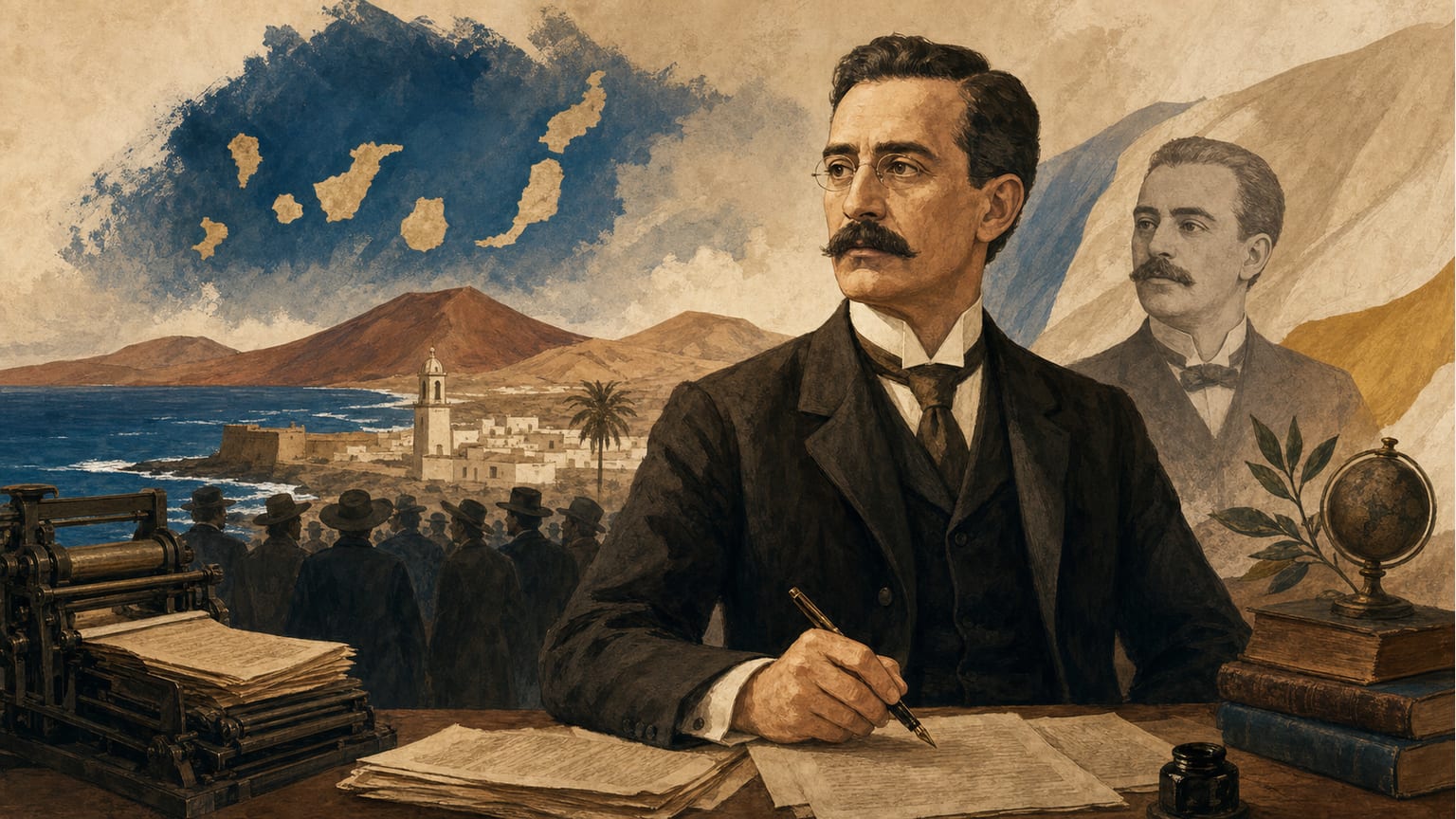
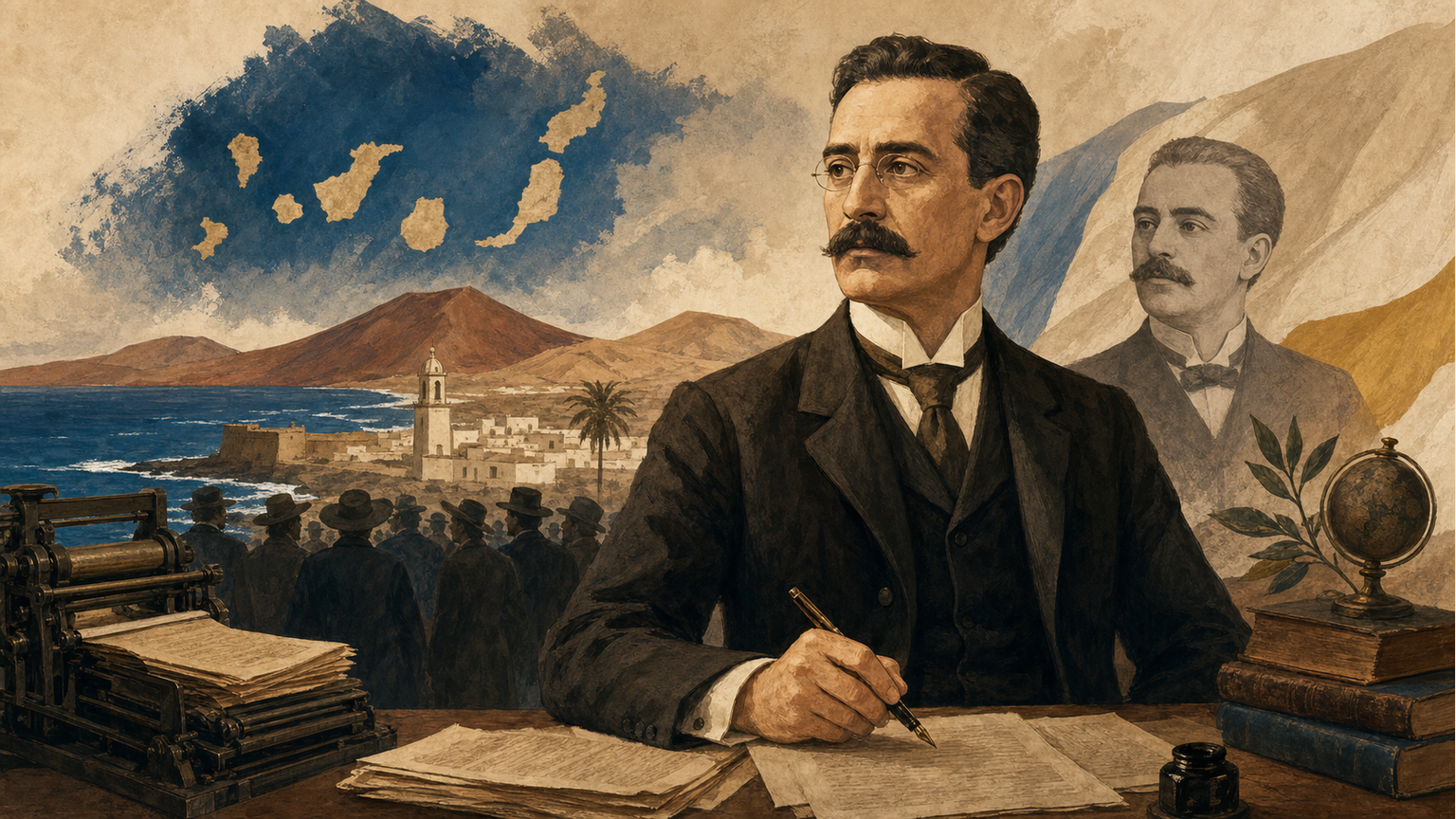
Manuel Déniz Caraballo (Arrecife, 1876 – Santa Cruz de Tenerife, 1921) was a schoolteacher, typesetter, journalist and town-council secretary in several parts of the Canary Islands. His name is usually cited only as the founder of ¡Vacaguaré!, the autonomist weekly directed by Secundino Delgado in 1902, but his own trajectory — that of a rural teacher who moved through Tenerife, Fuerteventura and back to Tenerife, who wrote for several newspapers under a pen name, and who set up one of the first correspondence-teaching academies in the Canary Islands — remains almost unknown [1].
From Arrecife to Canarian Intellectual Life
He was born in Arrecife de Lanzarote in 1876. The available documentation does not allow a detailed reconstruction of his childhood or his training as a teacher, but it does place his earliest known activity in the printing trade: in 1901 he was a member of the guild of printers, typesetters and bookbinders, and his signature was associated with the Imprenta Tinerfeña [1]. In 1902 he married Juana Torres Díaz, a dressmaker from Santa Cruz de Tenerife, in Tenerife; they had at least two daughters, Catalina (1902–1970) and Olimpia (1903) [1]. His link to the printing trade, and not only to writing, helps explain why it was he — not Secundino Delgado — who physically set up a newspaper.
Teaching and Cultural Vocation
From 1905 he worked as an interim teacher in the San Andrés neighbourhood of Santa Cruz de Tenerife. Between 1907 and 1911 he moved to Puerto de Cabras (today Puerto del Rosario), on Fuerteventura, where he ran the boys’ school on Calle Virgen del Rosario and sat on the Local Board of Primary Education [1]. In 1909 he organised evening classes for adults in Puerto de Cabras, inviting local figures to give instructional talks [1].
A complaint over abandoning his teaching post, ultimately dismissed, led him to resign and redirect his professional life [1]. He then settled in La Victoria de Acentejo (Tenerife), where he passed the civil-service examination to become a town-council secretary. In 1915 he opened a correspondence-teaching academy to prepare candidates for municipal- and court-secretary positions — covering subjects such as bookkeeping and accounting — an initiative described as pioneering in the Canary Islands in the field of distance education [2]. In La Victoria de Acentejo he also helped found El Centro, a recreational and educational society established on 1 February 1913, of which he became president and in whose theatrical and musical evenings he took part alongside his daughter Catalina [2].
Manuel Déniz and the Canarian Press
Before ¡Vacaguaré!, Déniz had already been contributing to Tenerife’s labour and autonomist press. In December 1900 he wrote for El Obrero under the pen name Daniel M. Nuez, defending the value of work against what he saw as the contradictions of the society of his time [1]. Later, as a teacher in Puerto de Cabras, he published an article in the newspaper Escuela Canaria about tributes to the Spanish flag at the boys’ school [1], and the weekly La Aurora, from the same town, publicly thanked him for his support of the island’s development [1]. His journalistic activity, then, was not confined to a single newspaper or a single period of his life: it accompanied both his labour and autonomist phase and, later, his life as a teacher and municipal official.
Political Ideas and Autonomism
Around 1900–1901 Déniz moved within the circle of the Asociación Obrera de Canarias and took part in the electoral campaign of the Partido Popular Autonomista ahead of the municipal elections of November 1901 [1]. There is, however, no extensive text of his own in which Déniz set out a detailed political programme comparable to the one developed by Secundino Delgado; the era’s most-cited autonomist demand — that the Canary Islands should have “their own legislative and executive bodies” — belongs to Delgado, not to Déniz, and should be attributed accordingly [3].
Almost a decade later, in 1910, Déniz was among the signatories in Puerto de Cabras of the Plebiscito de las Islas Menores (Plebiscite of the Minor Islands), promoted by Manuel Velázquez Cabrera to demand the islands’ own parliamentary representation and the creation of island councils (cabildos insulares) in Fuerteventura and Lanzarote [1]. His biographer also notes that Déniz’s later trajectory — centred on teaching, municipal administration and school ceremonies of patriotic exaltation — contrasts with the labour and autonomist commitment of his youth, which may partly explain the relative obscurity of his figure in Canarian historical memory [1][2].
The Founding of ¡Vacaguaré!
At the end of 1901, after distancing himself from the Partido Popular Autonomista, Déniz launched the newspaper ¡Vacaguaré! at the start of 1902; its direction fell to Secundino Delgado, working from Santa Cruz de Tenerife [3]. Sources agree that it was Déniz who set the publication in motion, though they do not always agree on the exact terms of each man’s role: the reference study on figures from Lanzarote attributes the paper’s effective direction to Delgado, while other sources describe Déniz as also assuming that direction [3][1]. The weekly barely reached four issues before Delgado’s arrest, weeks later, brought the publication to an end [3]. For a full account of Delgado’s arrest, the insular press’s reaction and the autonomist debate surrounding ¡Vacaguaré!, see the article on Secundino Delgado.
Manuel Déniz and Secundino Delgado
Their collaboration was brief but decisive: Déniz provided the editorial initiative — and, probably, the material means of a working typesetter — while Secundino Delgado, already known for his labour and autonomist activism after returning from the Americas in 1900, took on the public role of directing the newspaper from the Tenerife capital [3]. This distinction between founder and director is the key to understanding why the 1902 arrest fell on Delgado rather than on Déniz, and why later historiography has tended to subsume Déniz’s figure into Delgado’s. This article focuses on Manuel Déniz Caraballo’s own trajectory; for Secundino Delgado’s biography and the full development of the autonomist campaign, see the article Secundino Delgado and Canarian autonomism.
A Figure from Lanzarote in Canarian Debates
Déniz’s Lanzarote origin was not incidental. His time in Fuerteventura between 1907 and 1911 — and specifically his signature on the 1910 Plebiscito de las Islas Menores — places him within a current of demands specific to the so-called “minor islands” (Lanzarote and Fuerteventura), distinct from the Tenerife-Gran Canaria autonomism that drove ¡Vacaguaré! [1]. While ¡Vacaguaré! demanded autonomy for the archipelago from Madrid, the plebiscite promoted by Velázquez Cabrera demanded, within the Canary Islands, representation and institutions of their own for the peripheral islands against the administrative weight of Tenerife and Gran Canaria. That the same man took part in both episodes — founding a Canarian autonomist newspaper in 1902 and signing an insularist plebiscite eight years later — illustrates the complexity of early twentieth-century Canarian regionalist debates, which were not limited to a single confrontation between the Canary Islands and mainland Spain, but also involved tensions among the islands themselves.
Later Years and Legacy
After his time in Puerto de Cabras, Déniz settled in La Victoria de Acentejo, where he pursued his career as a town-council secretary and, in 1915, opened his correspondence-teaching academy [2]. He died in November 1921 in Santa Cruz de Tenerife. According to the newspaper El Progreso of 26 November that year, he died of a “painful illness” in the Hospital Civil de Los Desamparados; the very town council he had worked for owed him back pay, leaving him without the means to pay for his medical care [2].
The trajectory of Manuel Déniz Caraballo — typesetter, labour journalist, rural teacher, pioneer of correspondence education and founder of an autonomist newspaper that barely survived a few weeks — constitutes, beyond his link to Secundino Delgado, a biography of its own from the Canary Islands of the late nineteenth and early twentieth centuries: that of a man who moved between the print shop, the school and local administration, and whose contribution to the Canarian autonomist debate, though less visible than Delgado’s, was part of the same generation of teachers and journalists who sought to give the islands a political voice [1][2].