

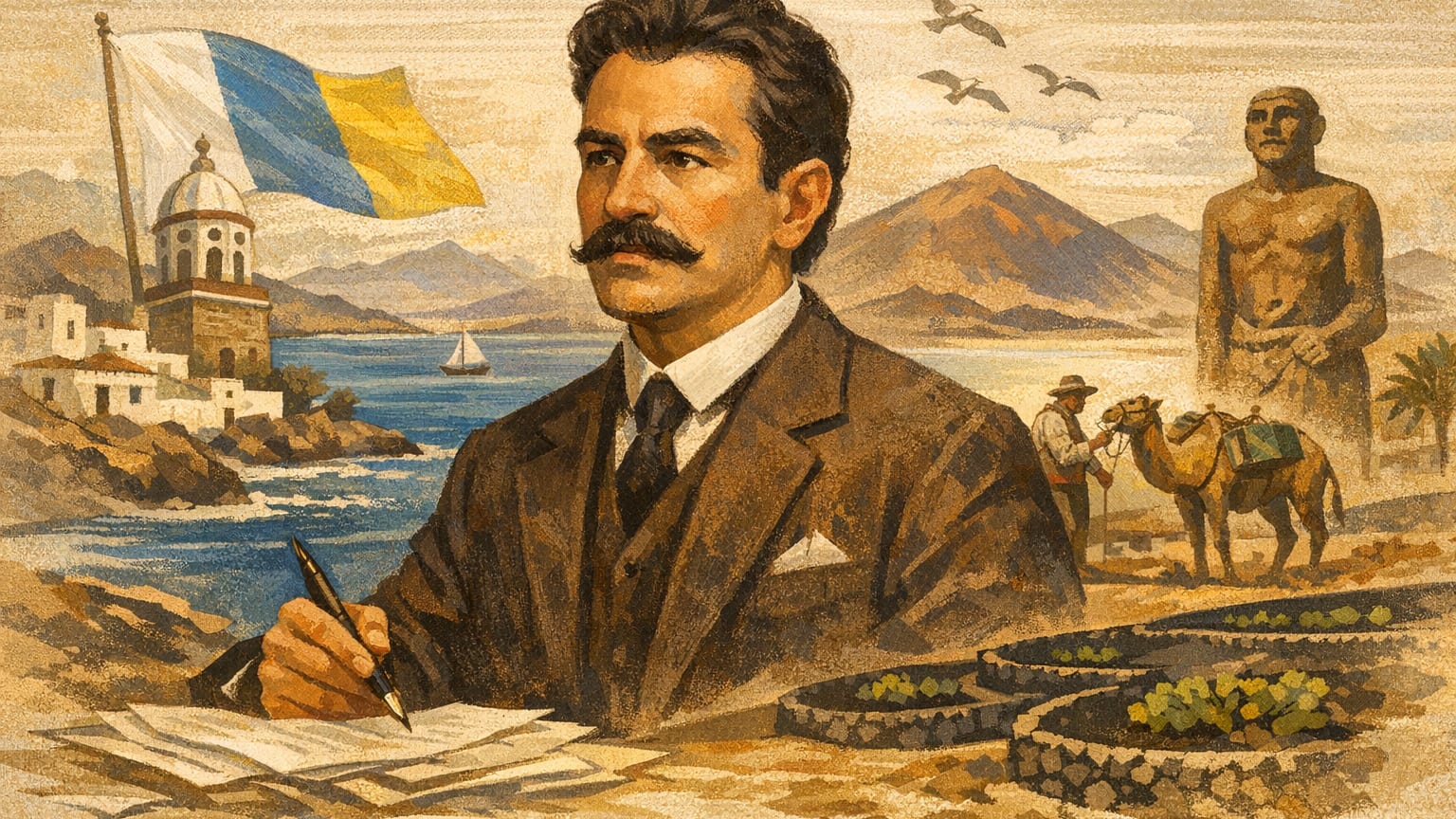
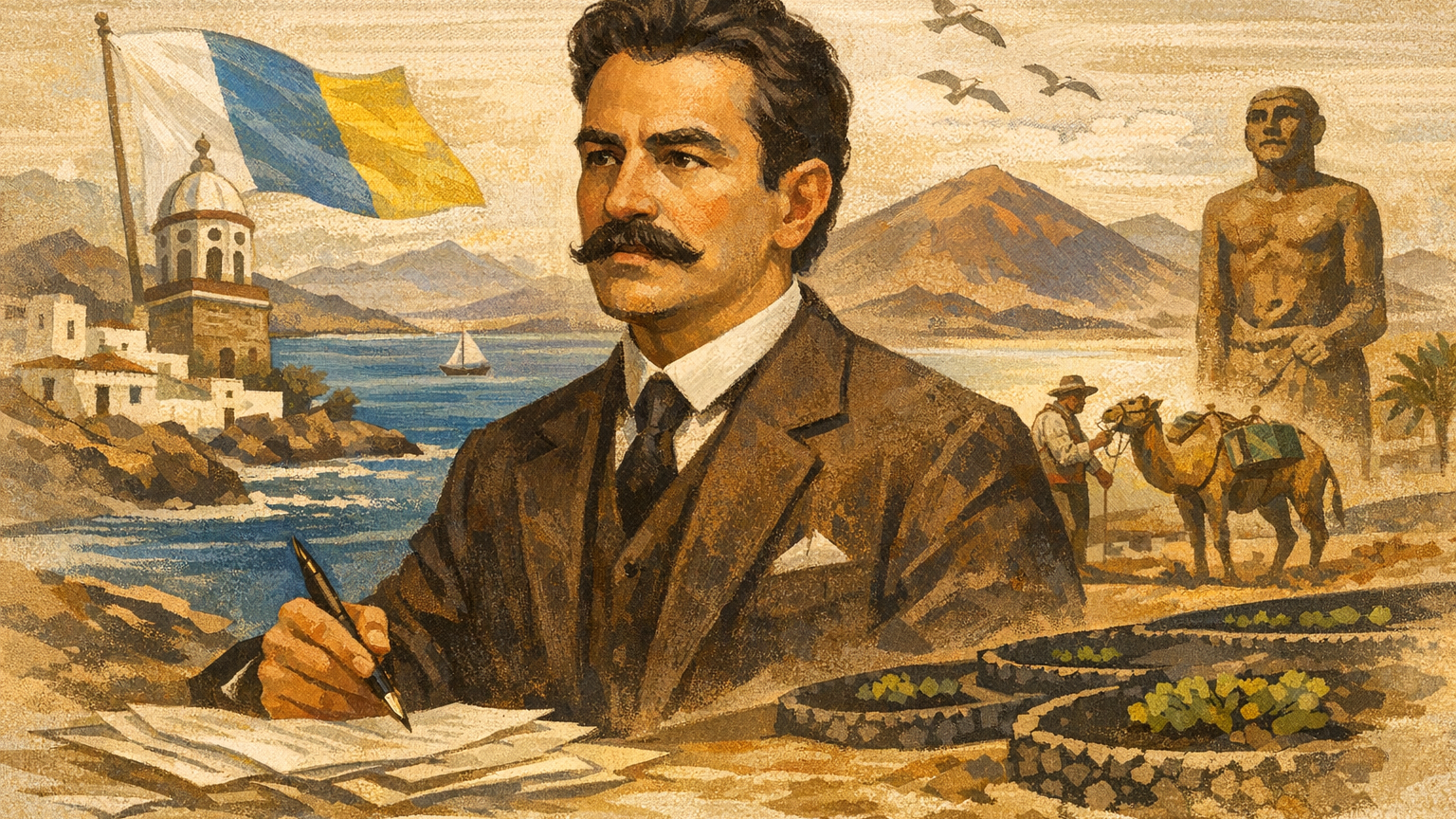
José Rafael Betancort Cabrera, known by the pen name Ángel Guerra, was born in Teguise on 19 March 1874. He began his education in his home town before moving to Las Palmas, where he started contributing to the press. He met Benito Pérez Galdós during one of the novelist’s visits to the Canary Islands in 1894 and, after settling in Madrid in 1900, made contact with the Canarian community there through Galdós[1].
His journalistic work continued at the Heraldo de Madrid and other publications. In 1901, Ricardo Ruiz y Benítez de Lugo founded Las Canarias, a newspaper intended to bring the archipelago’s concerns to Madrid from a viewpoint close to its dominant classes. Between June and August 1902, Ángel Guerra published five articles in its pages under the collective title Sobre Canarias. Britanización y separatismo[1].
The series answered suspicions of “Britanisation” and separatism circulating in parts of mainland public opinion. Betancort denied that the Canary Islands had a separatist movement with meaningful support and emphatically defended the islands’ Spanish identity. In 1902 he was a liberal journalist associated with the monarchical left and not yet affiliated with a political party, although his subsequent political career would bring him closer to other groups[1].
One of his aims was to discredit the autonomist campaign associated with Secundino Delgado. Ángel Guerra portrayed that campaign as vague and lacking social support, and credited Delgado with founding ¡Vacaguaré!. Nicolás Reyes’s study corrects two parts of this account: Manuel Déniz Caraballo founded the newspaper, although Delgado became its editor, and the island press did not maintain the silence that Betancort alleged[1].
His articles were more than a patriotic declaration. They examined the role of British capital and trade, dependence on foreign markets and the difficulty of sending agricultural produce to mainland Spain because of inadequate transport links. Betancort also defended two distinctive arrangements he believed were under threat: the historic Canarian militias and the free-port regime, to which he attributed much of the archipelago’s commercial prosperity[1].
Ángel Guerra did not always express his position in the same terms. In the regionalist survey published by El Progreso in 1906, he voiced sympathy for a common campaign and supported the pursuit of broad autonomy. At the same time, he insisted on the unity of the archipelago and on a Spanish identity that he considered beyond dispute. His answer reveals a shift from his rejection of “regionalist fevers” in 1902 to a cautious acceptance of regionalism four years later[2].
Rather than treating him as a spokesman for Canarian regionalism as a whole, his writings allow us to study an author negotiating several loyalties: to Lanzarote, to the Canary Islands and to Spain. Their historical interest also lies in their limitations and contradictions, and in the way he interpreted foreign economic power, autonomy and political campaigns in the islands from Madrid.