

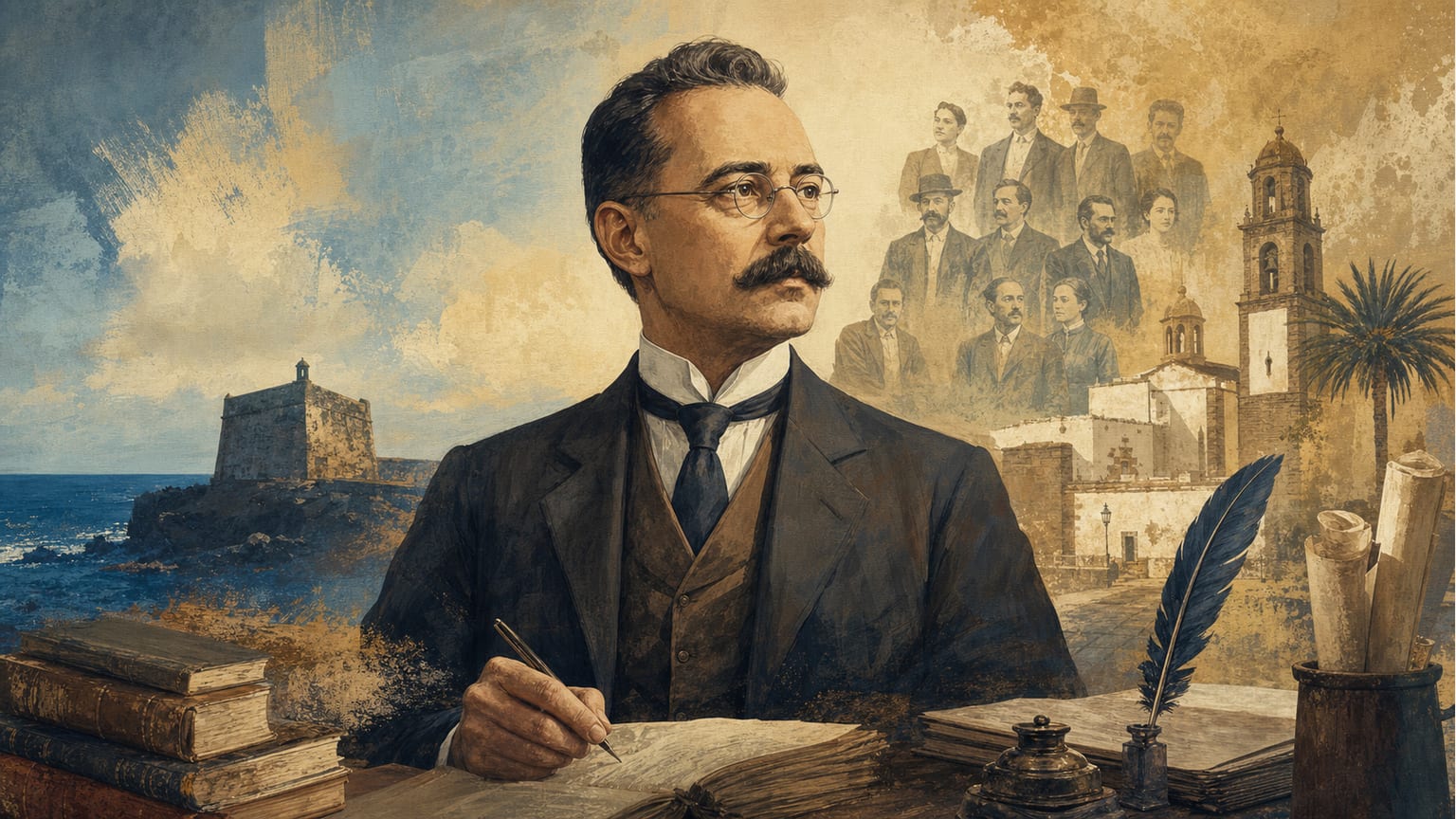
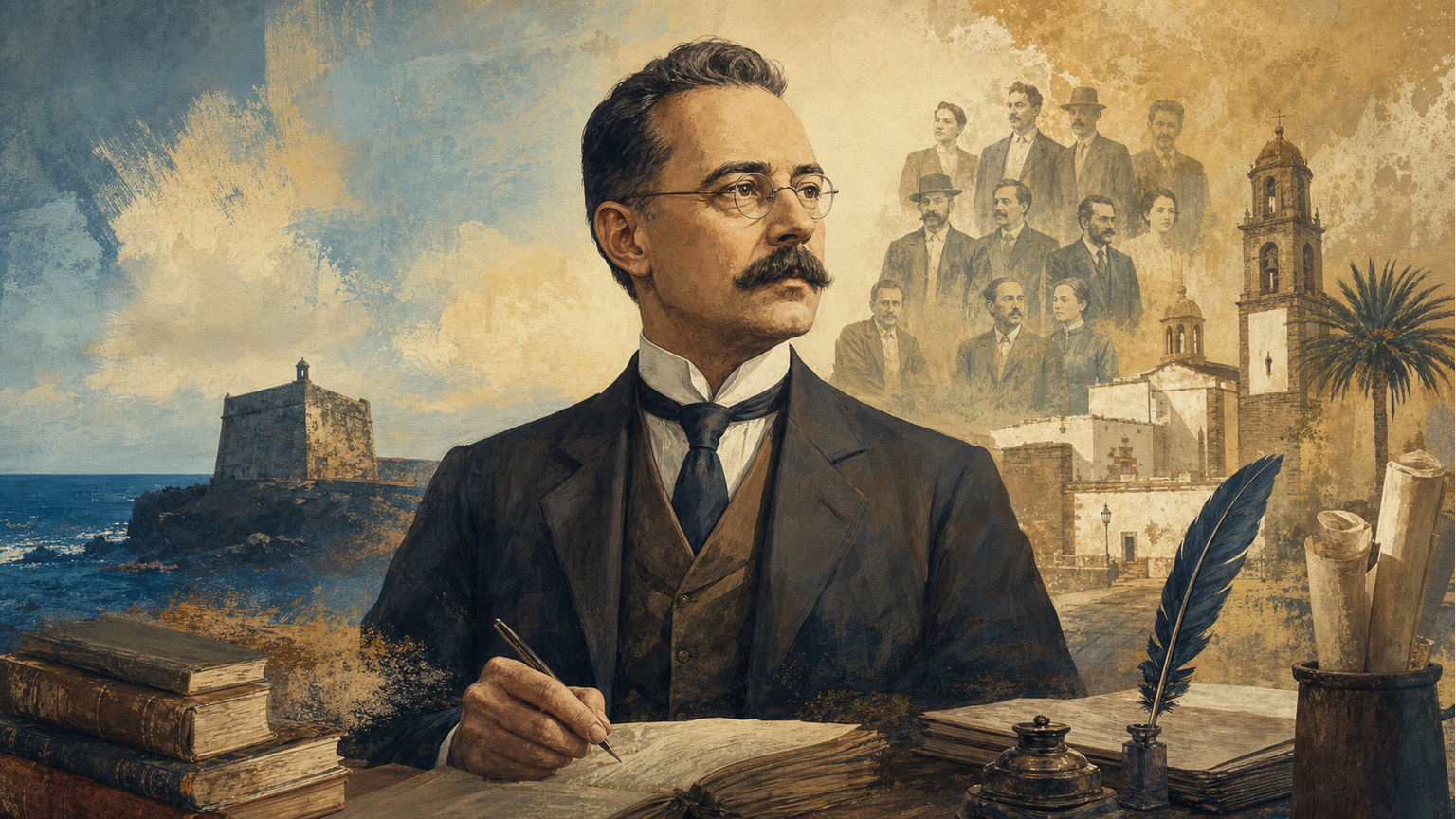
Francisco Fernández de Bethencourt is highlighted by Nicolás Reyes González as one of the Lanzarote-born figures who played a significant role in the contemporary history of the Canary Islands, especially during the transition from the 19th to the 20th century. His inclusion in Canarian historical memory is due to his valuable contributions to shaping Canarian identity and the development of what was then called “Canarian regionalism”[1].
In the selection of notable figures by Reyes González, Fernández de Bethencourt appears alongside other Lanzarote natives such as José Betancort Cabrera (Ángel Guerra), Manuel Déniz Caraballo, Benito Pérez Armas, Isaac Viera y Viera, and the Zerolo Herrera brothers. All were born in the 19th century and died in the 20th, either on the island or elsewhere, and were active participants in the political, cultural, and social life of the Canary Islands[1].
Fernández de Bethencourt stood out mainly as a genealogist, recognized for his research on Canarian lineages and families. According to the source, his work helped lay the theoretical foundations of Canarian regionalism, a movement that, in Reyes González’s words, is related to concepts such as nationalism, Africanism, federalism, autonomism, and republicanism[1].
Reyes González’s proposed methodology for recovering historical biographies emphasizes the importance of combining individual and group contributions from each island. In this context, Fernández de Bethencourt’s figure is presented as an example of the collective effort that can be made to rescue from oblivion those whose biographies have been manipulated or undervalued by the interests of insular oligarchies[1].
Fernández de Bethencourt’s work extended beyond genealogy to politics and culture. In most cases, according to the source, those who left a deep mark on Canarian collective memory excelled in these fields, and Fernández de Bethencourt is no exception[1].
Reyes González notes that some of these figures emigrated and, upon returning, enriched their islands with their contributions, while others, like Fernández de Bethencourt, maintained strong ties with Lanzarote and the Canary Islands, transferring cultural peculiarities abroad or incorporating new ones upon their return[1].
The recovery of figures such as Francisco Fernández de Bethencourt is, according to the source, essential to understanding the complex relationship between memory and history in the Canary Islands. His example illustrates how history can be an extension of collective memory, perpetuating the values and contents that have defined Canarian identity over time[1].