

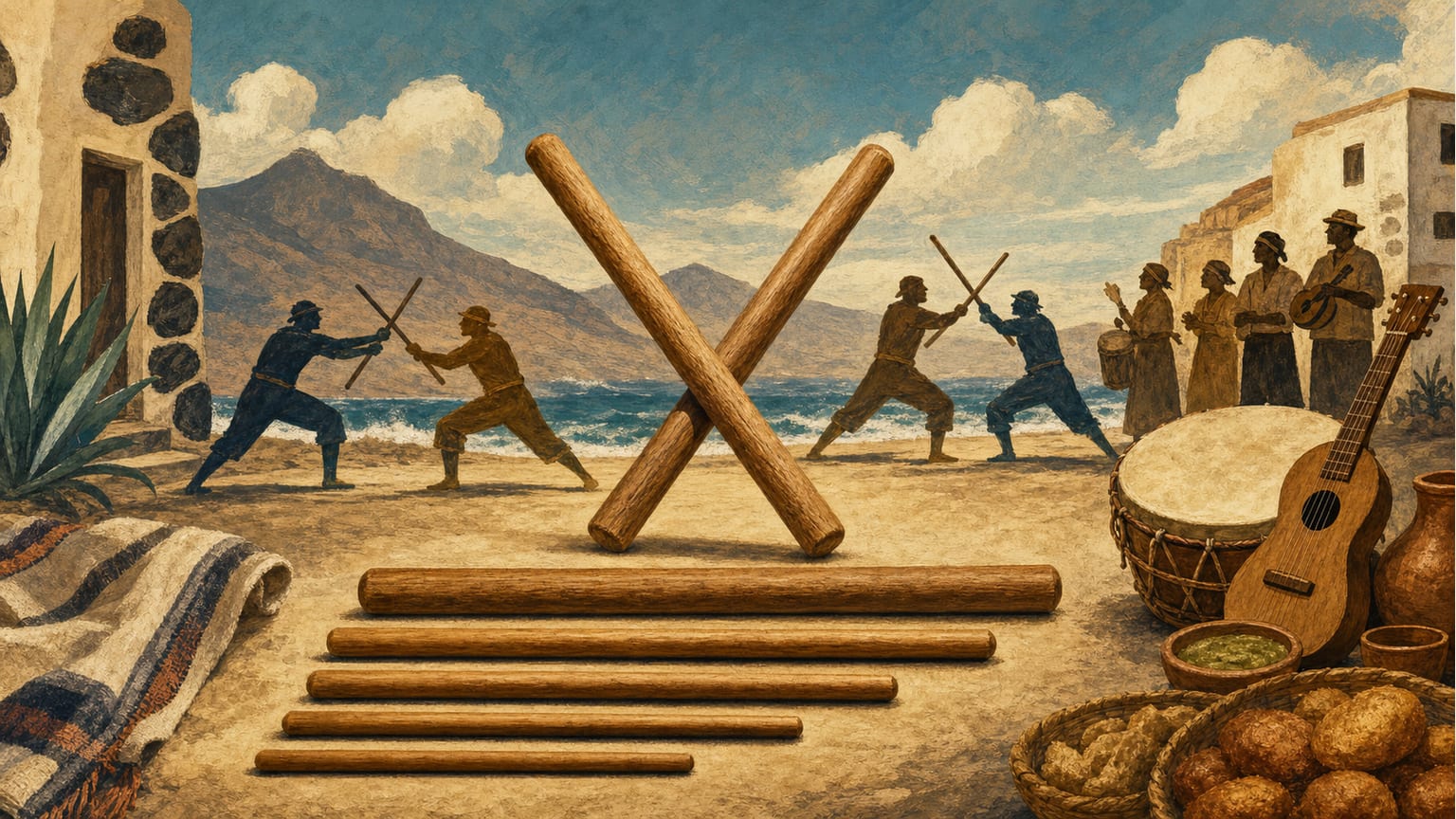
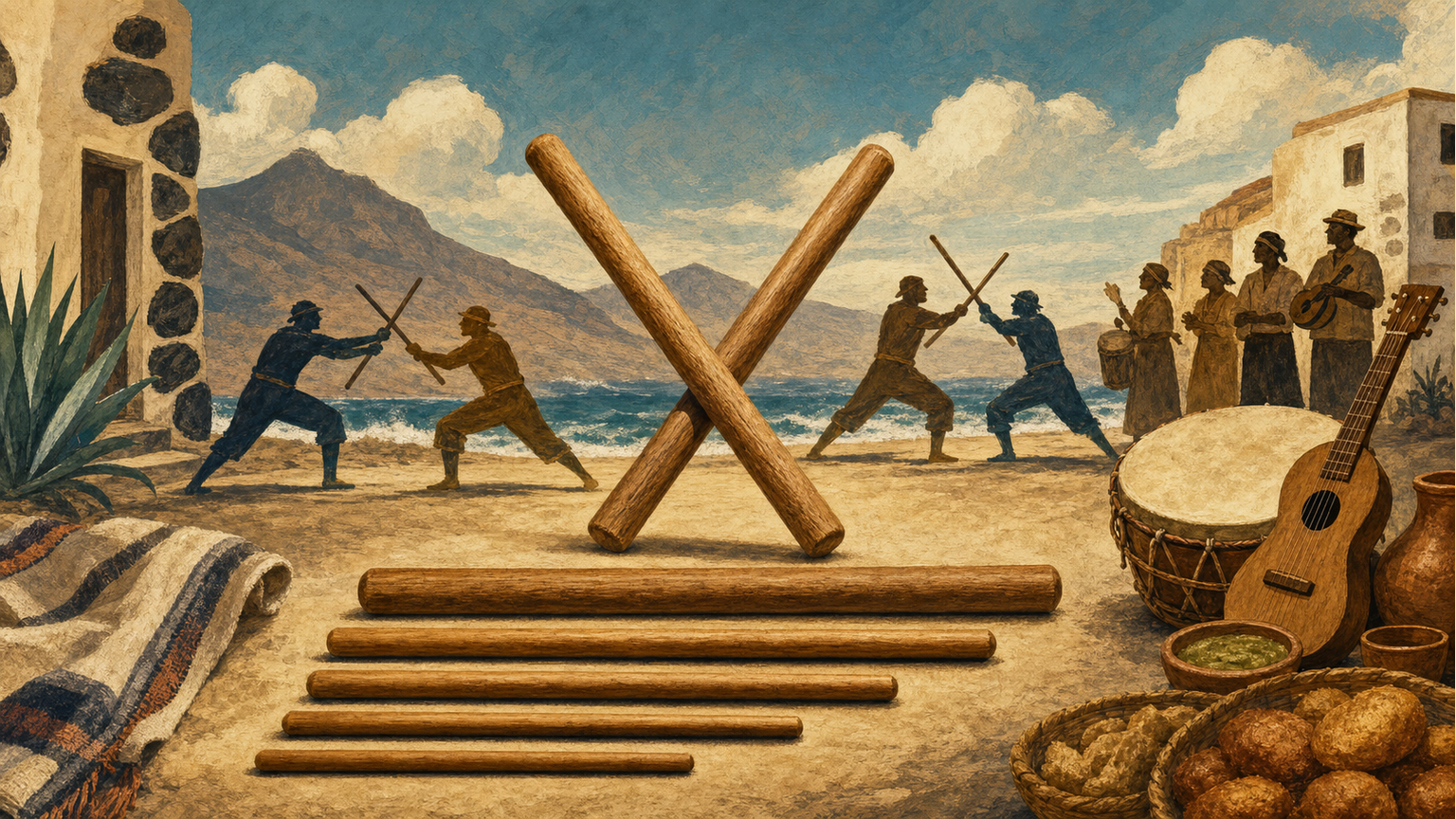
The Canarian Stick Game is a traditional activity involving simulated combat between two or more players, each wielding sticks of various sizes and applying codified techniques recognized by the participants [1]. According to the Centro Universitario del Palo Canario (C.U.P.C.), the game has its origins in the defensive and offensive practices of the indigenous populations of the Canary Islands, who also developed a playful aspect to stick use, as documented by historical chronicles [1].
Transmission of this knowledge has been uneven, often depending on the existence of traditional schools formed around the figure of a master recognized by other players [1]. The practice survived mainly among farmers and shepherds, who preserved and enriched it despite opposition from various institutions throughout Canarian history [1].
A key feature of the Canarian Stick Game is the distinction of modalities based on stick size. The C.U.P.C. identifies three main modalities: large stick (taller than a person), medium stick (not taller than the chin nor lower than the waist), and small stick (lower than the waist, generally the length of the arm) [1]. Each modality includes its own styles, defined by how the stick is held, defensive techniques, and the distance between players [1].
For the large stick modality, the traditional styles are Garrote and Lata, with established schools in Gran Canaria, Fuerteventura, Tenerife, and La Palma. The medium stick modality, known as vara, is the richest in variety, with seven recognized styles and schools in all islands except La Gomera [1]. The small stick modality, called macana, camel driver’s stick, or herdsman’s stick, did not maintain organized schools until recent times, although there is evidence of its practice in Tenerife, La Palma, and especially La Gomera [1].
The Asociación de Juego del Palo Canario (A.J.U.P.A.L.), founded in 1985, established two basic criteria for respecting tradition: lineage (learning from a traditional master) and tradition (maintaining the practice within traditional standards) [1]. According to this association, the officially recognized styles are, for large stick: Juego del Garrote and Juego de la Lata; and for medium stick: Déniz, Morales, Verga, Acosta, Quintero, Conejero, and Vidal [1].
The process of reviving and spreading the Canarian Stick Game in recent decades has focused on documenting the diversity of styles and the importance of both traditional schools and individual practitioners. The C.U.P.C. emphasizes the need for rigor in teaching and dissemination, respecting each style and avoiding the unification or invention of techniques lacking traditional foundation [1].