

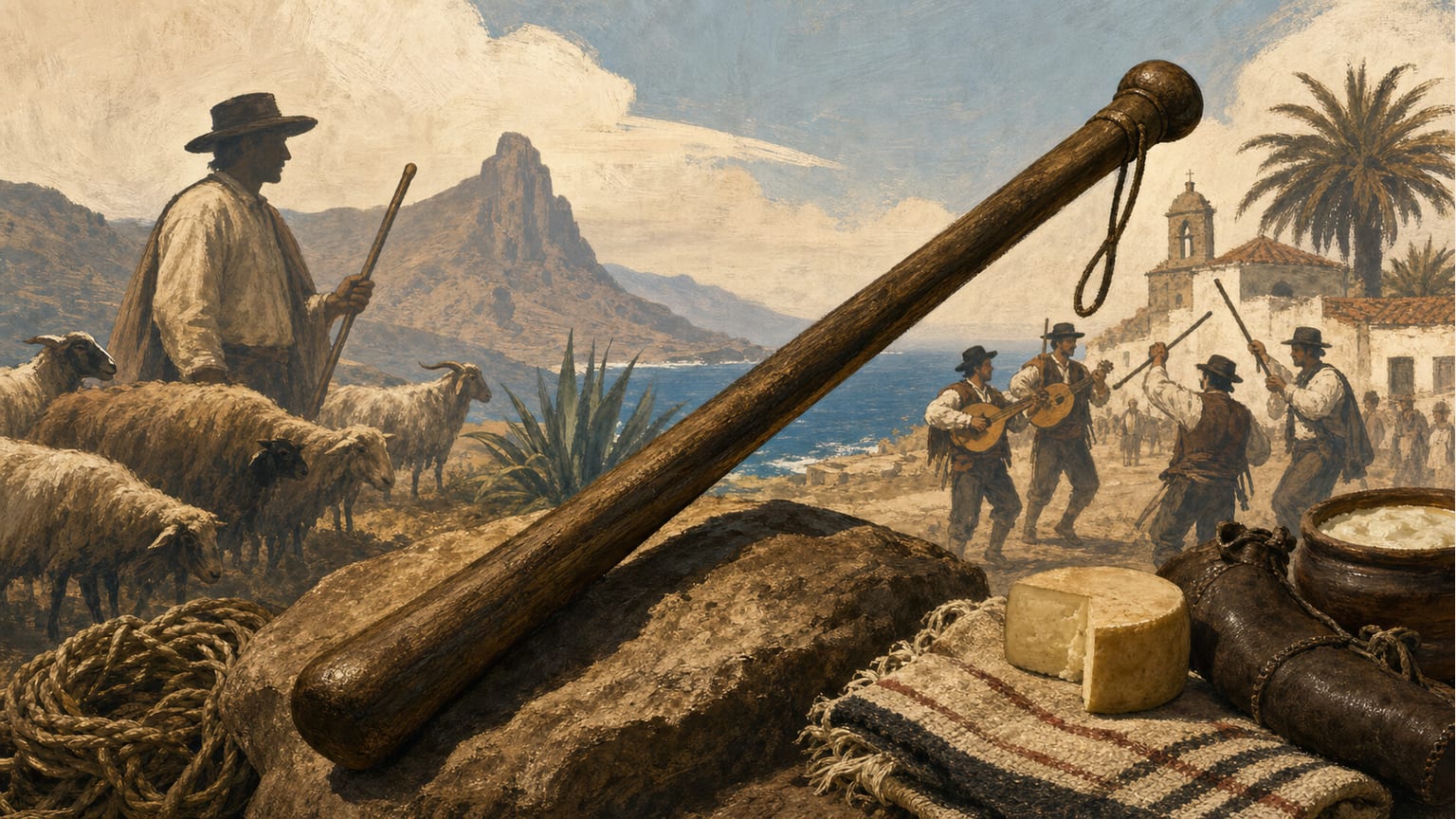
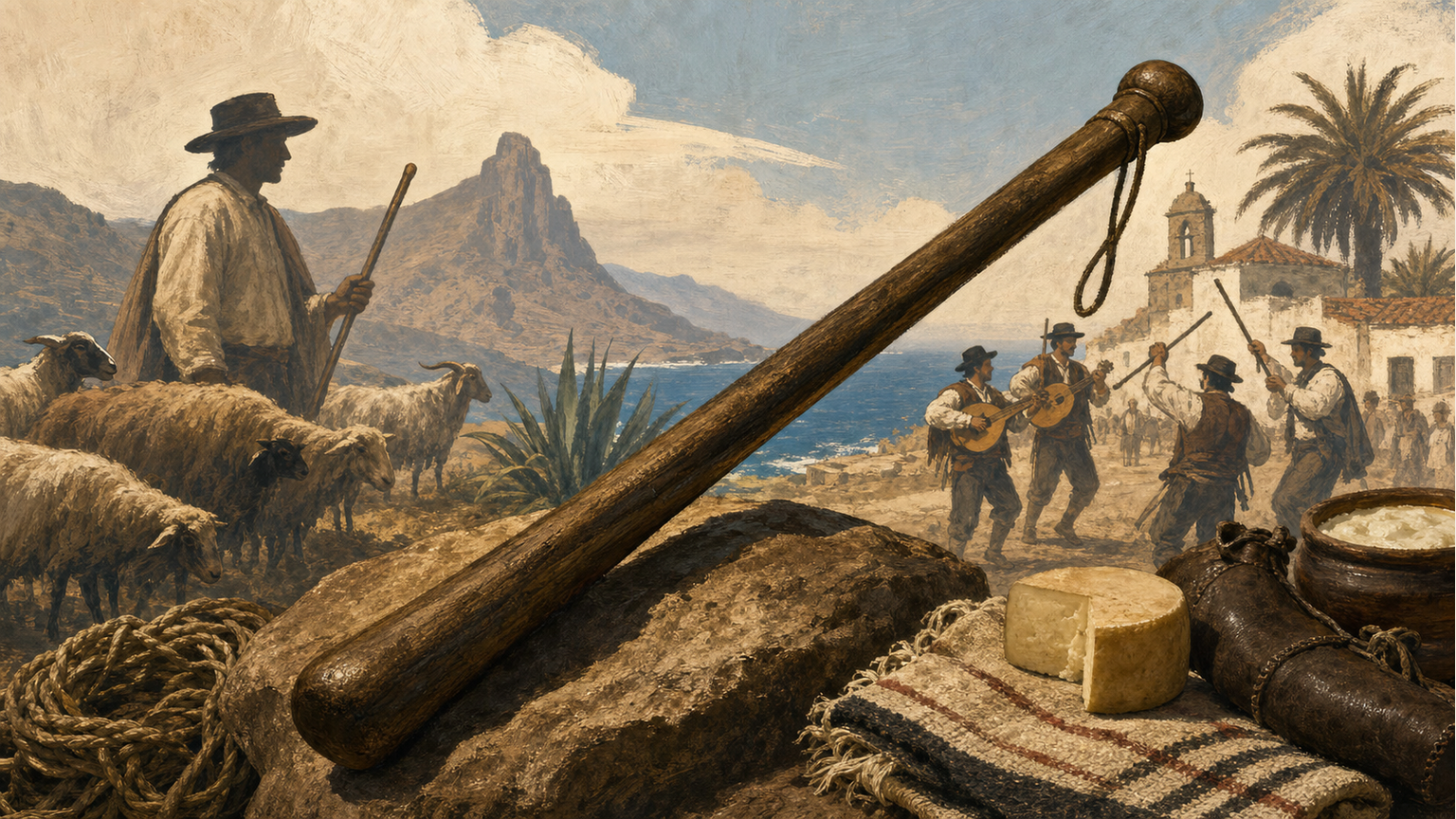
The connection between the staff (garrote) and pastoral life in Gran Canaria is a central theme in Domínguez Navarro’s study of the Lucha del Garrote. The author emphasizes that the staff was not only a weapon but also an indispensable tool for shepherds in their daily routines[1].
The source states: “In all eras, both yesterday and today, the staff along with the dog has been the inseparable companion of the shepherd during his long and solitary days. It goes with him everywhere, giving him security and confidence. It helps him control the livestock and overcome obstacles during his movements, being used as a work tool”[1].
Beyond its use as a tool, the staff was also employed as a weapon in conflicts between shepherds. Disputes over livestock, the defense of grazing lands, and constant vigilance led to frequent confrontations: “He also uses it as a weapon when, in his hard work and constant movement of livestock in search of fresh pastures, he has to compete with other shepherds. The continuous fights for this reason and for frequent livestock thefts, the unceasing vigilance of the flock, the anxious search for lost animals, and the tense defense of pasture, this continuous exercise in a healthy environment and diet, make the shepherd a strong person perfectly prepared for fighting”[1].
Thus, the staff became an essential element in an environment where resources were scarce and pastoral life demanded both physical and mental skills. The author notes that after the conquest and the prohibition of traditional weapons, the staff remained with shepherds under the pretext of being a work tool: “Once the island was conquered and pacified by the Castilians, the weapons of the ancient Canarians were prohibited and fell into disuse, but the shepherd could continue using the staff because he needed it as a work tool—that was the pretext! Shepherds have managed to maintain aboriginal traditions; their way of life and their method of defense, the Lucha del Garrote”[1].
Constant contact with the staff gave the shepherd special skill, developed over the years and tested in encounters with other shepherds, whether for personal disputes or as demonstrations of ability: “This close contact with the staff gives the man a skill in its handling that develops over the years as he has the chance to demonstrate it before other shepherds, either due to personal disputes or simply as a show of power through challenges or violent confrontations when used as a weapon; he also uses it to show his ingenuity to others, resulting in occasional competitions and displays of skill”[1].
Finally, Domínguez Navarro points out that the practice of using the staff, though relegated at times, remained alive in the memory and practice of shepherds, who preserved this tradition as part of their daily life and work in the countryside[1].