

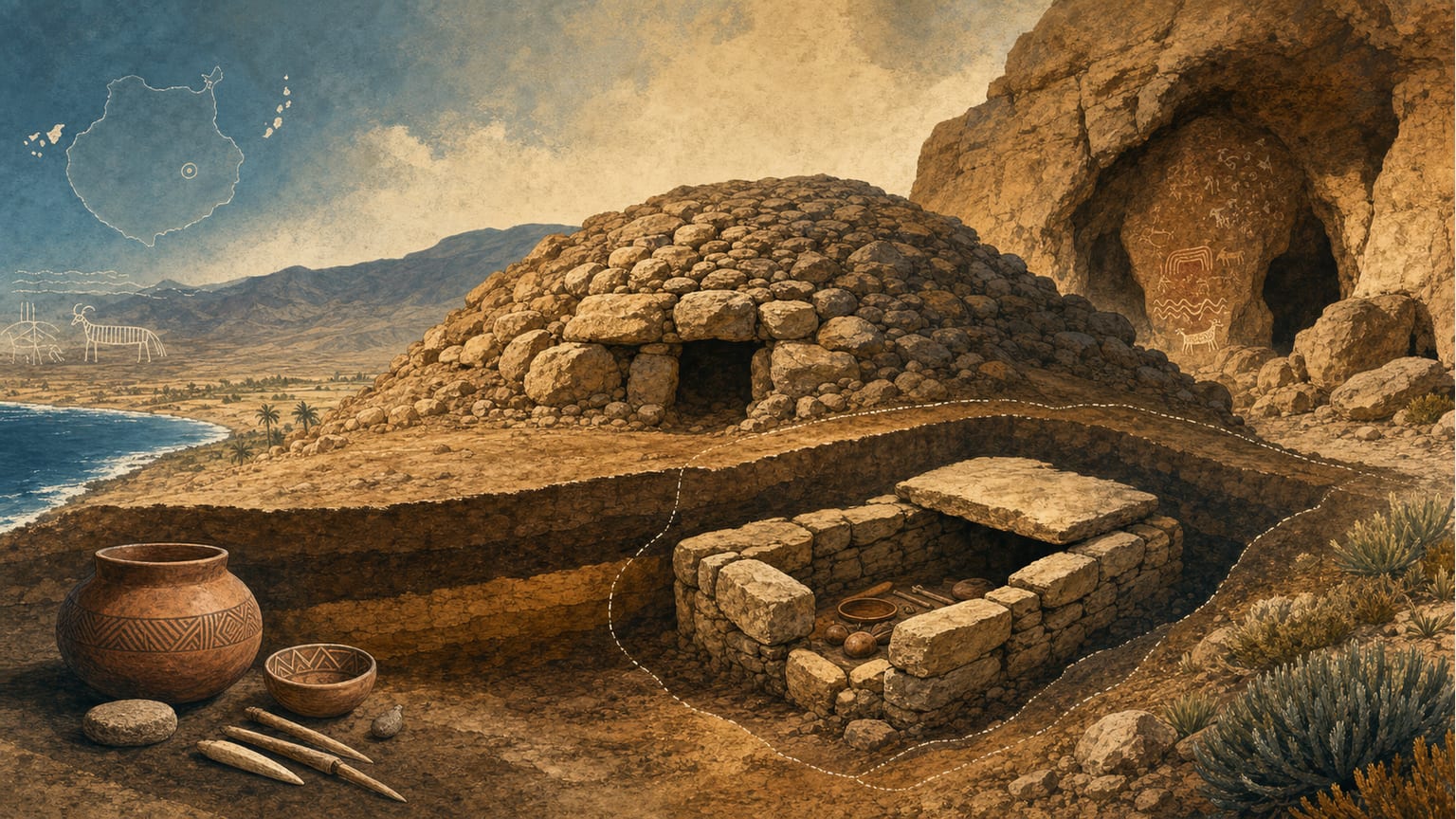
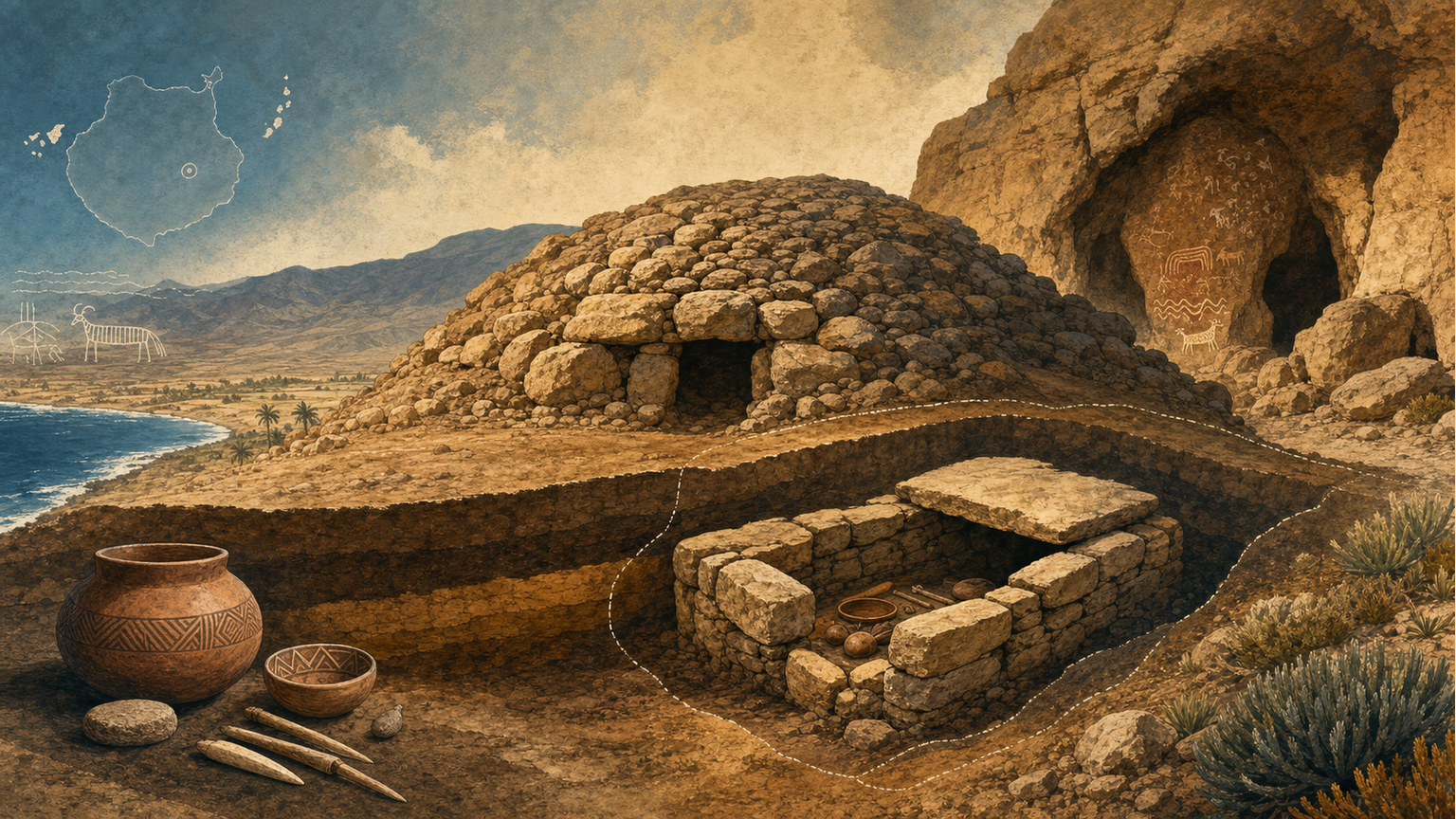
The Arteara Necropolis, located in the Fataga ravine on Gran Canaria, is the largest pre-Hispanic burial ground in the Canary Islands, with over eight hundred burials spread across more than 137,000 square meters[1]. This site stands out for the variety and complexity of its funerary structures, especially the tumuli and cists, which reflect the adaptation of ancient Canarian populations to the island’s volcanic and rocky environment[1].
According to Schlueter Caballero, Rosa, the tumuli at Arteara are generally simple in geometric design, with the truncated cone shape being the most common. The base completely surrounds the perimeter of the cist, above which oval rings of stones are stacked in several rows, gradually reducing in diameter to form the characteristic shape[1]. The cist, the core of the burial, is defined by stones driven vertically into the ground, forming a nearly rectangular receptacle, narrower at the base than at the head. In some cases, the cist walls are built using horizontal rows of stones, similar to masonry[1].
The covering system of the cists is one of the least well-preserved aspects, although some graves retain part of the original cover. This was made of rough, irregular stones placed transversely across the burial and supported by the cist’s side walls[1]. The cist floor was prepared in a rudimentary way, using gravel or small stones, which sometimes forced the body to be placed in positions adapted to the uneven terrain[1].
The inventory conducted by the author analyzed 245 cists, noting that most tumuli have variable orientation, although a tendency towards the north is observed in some cases. The orientation percentages of the catalogued tumuli are: north/south 34.8%, northeast/southwest 25.5%, northwest/southeast 22.7%, and east/west 16.9%[1].
In terms of morphology, 75.6% of the tumuli are truncated cones, followed by rectangular (7.8%), embedded (4.8%), mixed (3.5%), conical (0.5%), trapezoidal (0.3%), spherical cap (4.8%), cylindrical (2.1%), and irregular (0.3%) shapes. In plan, oval forms predominate (61.2%), followed by circular (12.6%) and mixed (11.5%) shapes[1].
The spatial distribution of the tumuli responds to the irregular topography, with three main clusters: one on a central crest, another in a northern/northeastern hollow, and the rest scattered on slopes and inclines[1]. The state of preservation is uneven: of the 809 tumuli recorded, only 74% have a clear typology, while the remaining 26% are unclassifiable due to deterioration[1].
The Arteara Necropolis is an exceptional testimony to the funerary architecture of the ancient Canarian populations, showing remarkable adaptation to the environment and a typological diversity that continues to be the subject of archaeological study[1].