

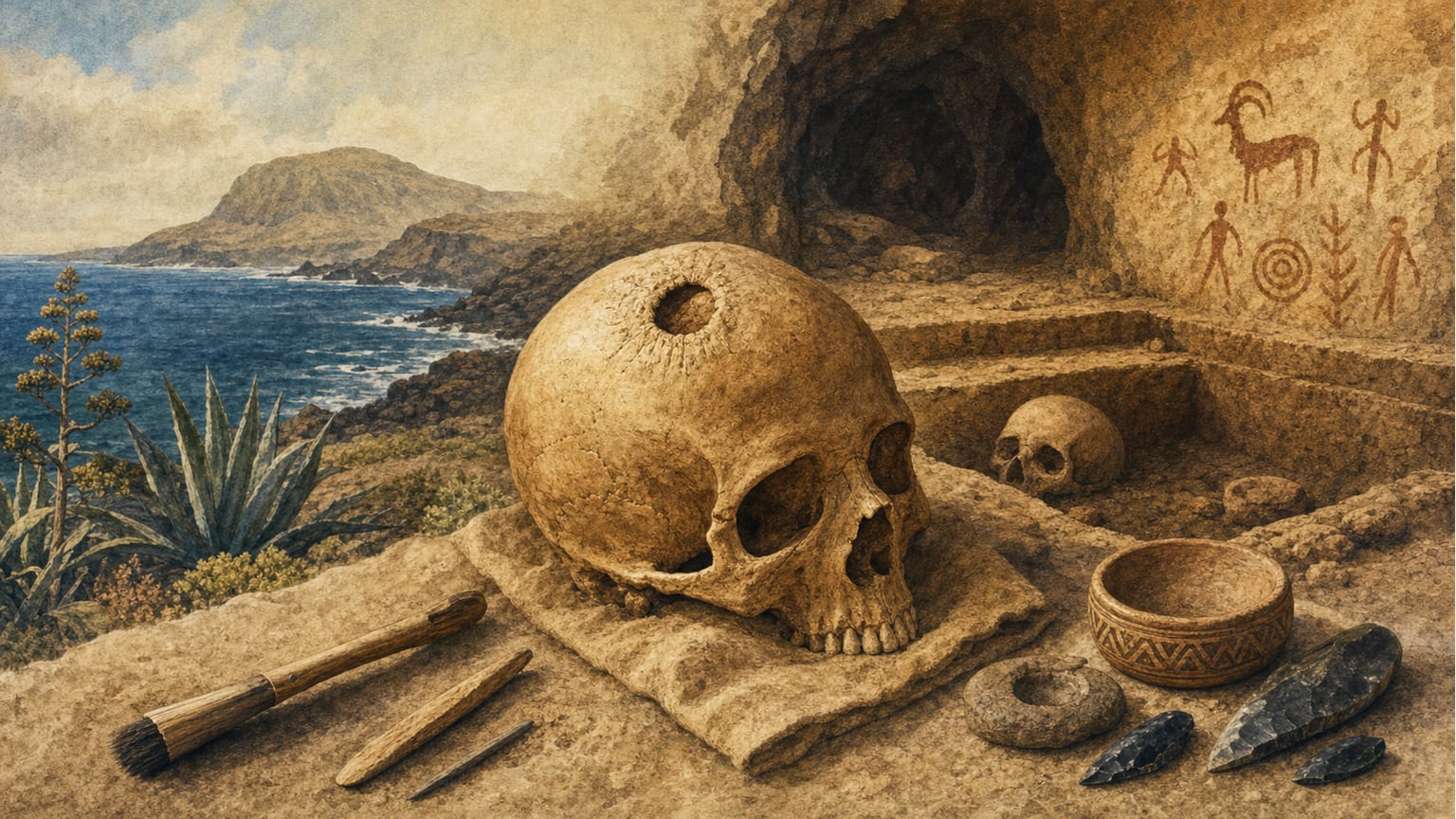
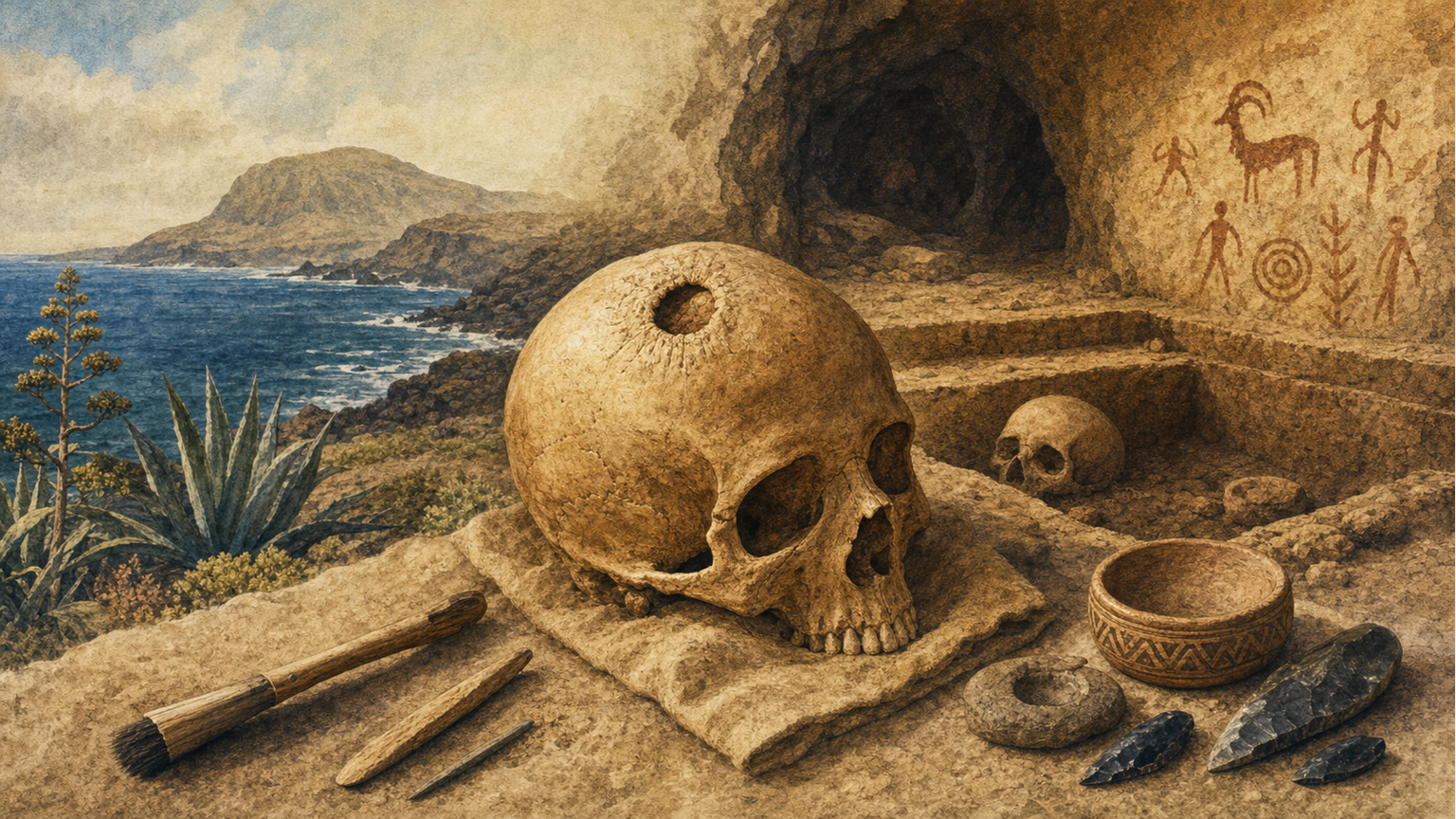
Bregmatic cauterization is one of the most distinctive cranial practices documented in the skeletal remains of the indigenous populations of the Canary Islands. According to the research compiled by Rafael González Antón (director) and various authors in Eres (Arqueología), this intervention was first systematically identified and described by German researchers Felix von Luschan and Robert Lehmann-Nitsche in the late 19th and early 20th centuries [1].
In his 1896 study, Luschan analyzed a collection of 52 Guanche skulls from Tenerife, of which only 20 were free from well-healed wounds. Among his findings, he described three clear cases of pre-Hispanic trepanation, but also identified several scars in the bregmatic region, which he considered the result of surgical interventions. Later research, such as that of Lehmann-Nitsche, allowed these lesions to be classified as bregmatic, parabregmatic, and T-shaped cauterizations, comparing them to Neolithic European cases [1].
The characteristics of bregmatic cauterization in the Canary Islands, according to these authors, include greater frequency in adults, similar distribution between sexes, oval-shaped scars, complete healing in most cases, preservation of cranial sutures, and absence of signs of infection. These observations have been confirmed by more recent studies, such as those by Rodríguez Martín and Gutiérrez González in the 1980s [1].
The importance of these findings lies in the fact that bregmatic cauterization not only demonstrates the existence of rudimentary medical knowledge among the ancient Canarians, but also allows inferences about their social and cultural life. The presence of healed scars suggests that individuals survived the intervention, implying a certain degree of skill in performing the practice and possibly empirical knowledge of healing techniques [1].
In the context of paleopathology, the description of these lesions has been fundamental in distinguishing between surgical interventions and accidental trauma. Bregmatic cauterization is distinguished by its location, morphology, and the healing process observed in the skeletal remains. Furthermore, comparison with similar practices in other prehistoric cultures has enriched the debate on the diffusion and origin of these techniques in the Atlantic and Mediterranean regions [1].
Despite the abundance of archaeological material in the Canary Islands, for a long time researchers focused on physical anthropology and raciology, relegating paleopathology to a secondary role. However, the work of von Luschan, Lehmann-Nitsche, and other foreign authors helped to rescue and highlight the study of diseases and medical practices in the island’s past [1].
In conclusion, bregmatic cauterization is tangible evidence of the cultural and medical complexity of the indigenous populations of the Canary Islands. Its study has advanced the knowledge of island paleopathology and underscores the importance of international collaboration in archaeological research [1].