

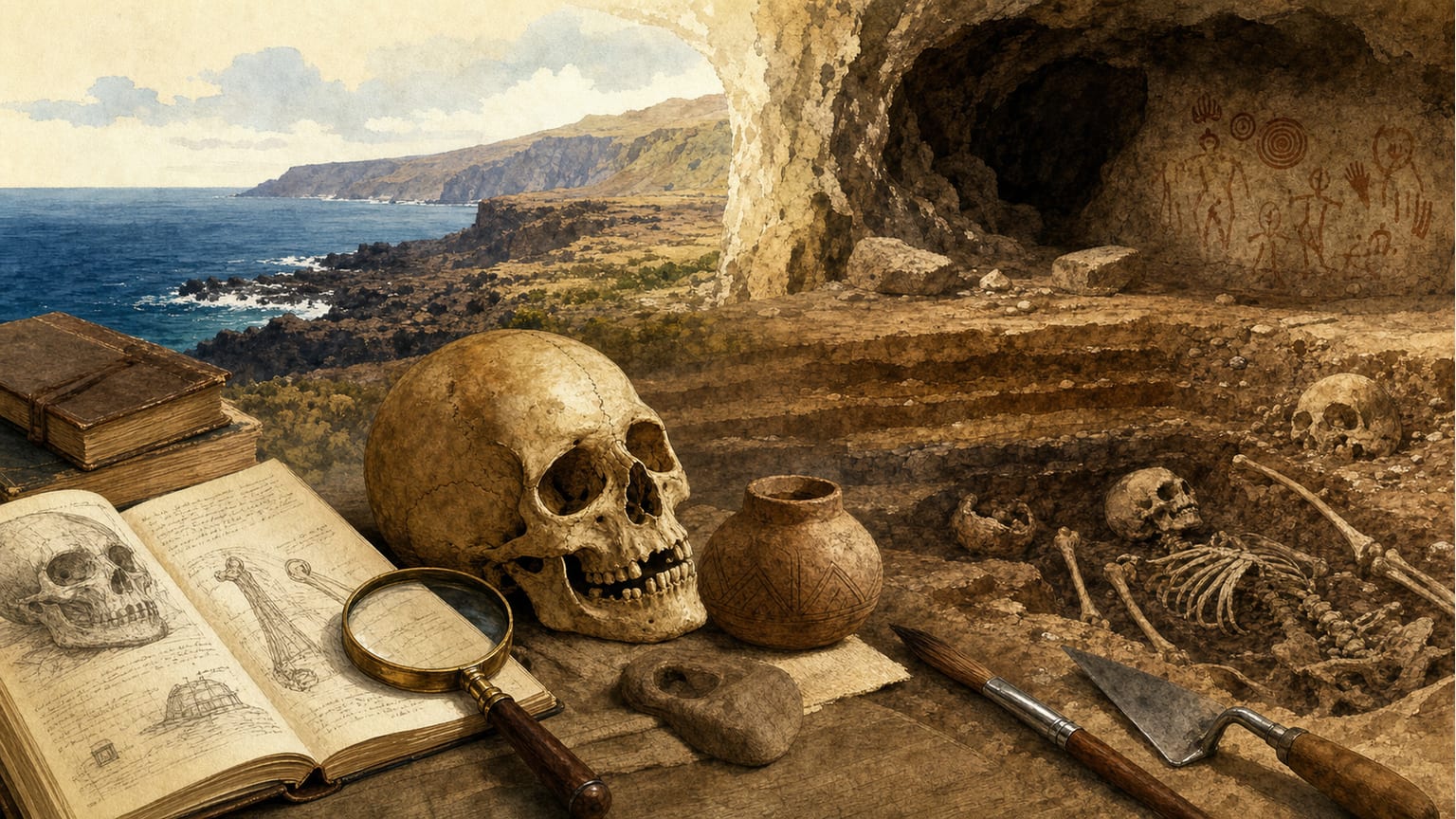
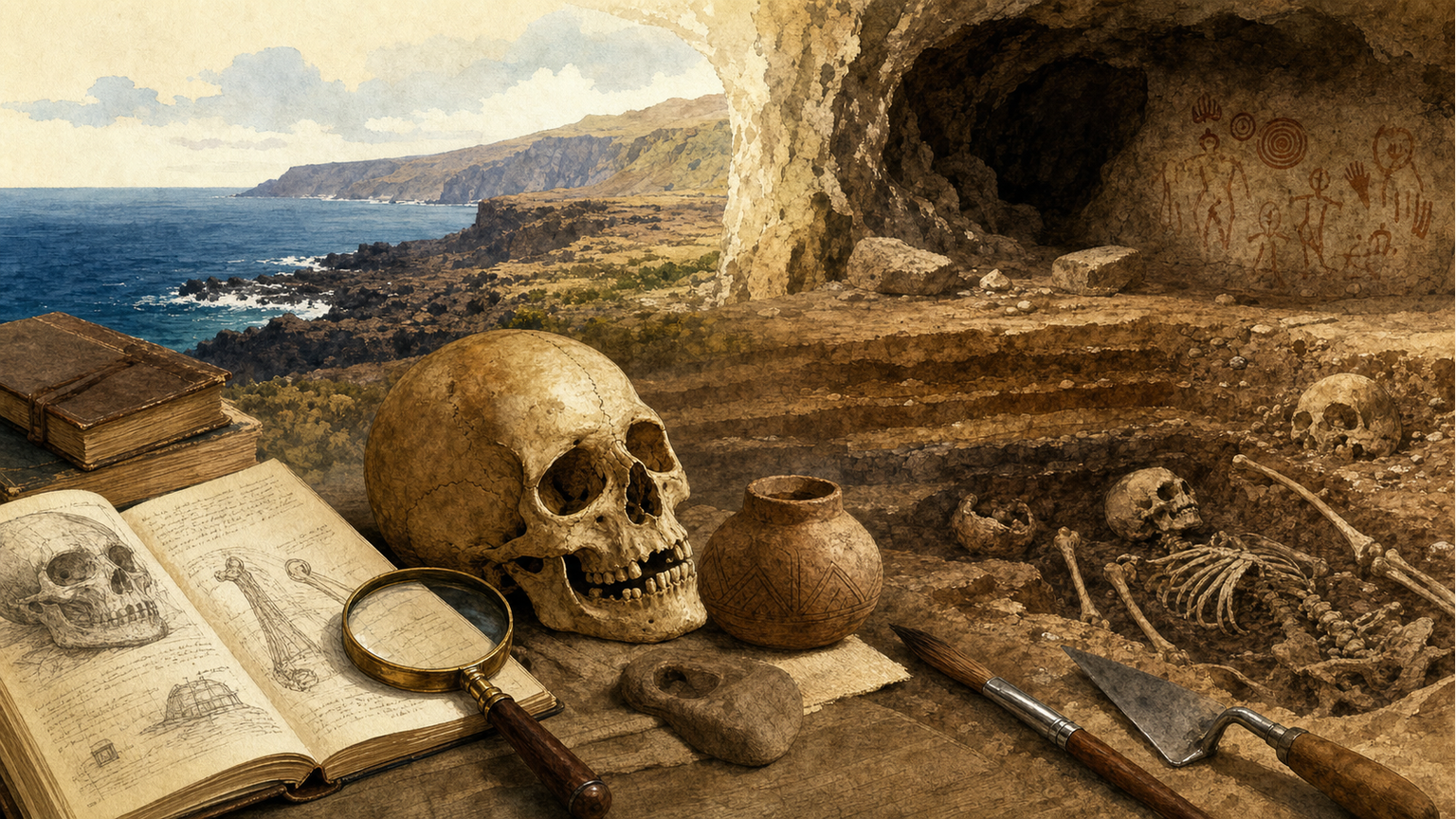
Paleopathology, the discipline that studies diseases in ancient human remains, developed late and in a unique way in the Canary Islands, according to the source directed by Rafael González Antón and various authors. For centuries, researchers mainly focused on physical anthropology and raciology, leaving the study of disease in indigenous populations in the background[1].
In the archipelago, the earliest references to disease among the aboriginal people appear in written sources, such as the chronicles of Espinosa, Torriani, and Abreu Galindo, but always indirectly and without direct observation of remains[1]. In the 18th century, José de Viera y Clavijo dedicated a chapter in his “Noticias de la Historia General de las Islas Canarias” to embalming and burials, providing data on the position of bodies and the possible existence of specialists in mummification, although the source notes that evisceration was not a common practice in Canarian mummies[1].
According to Diego Cuscoy and Rodríguez Martín, as cited in the source, the true beginning of paleopathology in the Canary Islands can be traced to the physician Gregorio Chil y Naranjo (1831-1901). Chil made the first systematic contributions to the study of diseases in aboriginal remains, although his work mainly focused on the prehistory and physical anthropology of the archipelago[1]. In his work “Estudios Históricos, Climatológicos y Patológicos de las Islas Canarias” (1876-1891), Chil addressed issues such as the sexual division of medical labor, the use of plant and animal products in therapy, and mummification, denying the practice of evisceration and the introduction of preservatives into bodies[1].
Chil also published specific works on pathology, such as “Anatomía Patológica de los aborígenes canarios” (1900), where he described fractures, immobilization techniques, and cases of tumors, abscesses, and rheumatic disorders. Notably, he described an osteosarcoma in a woman’s jaw, considered the first documented case in Canarian historiography[1].
At the end of the 19th and beginning of the 20th century, European scientists such as René Verneau, Felix von Luschan, Robert Lehmann-Nitsche, and Detloff von Behr made significant contributions from foreign institutions that possessed Canarian remains. Verneau, although focused on physical anthropology, mentioned cases of hydrocephalus, cranial trauma, and bone lesions, and organized the Physical Anthropology Section of the Museo Canario[1]. Luschan was the first to describe cases of pre-Hispanic trepanation in Tenerife and bregmatic lesions, while Lehmann-Nitsche classified the types of cranial cauterization present in the Canaries[1]. Behr, meanwhile, made the first paleopathological description of aboriginal dentitions, noting a high incidence of caries and abscesses[1].
According to the source, these pioneering works laid the foundation for the later development of paleopathology in the Canary Islands, although for a long time, observations on disease were considered mere curiosities within broader raciological and osteometric studies[1].