Luis de la Cerda
Pre-HispanicHistory13th CenturyPrince of Fortuna

Prince of Fortuna and Franco-Castilian nobleman

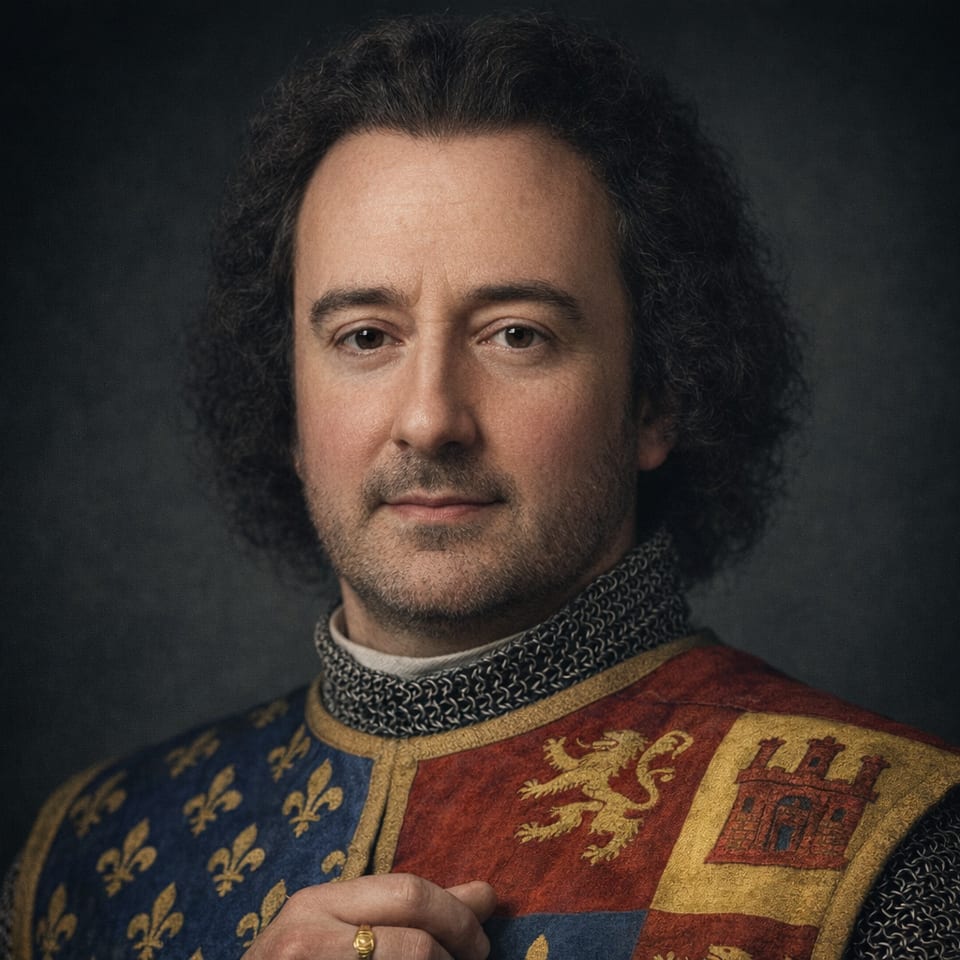
Franco-Castilian prince, great-grandson of Alfonso X of Castile, who built his career in France as count of Talmont and Clermont and admiral of France. In 1344 Pope Clement VI granted him the Fortunate Isles with the title Prince of Fortuna; the venture failed and he never travelled to or governed the Canaries. He died in 1348.

Early life

Luis de la Cerda, also known as Luis de España, was born around 1291 in France. He was the son of Alfonso de la Cerda, called "the Disinherited", and the paternal grandson of Fernando de la Cerda, eldest son of King Alfonso X of Castile, from whom his uncle Sancho IV seized the crown. He therefore belonged to a dispossessed but royal branch, doubly tied to the great monarchies of Christendom: he descended from Alfonso X through his father and, through his grandmother Blanche of France, from King Louis IX of France. His mother was Matilde de Brienne.

Historical role

His career unfolded in the service of the French monarchy. King Philip VI granted him the county of Talmont and the island of Oléron in 1339 and made him count of Clermont; on 13 March 1341 he appointed him admiral of France, in place of Hugues Quiéret, killed in the naval disaster of Sluys against the English. He left the office before the year was out but kept fighting in the early years of the Hundred Years' War: the chronicles of Jean le Bel and Froissart remember him among the French captains, and his troops besieged and sacked Guérande in 1342. In 1306 he had married Leonor Pérez de Guzmán in Seville, daughter of Alonso Pérez de Guzmán, with whom he had several children.

In 1344 Luis de la Cerda turned his ambition toward the Atlantic. On 15 November of that year Pope Clement VI, with the bull Tuae devotionis sinceritas, granted him the Canary or Fortunate Isles as a perpetual fief of the Holy See and bestowed on him the title Prince of Fortuna, in exchange for an annual tribute of four hundred gold florins and liege homage to the pontiff; the grant included indulgences for those who would take part in the enterprise. Petrarch describes the investiture ceremony in his work De vita solitaria. The donation provoked immediate reactions: King Afonso IV of Portugal protested to the pope in February 1345, and King Alfonso XI of Castile was quick to state his position. The venture, however, never took shape: the fleet's preparations advanced with difficulty, and Luis de la Cerda never travelled to the islands nor exercised any government over them.

Legacy

Luis de la Cerda drew up his will on 30 June 1348 and died the following 5 July at Lamotte-du-Rhône. With him the Principality of Fortuna came to nothing. His importance for the history of the Canaries is diplomatic and juridical, not effective: the bull of 1344 stands as one of the first formal European claims of sovereignty over the archipelago, promoted from the Avignon papacy almost sixty years before the Norman conquest of 1402, and it anticipates the arguments by which medieval Christendom legitimised expansion over the lands of "infidels".

Timeline

  1. c. 1291He is born in France, son of Alfonso de la Cerda, "the Disinherited", great-grandson of Alfonso X of Castile.
  2. 1341March 13, 1341Philip VI of France appoints him admiral of France, replacing Hugues Quiéret, killed at Sluys.
  3. 1344November 15, 1344Clement VI grants him the Fortunate Isles as a perpetual fief of the Holy See and invests him as Prince of Fortuna with the bull Tuae devotionis sinceritas.
  4. 1345Afonso IV of Portugal protests to the pope over the grant; Alfonso XI of Castile also states his position.
  5. 1348July 5, 1348He draws up his will on 30 June and dies on 5 July at Lamotte-du-Rhône, having never travelled to the Canaries.

Sources and verification