

The dragon tree in the classroom: how Canarian environmental education taught its symbol tree
The dragon tree has not only been studied as a plant; it has also served as teaching material. The Libro Vivo de la Educación Ambiental en Canarias (2004), by José Julio Cabrera Mujica, devoted its opening chapter to the species and turned it into a working unit with concrete activities for the classroom and the field[1].
A manual that had to choose its symbols
The book did not pick its contents at random. The authors explain that they decided to devote fifteen chapters to each thematic area, and that the need to add two more on environmental problems forced them to give up the same number of flora chapters[1].
To select the flora and fauna chapters they applied three criteria: the bibliographic support available, the possibility of audiovisual treatment, and the sixteen botanical and zoological symbols of the archipelago. Of those sixteen they could only use ten — Canary pine, savin, palm, dragon tree, cardón, tabaiba, canary, janieo, houbara and lizard — weighing above all the teaching possibilities and the relative importance of the ones chosen[1].
Those left out did not disappear entirely: the Jandía cardón was covered alongside the cardón, the viñátigo within the laurel forest, and the presa canario could be included with the introduced animals. The chough, the blue chaffinch and the laurel pigeon had to be set aside in favour of another group of animals that the authors judged more poorly represented in the whole. Within that distribution, the dragon tree and the savin stood as representatives of the thermophilous woodland[1].
The dragon as a way in
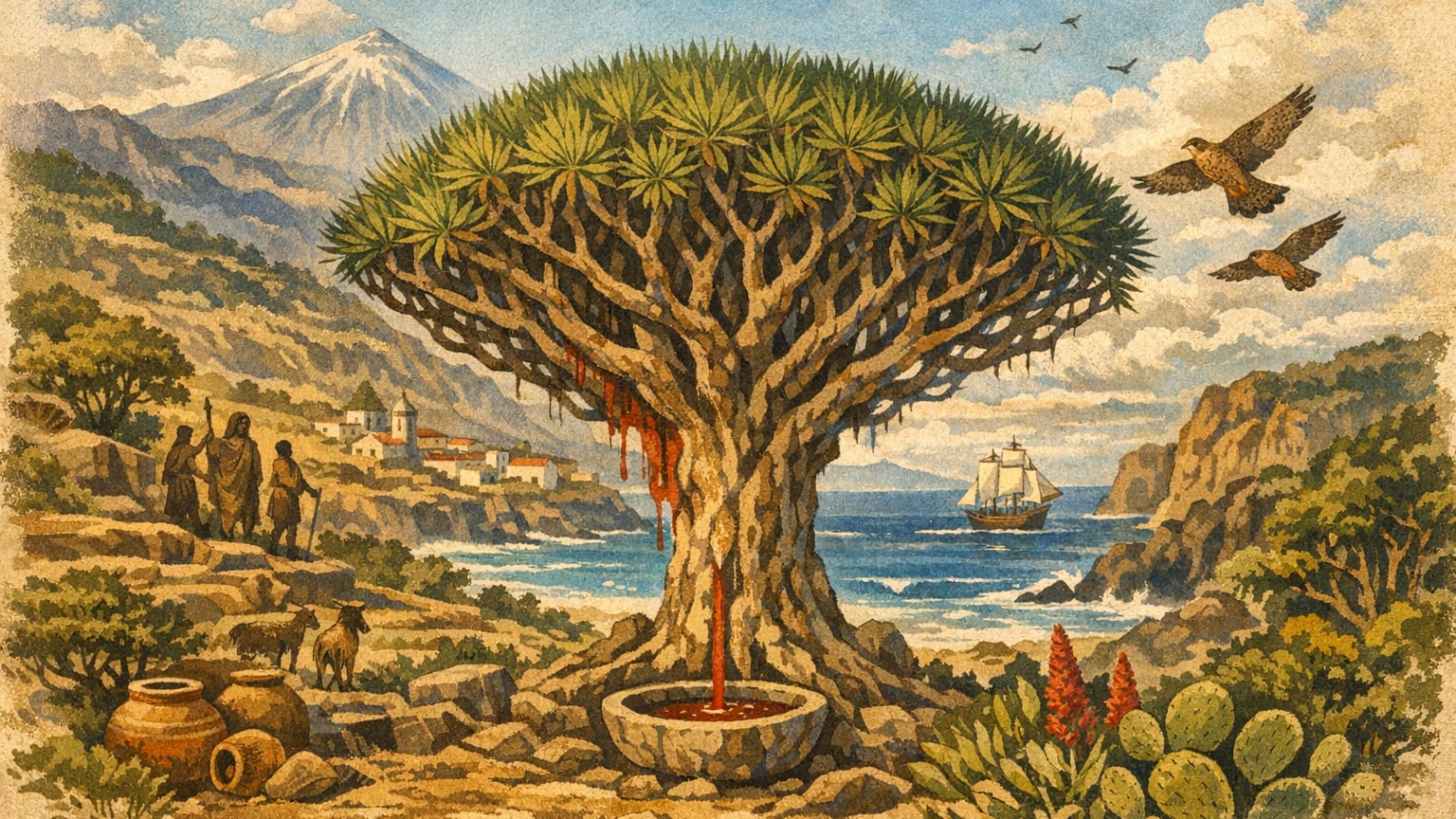
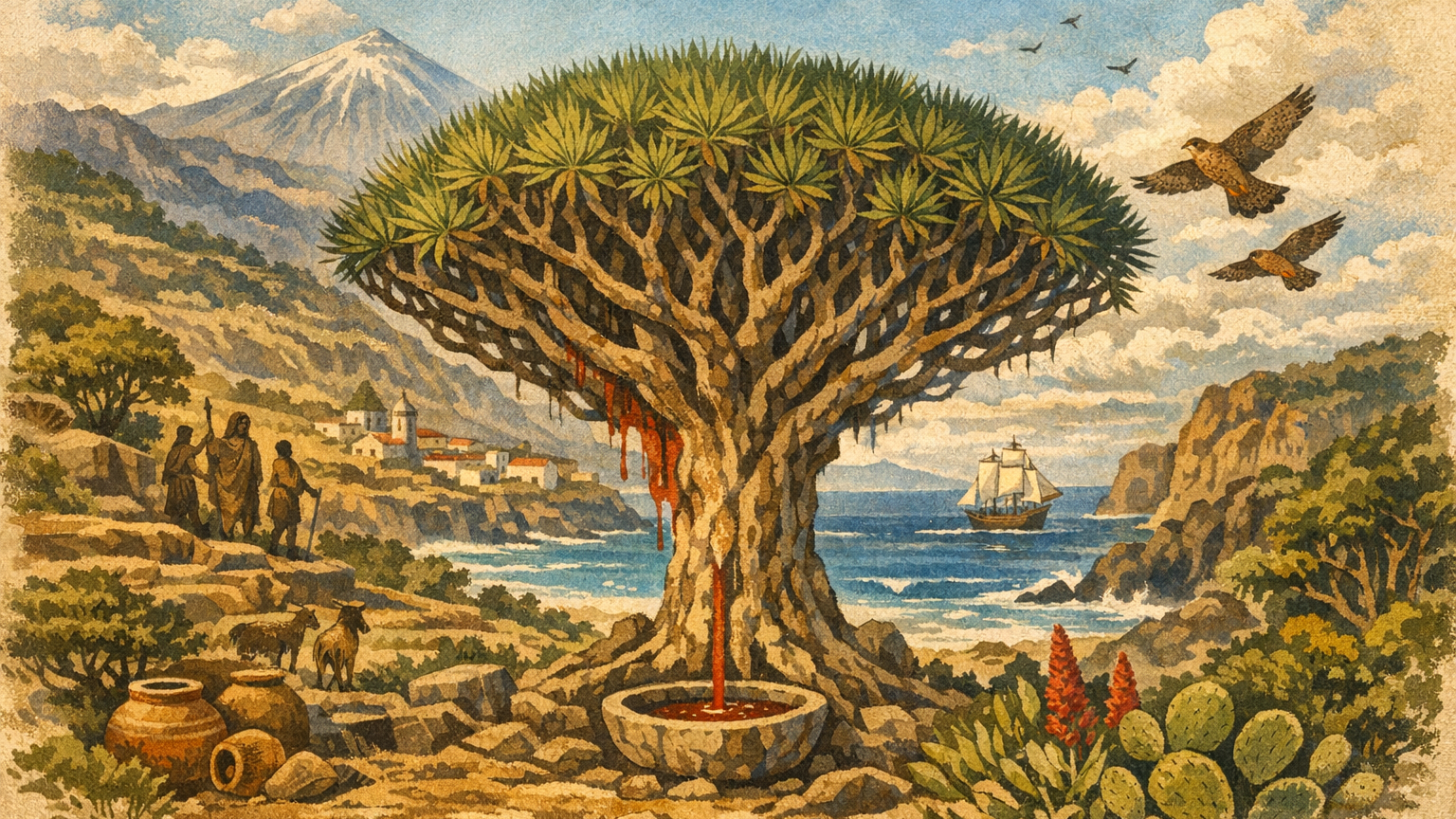
The chapter illustration carries an explicit pedagogical intent. According to the text itself, the drawing leans on mythology by using the parallels between the dragon tree (Dracaena draco) and the dragon of myth as a teaching resource. The authors note that its simplicity of line makes it better suited to younger pupils, while warning that this aspect is in no case decisive[1].
Into the field, the garden and the place names
The proposed activities turn the dragon tree into an object of direct observation. Pupils are asked to visit areas holding wild dragon trees or whose place names are associated with them and, failing that, parks and gardens containing them; to grow the plant from the seedbed until the moment of its replanting while keeping a diary of incidents; and to inventory specimens in the field in order to draw up a distribution map[1].
Other tasks point to data pupils must quantify themselves: finding out at what age garden specimens branch, counting how many gardens host them, and observing whether those gardens stand near or far from houses and buildings and whether roots or branches come to affect them. Pupils are also asked to inventory the nests the tree holds, indicating which species they belong to, and to check whether its fruit is edible, describing the experience[1].
A dragon tree in The Garden of Earthly Delights
The chapter closes with two exercises that step outside botany. One asks pupils to write a tale about the dragon tree gathering the mythological sources of its scientific name. The other points to Bosch’s The Garden of Earthly Delights, where a dragon tree is depicted: pupils are to find it in the painting, show it to their classmates, and try to explain its presence there in light of when the work was painted and how little was known about the Canary Islands at the time[1].
The chapter also rests on specialist botanical literature, with works by Bramwell, Kunkel, Oliva and Viera among the references cited for the dragon tree[1].