

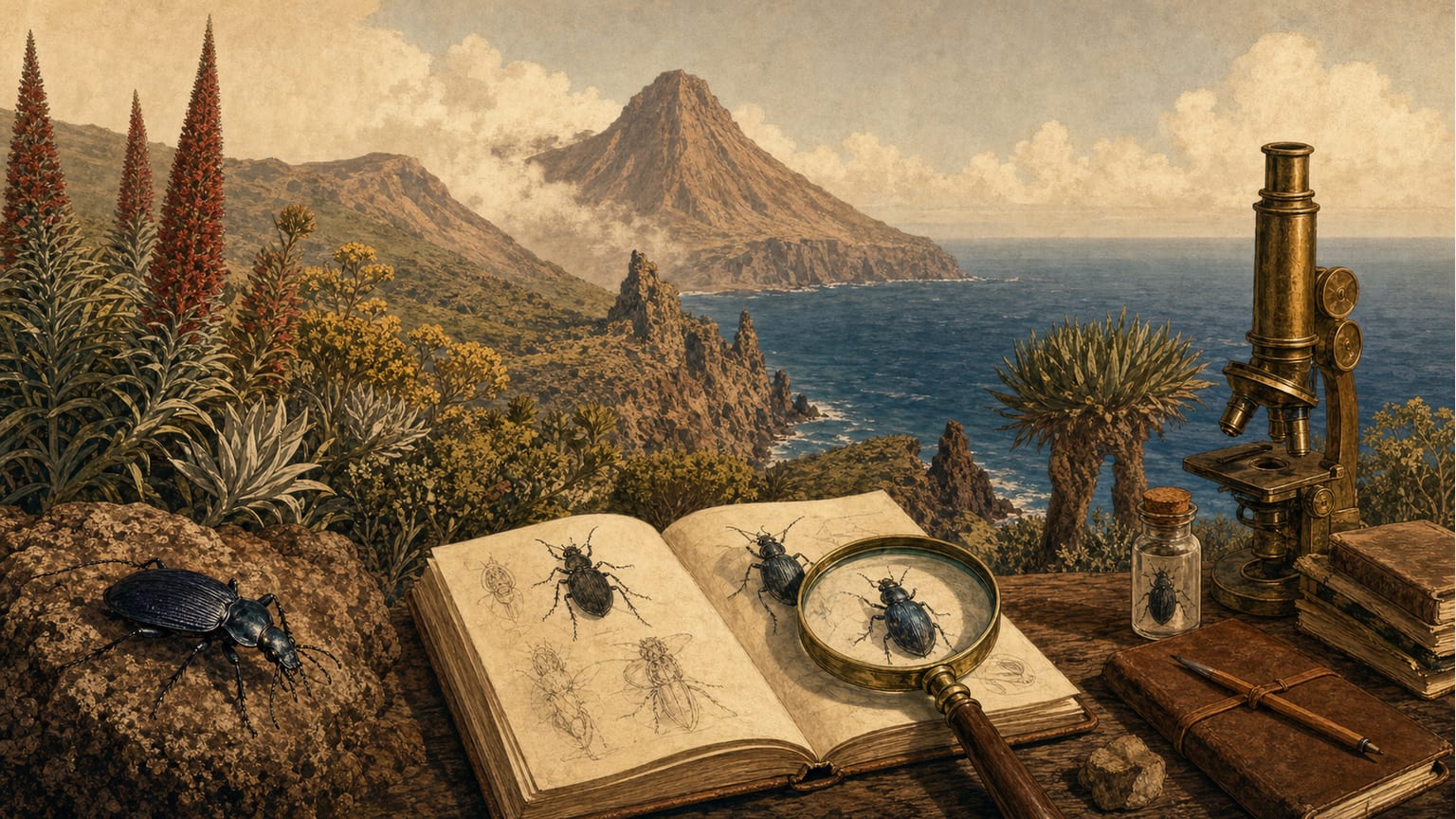
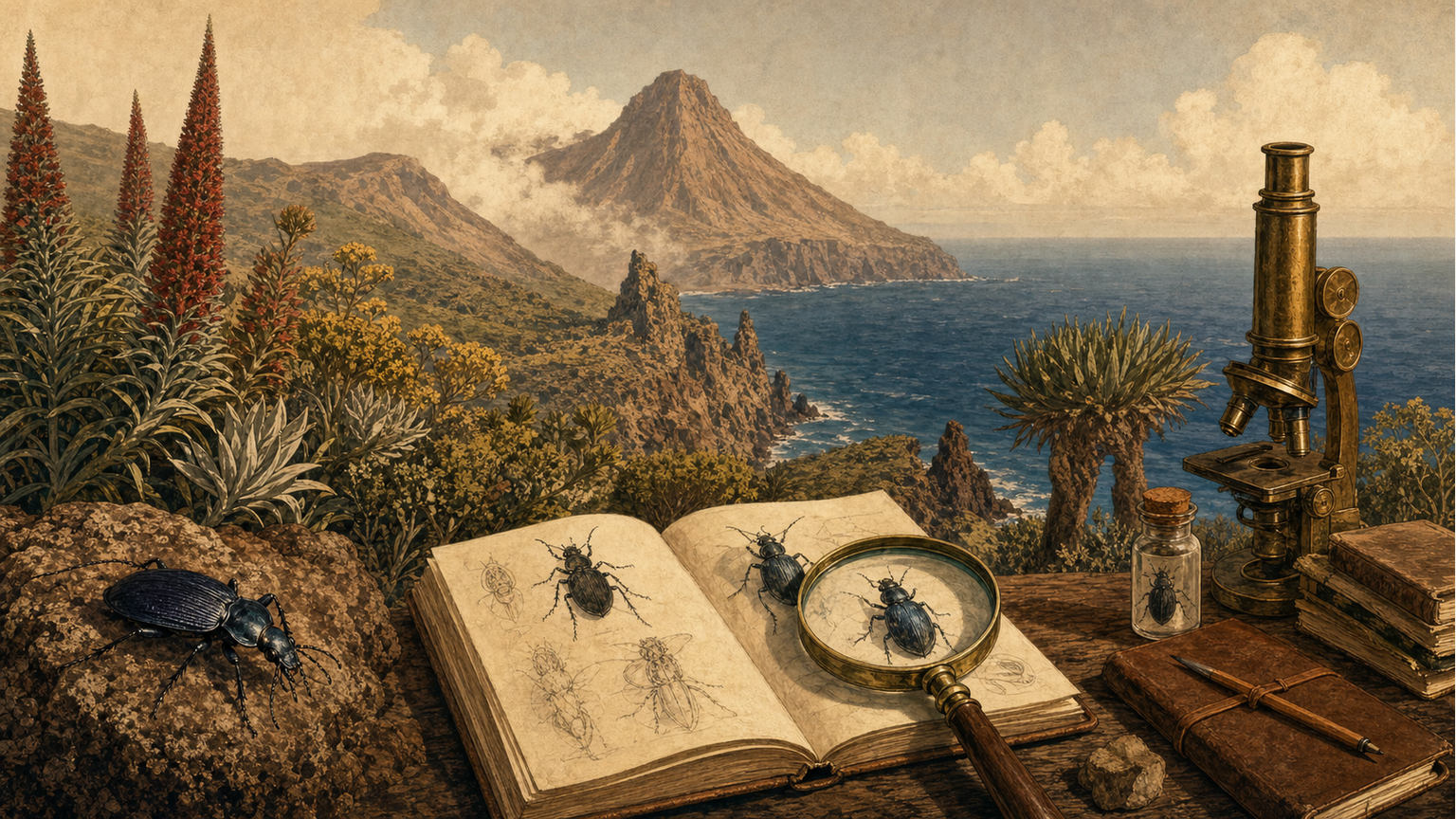
Research on carabids in the Canary Islands has a history spanning over two centuries, marked by significant milestones and key figures. According to Machado Carrillo, Antonio, the first reference to a carabid in the archipelago appears in José de Viera y Clavijo’s «Diccionario de Historia Natural de las islas Canarias», written at the end of the 18th century and published in 1866. In this work, Viera y Clavijo describes the black beetle, detailing its morphology and habits, reflecting an early interest in the biology and ecology of these insects[1].
Throughout the 19th century, references to carabids in the Canary Islands were mainly anecdotal, linked to European travelers and naturalists. For example, Bory de Saint Vincent in 1803 and André-Pierre Ledru in 1810 mention carabids in their travel accounts but without precise taxonomic details[1]. The specimens collected by these travelers were often sent to renowned European naturalists such as Latreille and Dejean, who described the first endemic species from the Canary Islands, though often with confusion about the exact origin of the specimens[1].
A turning point came with Thomas Vernon Wollaston in the second half of the 19th century, who conducted systematic campaigns in the archipelago. According to Machado Carrillo, Antonio, Wollaston laid the foundations for the knowledge of Canarian coleoptera with works such as «Coleoptera Atlantidum» (1865), integrating the fauna of the Canary Islands, Madeira, and the Salvage Islands. His meticulous documentation of localities and descriptions of new species remain fundamental, with his collection housed at the British Museum[1].
By the late 19th and early 20th centuries, other naturalists such as Charles Alluaud and Louis Bedel contributed critical analyses and new descriptions, consolidating what Machado Carrillo calls the “romantic” stage of Canarian entomology. Bedel, for instance, reviewed the validity of many species described by Wollaston and created new endemic genera such as Nesarpalus and Licinopsis[1].
The first half of the 20th century was marked by organized expeditions, such as those led by Hakan Lindberg from Finland, who collected extensively on several islands and deposited their collections in European museums. Collaboration between local and foreign naturalists intensified, with figures like D. Anatael Cabrera Díaz and D. José Moreno Naranjo playing key roles in collecting and preserving specimens, though they published little on carabids[1].
The 6th International Congress of Entomology in 1935 was a milestone, enabling direct contact between leading European entomologists and Canarian fauna. René Jeannel and Cándido Bolívar, among others, studied material collected during the congress and described new genera and species, contributing a broader biogeographical perspective[1].
Finally, according to Machado Carrillo, Antonio, the second half of the 20th century saw the consolidation of a local entomological community and the creation of institutional collections, such as that of the Museo Insular de Ciencias Naturales de Tenerife. This period, called the “academic stage,” is characterized by both the discovery of new species and the critical revision of historical material, clarifying numerous taxonomic issues accumulated over decades[1].