

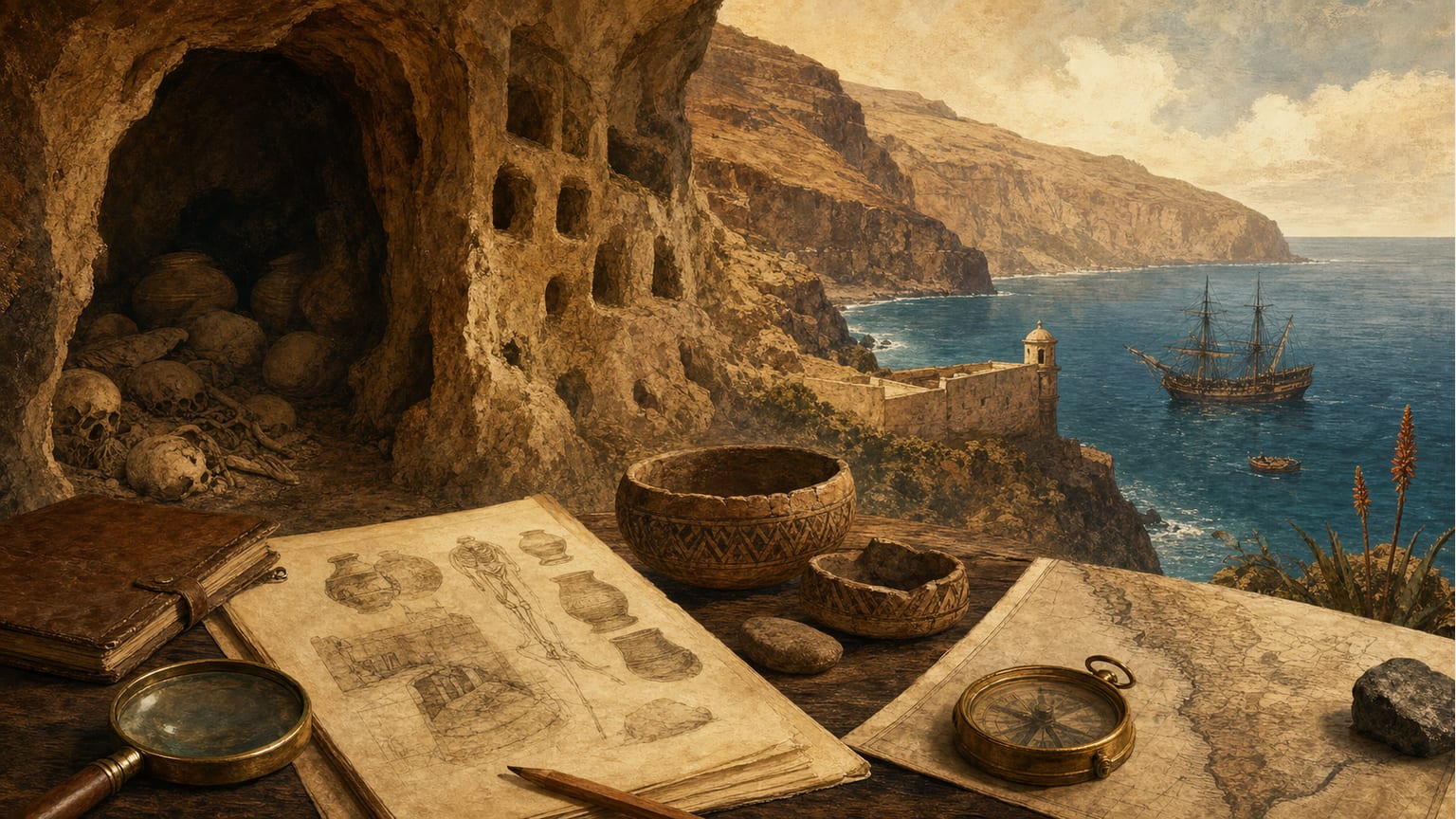
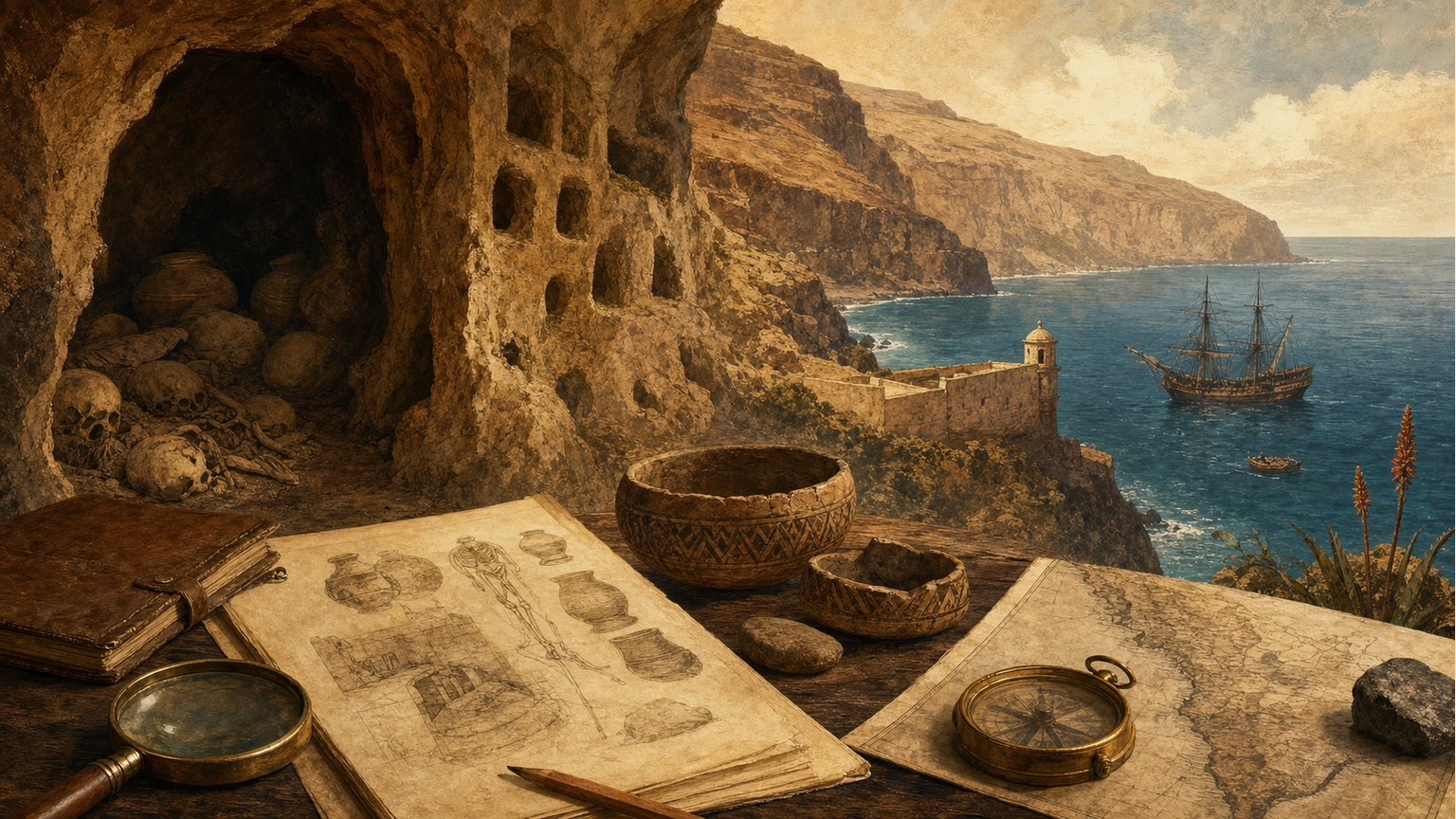
Between September 1880 and February 1881, El Museo Canario, the journal of the eponymous society in Las Palmas de Gran Canaria, recorded an archaeological expedition to the burial caves of the Guayadeque ravine. According to the authors, the aim was to continue exploration in the area and collect anthropological and archaeological materials to enrich the museum’s collections[1].
The expedition account details how participants accessed previously unexplored caves, some of which were difficult to reach. In one case, a worker descended by rope and found important objects and well-preserved human remains inside[1].
One cave, named “la cueva del Artillero” by the explorers, featured a main chamber measuring seven meters long by five meters wide, with a window and two raised benches. Skeletons were found laid out parallel to each other, all wrapped in reed coverings and, in some cases, animal skins. No burial traces were found on the floor, and the cave’s openings allowed a constant strong airflow regardless of the weather[1].
Another nearby cave, carved into two compartments supported by three columns, appeared to have partially collapsed, explaining the presence of skeletons at and outside the entrance. The bodies, also wrapped in reed mats and skins, were found mixed together without separation by sex or apparent order, contradicting the traditional idea that the ancient Canarians always buried their dead in an isolated and orderly fashion[1].
The remains were carefully transported to the village of Ingenio for further study. The expedition concluded that the Guayadeque finds provided sufficient data to advance knowledge of the ancient Canarian people from both anthropological and typographical perspectives. The authors also drew two historical conclusions: that the town of Agüimes, identified by some historians as the ancient Argones, was actually Guayadeque; and that, contrary to previous beliefs, the ancient Canarians did not always bury their dead in isolation or in the same direction, but could be found mixed and in various positions[1].
According to the source, the Museo Canario Society considered it a priority to organize similar expeditions regularly in Gran Canaria and other islands to complete the collections and shed light on the history and anthropology of the Canary Islands’ indigenous peoples[1].