

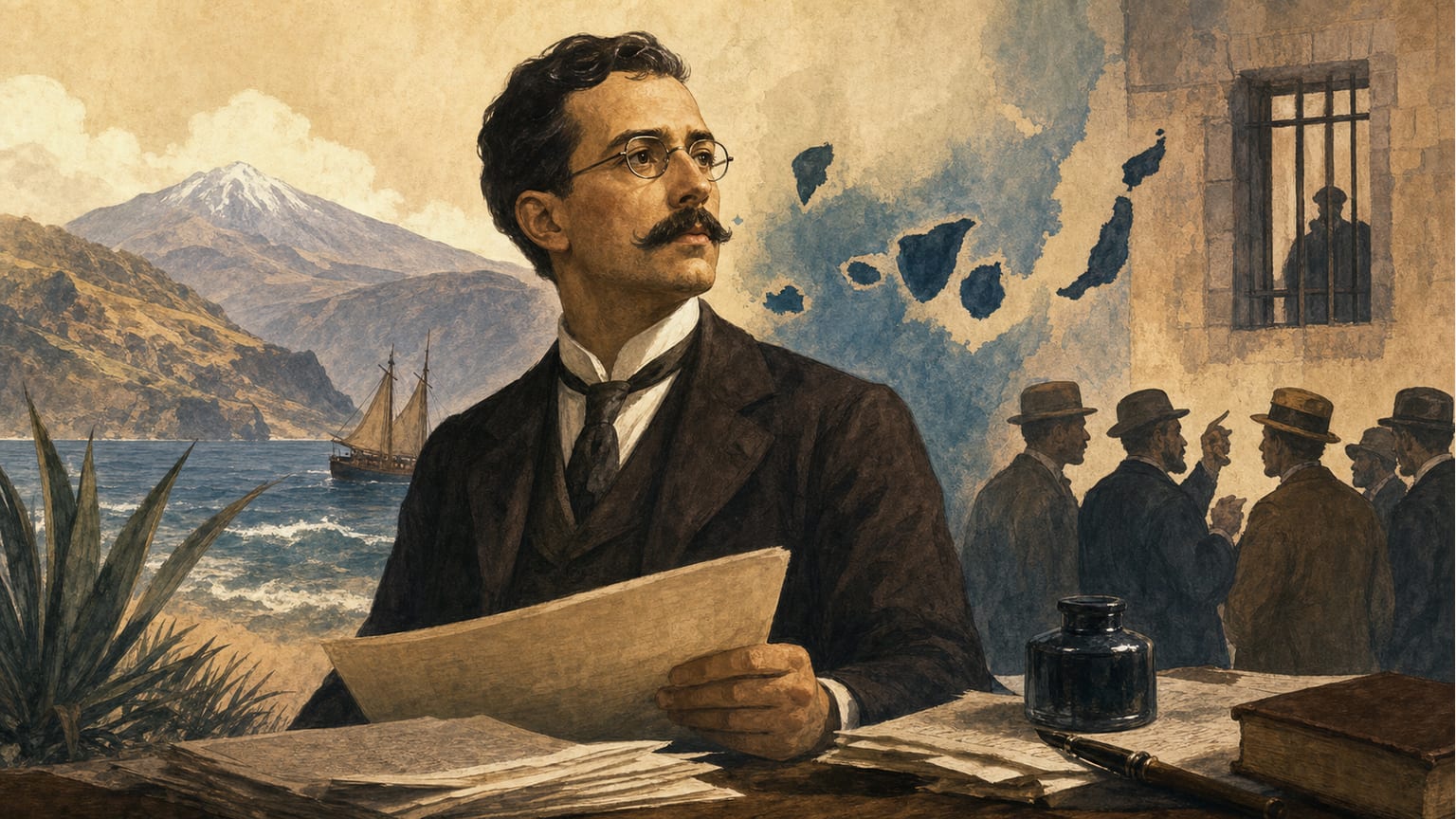
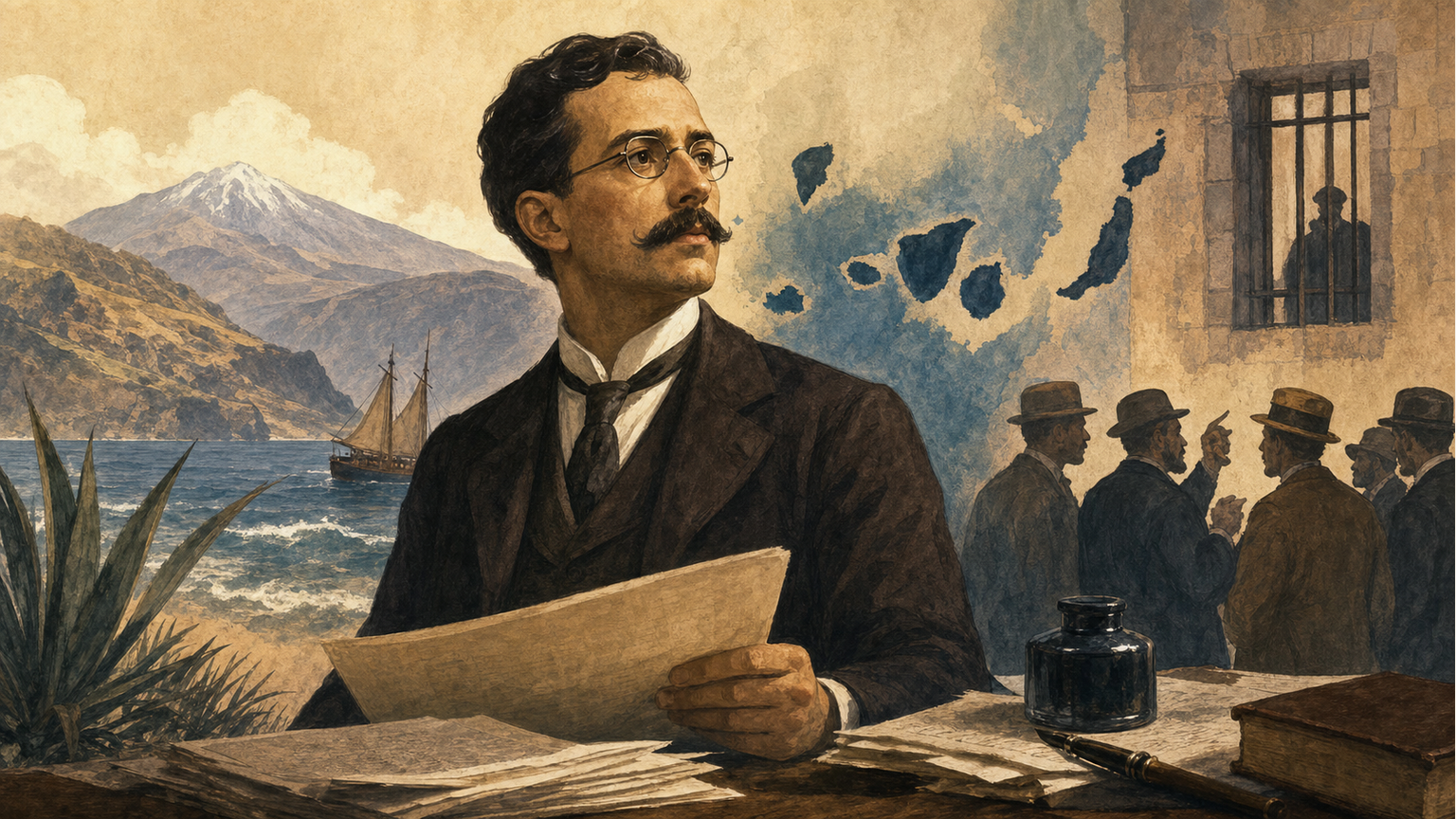
Secundino Delgado stands as a prominent figure in the history of Canarian autonomism at the start of the 20th century, particularly through his journalistic activity and his association with the newspaper ¡Vacaguaré![1]. After returning from voluntary exile in America in 1900, Delgado became involved in Canarian political and social life, actively contributing to El Obrero, the organ of the Workers’ Association in Santa Cruz de Tenerife, where he launched a campaign for the autonomy of the archipelago[1].
Delgado’s proposal was for the Canary Islands to have “their own legislative and executive bodies with a general governor assisted by the Executive Council or Cabinet, supported by the majority of the legislative assembly,” arguing that “England’s tendencies to assimilate us through its trade and industry would be null if the Fortunate Isles were autonomous, because above all comes pride of race, language, customs, etc.”[1]. For Delgado, autonomy was the solution to maintain political ties with Spain and prevent British interests from advancing in the islands[1].
Delgado’s arrest became a central episode in the autonomist debate. Officially, he was accused of “conspiring against the Spanish government in Cuba and having attacked, together with Zayas, the palace of Valeriano Weyler in Havana,” but Canarian public opinion interpreted the real reason as “the need to suppress his autonomist campaign and neutralize the newspaper ¡Vacaguaré!, founded by Lanzarote native Manuel Déniz Caraballo and directed by Secundino in Santa Cruz de Tenerife”[1].
The insular press’s treatment of Delgado’s imprisonment was varied. Ángel Guerra (pseudonym of José Betancort Cabrera) argued that “for the founder of the newspaper Vacaguaré, the silence of the island press and the solemn indifference with which people received his suspicious preaching was a double punishment. Ideas born dead do not need to be killed. They neither take root nor endure”[1]. However, the study’s author notes that this information “does not seem very accurate or truthful, because as we have already pointed out, the founder of ¡Vacaguaré! was not Secundino Delgado, but Manuel Déniz Caraballo. The direction of the newspaper was indeed assumed by Secundino. Nor is it true that the island press responded with silence to the autonomist campaign of ¡Vacaguaré!, perhaps with surprise or fear at the novelty it represented”[1].
The republican newspaper El Grito del Pueblo reported Delgado’s imprisonment as follows: “We have learned that the consistent autonomist and press colleague Mr. Secundino Delgado was imprisoned in the town of Arafo (…) taken to the capital and shipped to Spain at the disposal of the Hon. Captain General of Madrid, in compliance with orders from the Ministry of War. We have heard the rumor that the use of force against Mr. Delgado originated in the autonomist propaganda carried out by the newspaper ¡Vacaguaré! (…). We resist believing it, since such a political aspiration is not a crime and has thousands of supporters in various regions”[1].
The case of Secundino Delgado and ¡Vacaguaré! exemplifies the complexity of the debate on Canarian autonomy, the influence of the press, and the authorities’ reaction to the rise of regionalism in the islands at the beginning of the 20th century[1].