

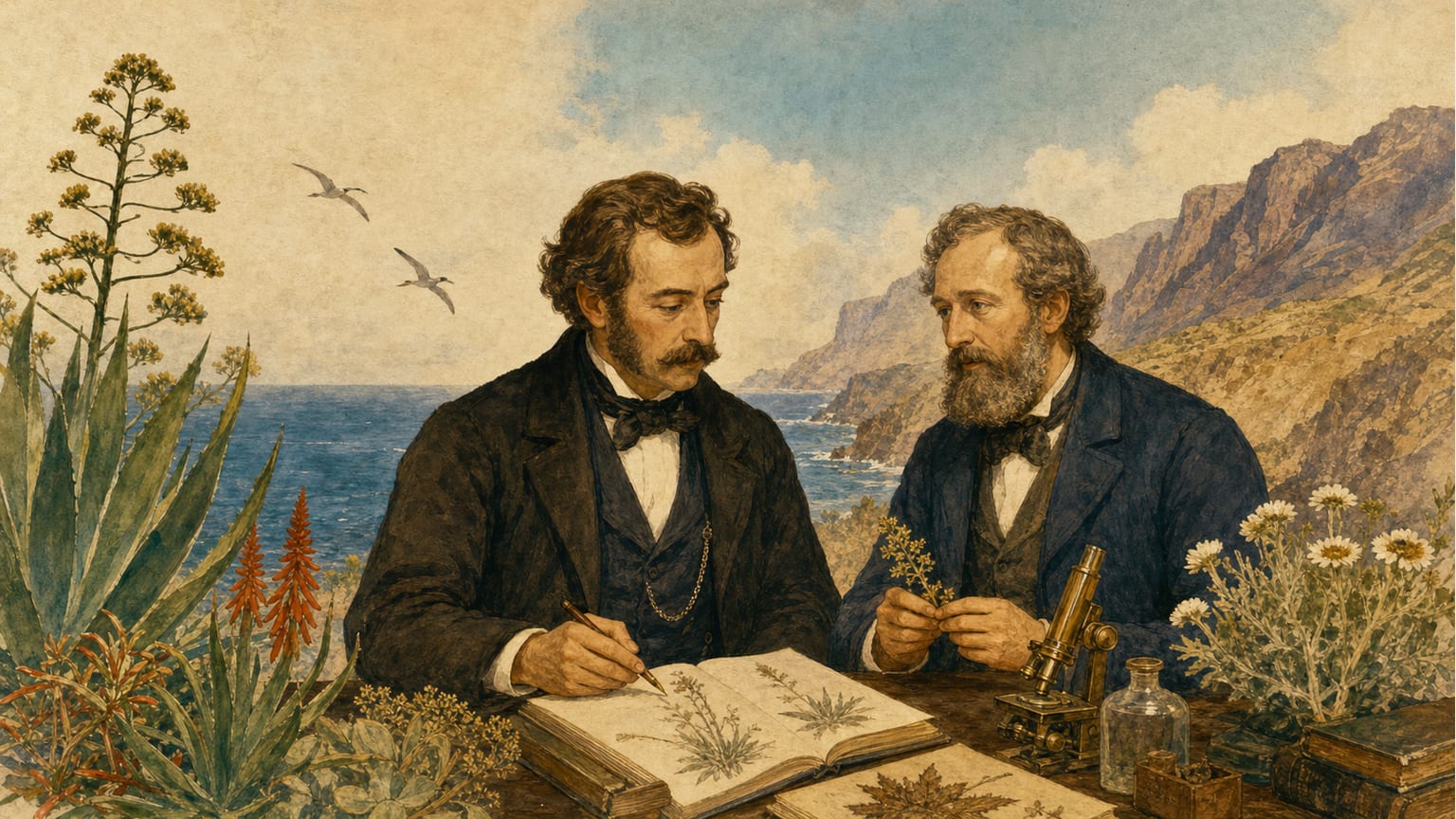
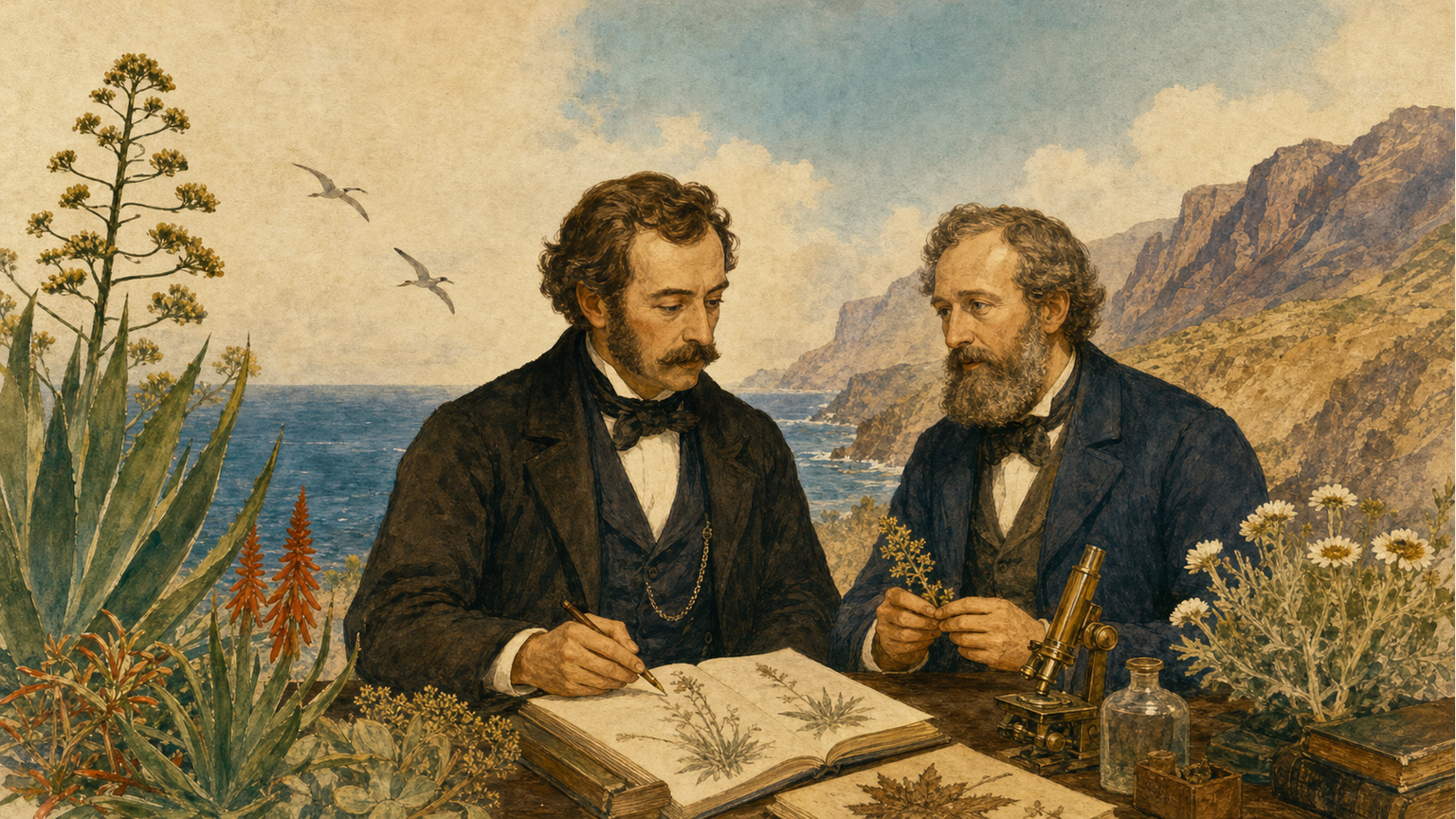
The relationship between Sabino Berthelot and Philippe Barker-Webb stands out as a key episode in the scientific exploration of the Canary Islands during the 19th century. According to Berthelot, his meeting with Webb in 1827 was decisive for the advancement of his research on the archipelago’s natural history[1].
Berthelot recounts that after a decade of explorations in Tenerife and Gran Canaria, he lacked the resources to continue his work. The arrival of Webb, an English naturalist educated at Oxford and owner of a considerable fortune, gave a significant boost to his studies. Berthelot describes how they met by chance while both were collecting plants in a ravine in Tenerife, and from that moment, their shared interests and personal friendship led to a close collaboration[1].
Webb, as described by Berthelot, was notable for his solid scientific background and his command of several classical and modern languages. He had traveled extensively throughout Europe, Asia Minor, and North Africa before arriving in the Canary Islands. His work on the location of Troy was already known among archaeologists. Berthelot highlights Webb’s generosity, modesty, and hospitality towards naturalists at his Paris residence, where he died in 1859 during a cholera epidemic[1].
The two scientists undertook numerous expeditions across the islands, including ascents, botanical explorations, and trips to other islands in the archipelago. Berthelot especially recalls their stay in Arico, the ascent to El Sombrerito, and visits to the homes of local personalities. He also mentions joint travels through Andalusia, northern Italy, the Alps, and Switzerland, as well as the writing of the “Natural History of the Canary Islands” after returning to France and England[1].
Their correspondence, preserved in Berthelot’s letters, shows the continuity of their scientific and personal relationship over the years. Berthelot notes that after Webb’s death, his herbarium and library were bequeathed to the Grand Duke of Tuscany and deposited in the museum in Florence, where a marble bust was inaugurated in his honor[1].
According to Berthelot, none of the published biographies of Webb satisfied him fully, so he considered it necessary to pay tribute through his own memories and documents. Their collaboration is presented by Berthelot as an example of friendship and shared scientific work that left a deep mark on the knowledge of the Canary Islands’ flora and natural history[1].