

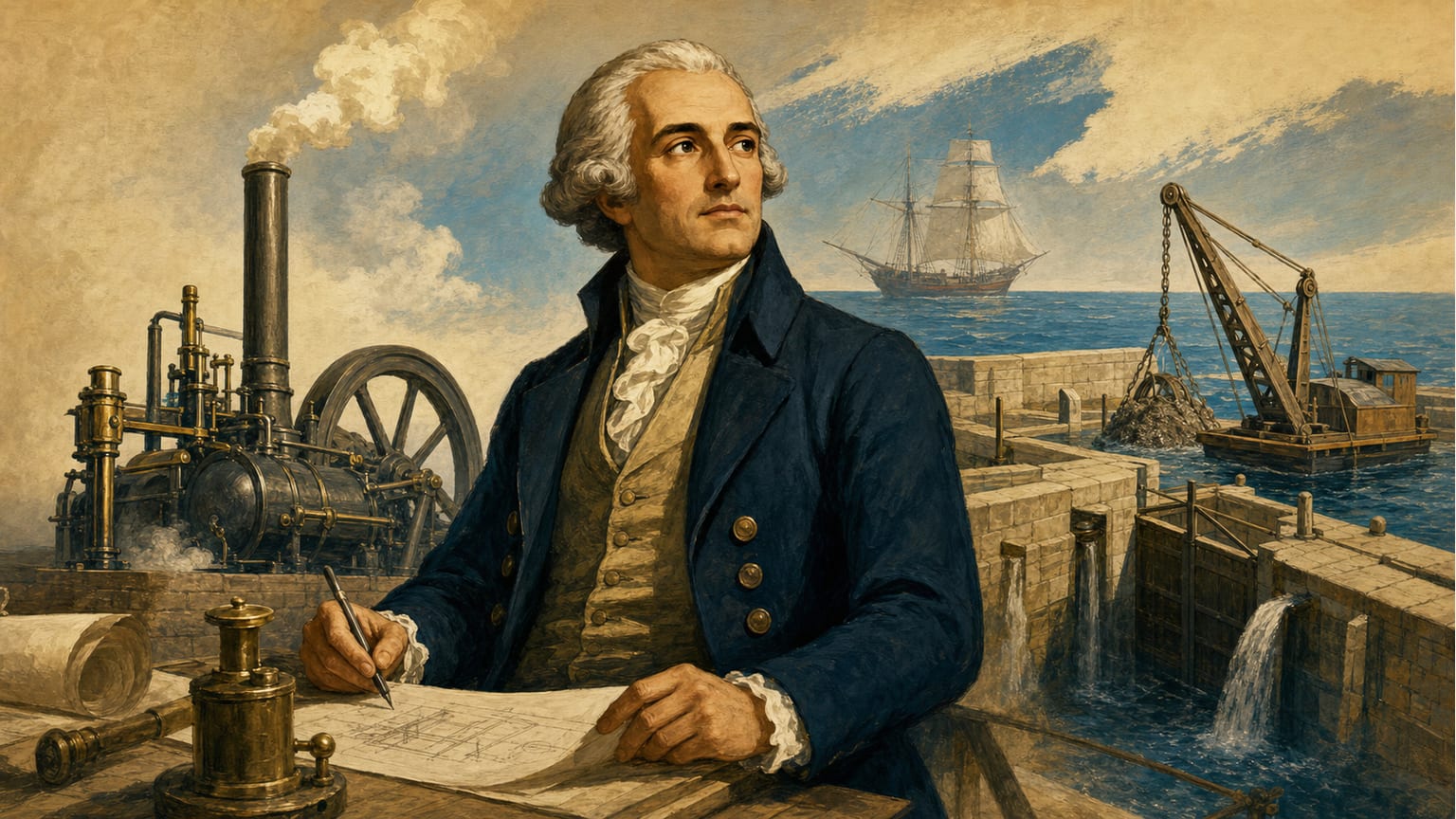
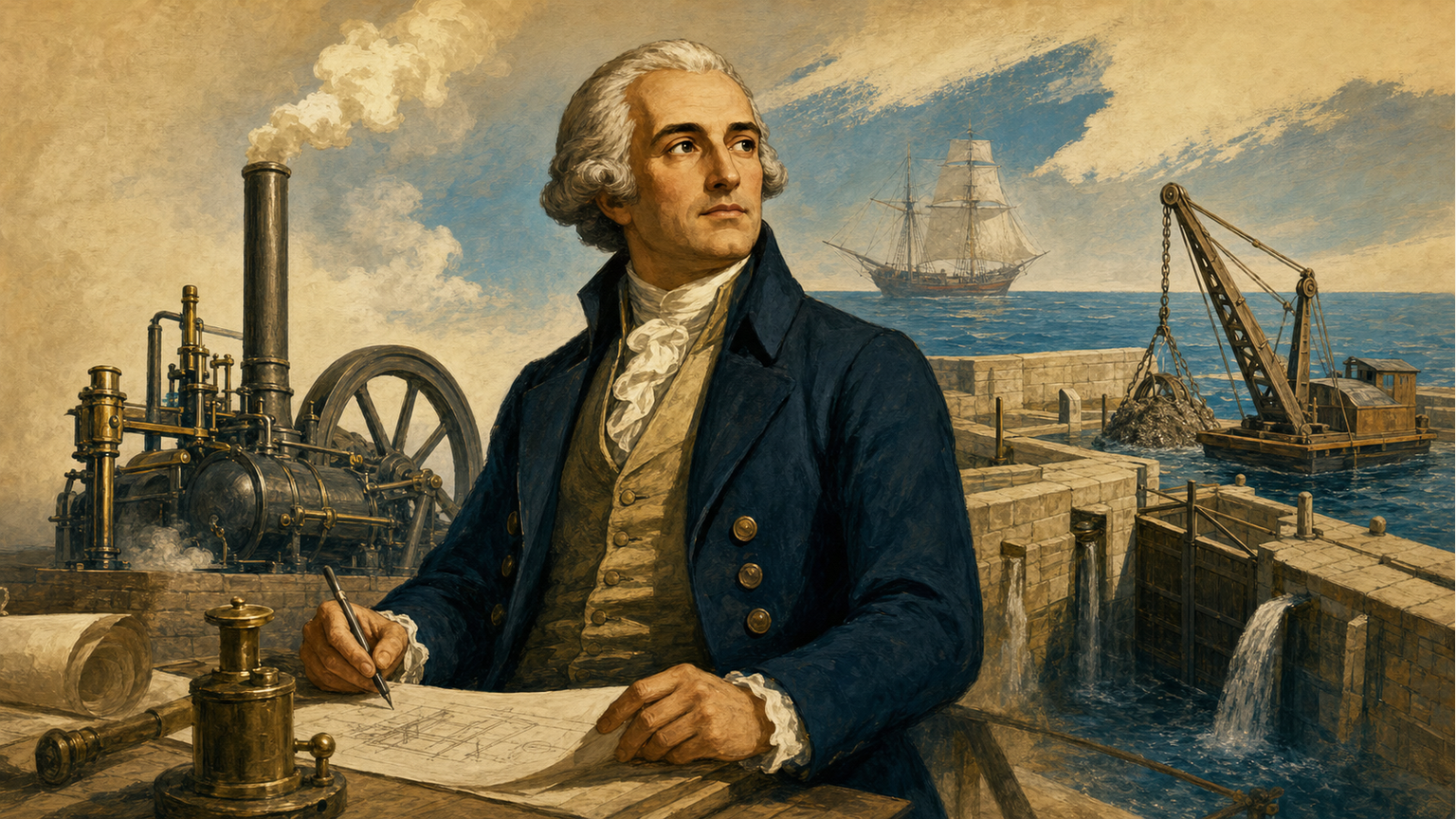
Agustín de Bethencourt y Molina, born in Puerto de la Cruz in 1758, is described by Padrón Acosta, Sebastián as one of the most significant figures in Spanish and international science, especially for his work in hydraulic engineering and steam technology[1].
One of Bethencourt’s most notable achievements was his 1790 presentation of the “Mémoire sur la force expansive de la vapeur de l’eau” to the Paris Academy of Sciences. The Academy’s commission, including Borda, Monge, and Brisson, praised his technical solution for the piston movement in steam engines, using an iron parallelogram to achieve the necessary vertical motion. The commission stated: “La Memoria nos parece digna de la aprobación de la Academia y creemos que debe publicarse entre las Memorias de los sabios extranjeros”[1].
Bethencourt himself acknowledged in a letter to his brother from Paris in 1789 that his trip to London was crucial in changing his ideas about steam engines, and that French scientists who saw his project decided to build it “en grande, con todas las innovaciones que he practicado”[1].
According to Padrón Acosta, Sebastián, Bethencourt was also among the first to experiment with electrical telegraphy, presenting a memoir with Bréguet to the French National Institute and conducting early tests between Madrid and Aranjuez[1].
In the field of hydraulics, Bethencourt invented a lock with two chambers connected at the bottom, which allowed significant savings in water and energy for inland navigation. Godoy, as cited by the source, described: “por el invento de Betancourt, cada esclusa, en lugar de un solo vaso, tenía dos contiguos que se comunicaban por el fondo… un hombre solo bastaba para la maniobra de hacer subir o bajar un barco, por muy grande que éste fuese”[1].
Bethencourt also designed a machine for cutting grass in rivers and navigable canals, which was adopted as a model by the Society of Arts, Manufactures, and Commerce in London, and wrote a memoir on a dredging machine for cleaning riverbeds, which was approved by the Spanish Navy’s Board of Generals[1].
He was responsible for founding and directing the Royal Cabinet of Machines at Buen Retiro, which housed over 270 machines and 358 plans drawn by him, as well as 100 technical memoirs and 92 diagrams, according to the Count of Fernán-Núñez[1].
The source notes that, although many of his innovations were recognized in France and other European countries, Bethencourt faced obstacles and lack of support in Spain, which eventually led him to continue his scientific career in Russia[1].