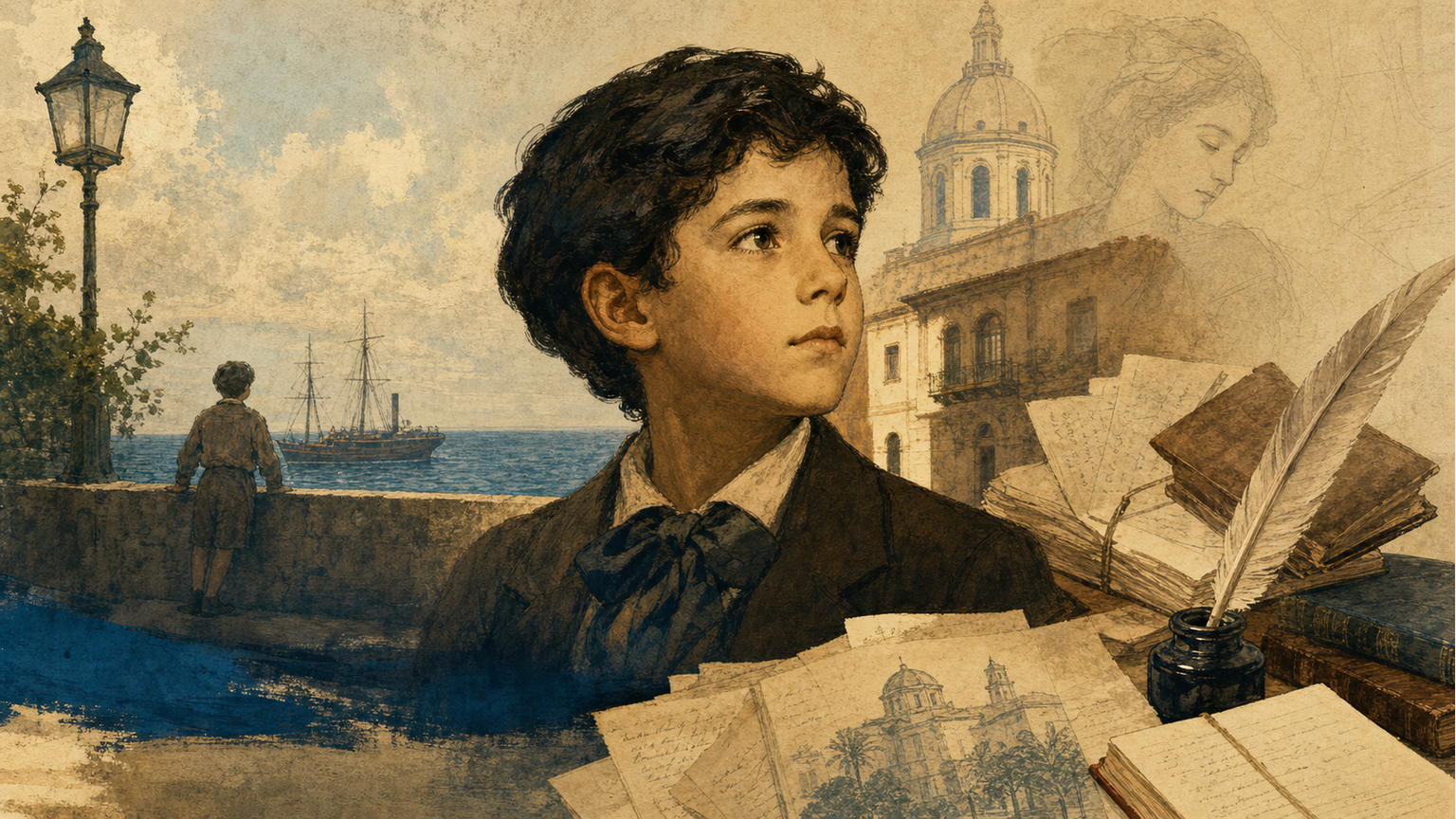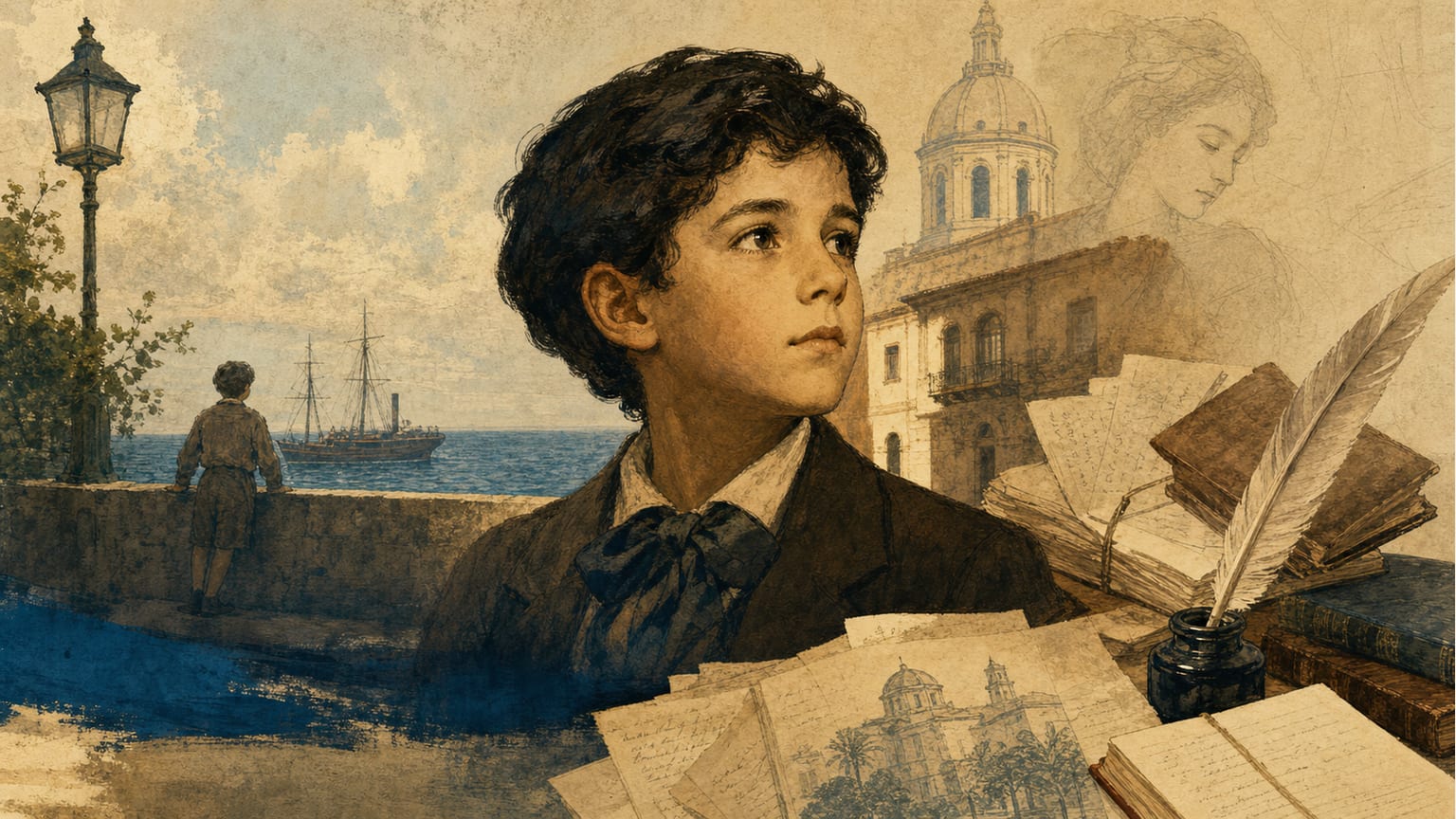

The Childhood of Ángel Guimerá: Separating Legend from Historical Fact
Ángel Guimerá’s early years have often been surrounded by legendary stories, many of which have been repeated in biographies and articles without solid documentary evidence. According to Miracle, Josep, the traditional narrative about Guimerá’s childhood, especially as presented by Carlos Capdevila and Francisco Caravaca, contains numerous errors and novelistic elements that do not correspond to historical reality[1].
One of the most controversial points is Guimerá’s date and place of birth. While some sources place it in 1847 or 1849, Miracle, Josep points out that both dates are incorrect and that the confusion has been perpetuated by the uncritical transmission of data between dictionaries and biographies[1]. Even Guimerá himself, in a letter to Juan Fastenrath in 1890, stated he was born in 1848 in Santa Cruz de Tenerife, but Miracle, Josep notes that church records consulted by Caravaca place his birth in 1845[1].
Legend has also attributed dramatic episodes to Guimerá’s childhood, such as the supposed shipwreck of the ‘Riánsares’ from which the family was miraculously saved, or their escape from a cholera epidemic in Barcelona, where the family allegedly escaped death several times[1]. However, Miracle, Josep debunks these stories after a critical review of the sources, showing that many of these events did not happen as told, or did not happen at all[1].
For example, Miracle, Josep asserts that it can be documented that Ángel Guimerá was not born in 1849, that his father did not liquidate the business after his uncle’s death, nor did the family arrive in Barcelona in 1855, nor did the ‘Riánsares’ sink as described in legendary biographies[1]. Furthermore, the cholera epidemic did not break out in Barcelona in the summer of 1856 as some versions claim[1].
Miracle, Josep emphasizes that Guimerá’s biography has been treated more as a journalistic exercise than as a historical-critical work, which has encouraged the spread of inaccurate versions[1]. The author insists on the need to base the reconstruction of Guimerá’s childhood on original documents and direct testimonies, rather than on orally transmitted stories or family tradition, which tend to distort facts over time[1].
In conclusion, Ángel Guimerá’s childhood, far from providential and novelistic episodes, was more ordinary and less extraordinary than legend has suggested. Miracle, Josep’s work allows us to distinguish between legend and history, providing a more accurate and documented view of the early years of the Canarian-Catalan playwright[1].