

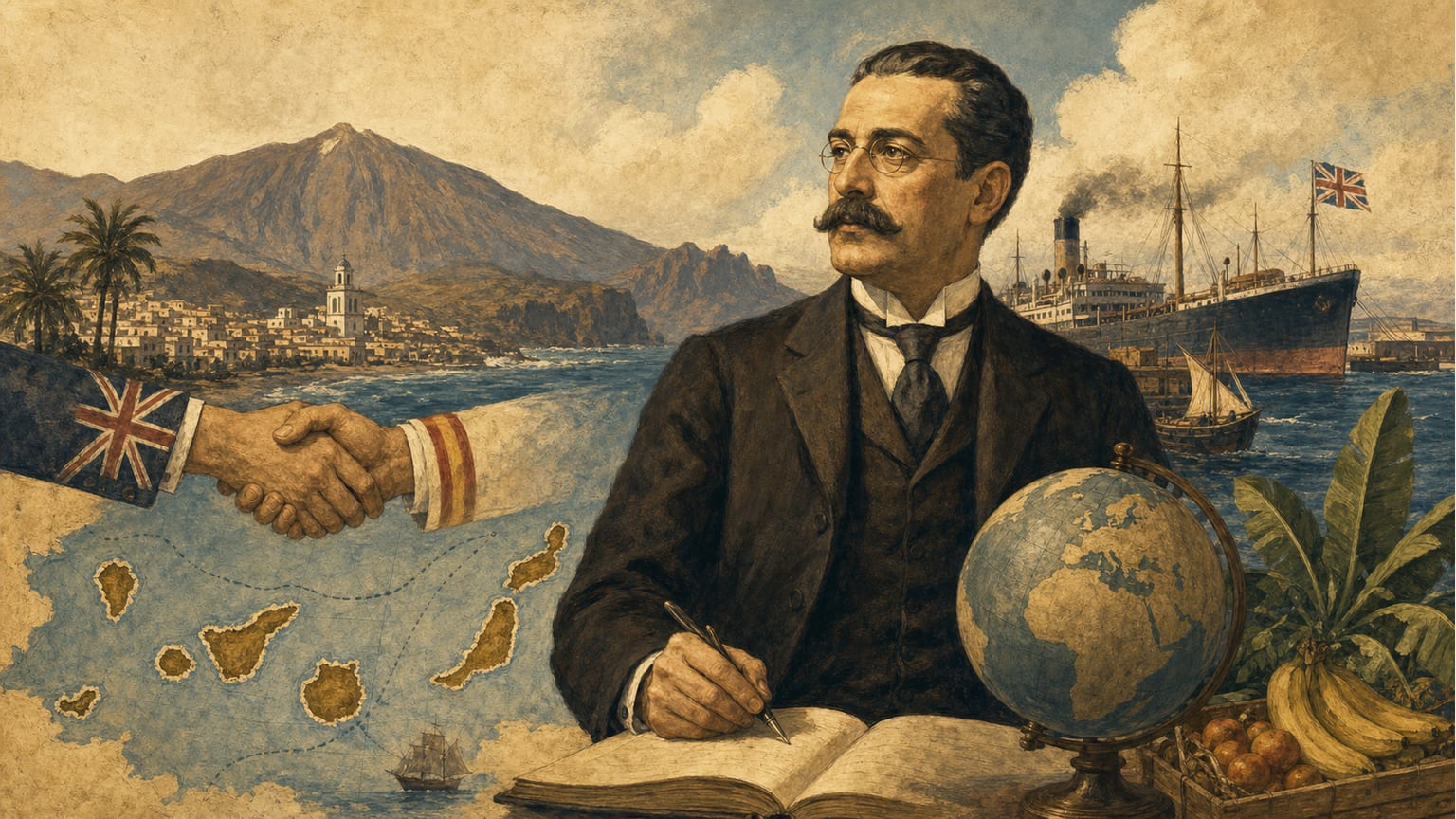
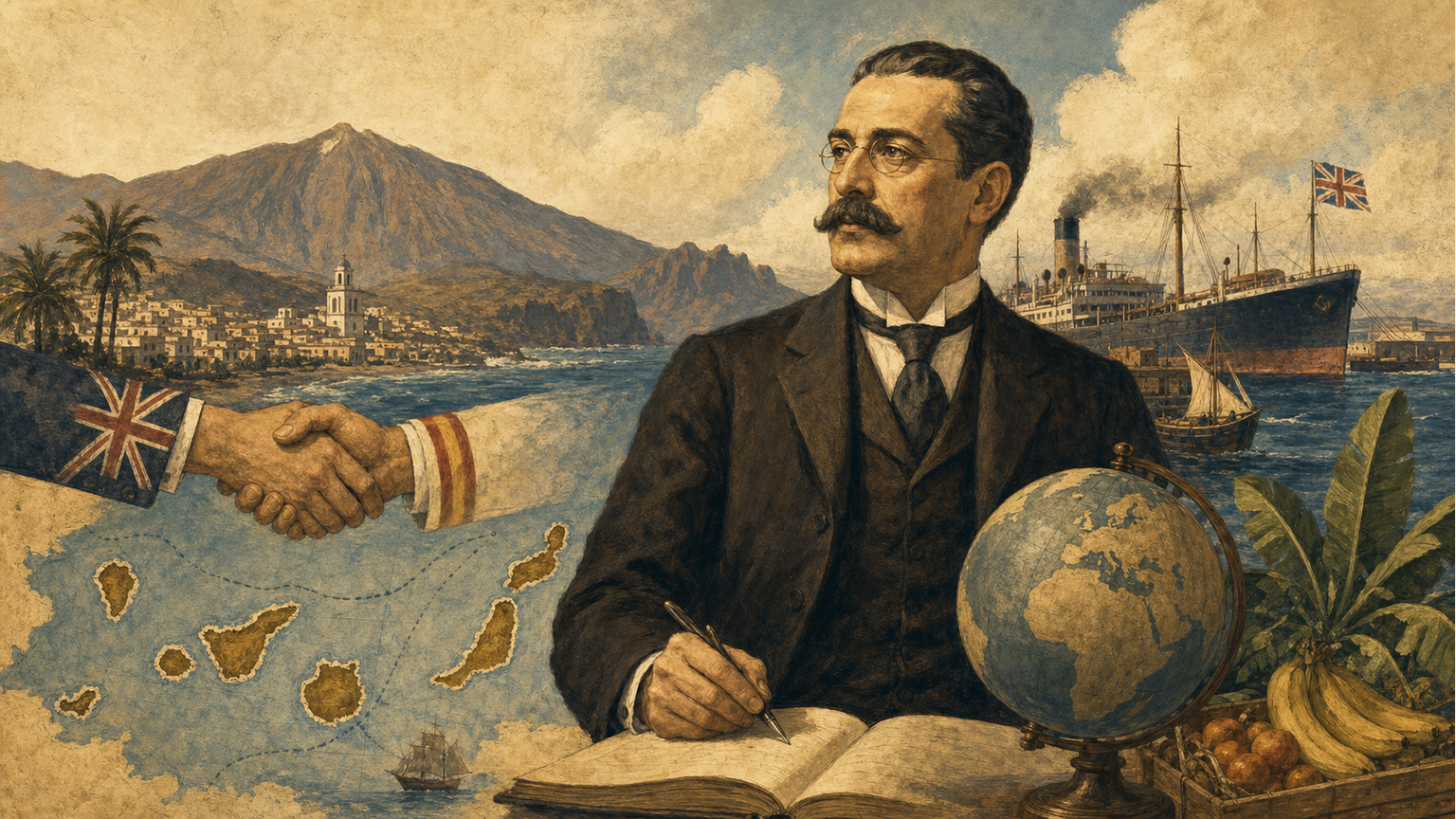
British Influence on the Canarian Economy According to Ángel Guerra (José Betancort Cabrera)
At the turn of the 20th century, the Canarian economy was notably shaped by British influence, a phenomenon analyzed by Lanzarote-born writer and journalist José Betancort Cabrera, known as Ángel Guerra. In a series of articles published in 1902 in Las Canarias (Madrid), Guerra addressed the “britanization” of the archipelago and the perception of separatism circulating in Spanish public opinion [1].
Throughout much of the 19th century, the Canary Islands experienced neglect from Spanish authorities, which allowed the United Kingdom to exert economic dominance over the archipelago. Historians cited in the study agree that this British economic control was constant and uninterrupted from 1860, without any need for military occupation [1].
Ángel Guerra, in his series Sobre Canarias. Britanización y separatismo, explained that the Canarian economy was oriented outward due to Spain’s lack of attention and resources. He criticized that Spain maintained minimal commercial relations with the Canaries, limited to a biweekly ship that barely connected the islands with the mainland [1].
Guerra emphasized that “commercial relations establish bonds of solidarity and affection between peoples,” warning that Spanish neglect favored the consolidation of economic ties with the United Kingdom and other European countries [1]. He also noted that the agricultural wealth of the Canaries required external markets and that the lack of rapid transport prevented efficient exports to Spain [1].
He argued for the strategic and commercial importance of the Canaries, stating that the archipelago’s geographic position made it a key point for transactions between Europe and Africa. However, he lamented that Spanish authorities failed to capitalize on this potential, facilitating British economic penetration [1].
Ángel Guerra’s analysis of the “britanization” of the Canarian economy is set within broader debates about regionalism, autonomy, and insular identity, but his economic diagnosis focuses on the lack of effective integration of the Canaries into the Spanish market and the resulting dependence on foreign powers [1].