

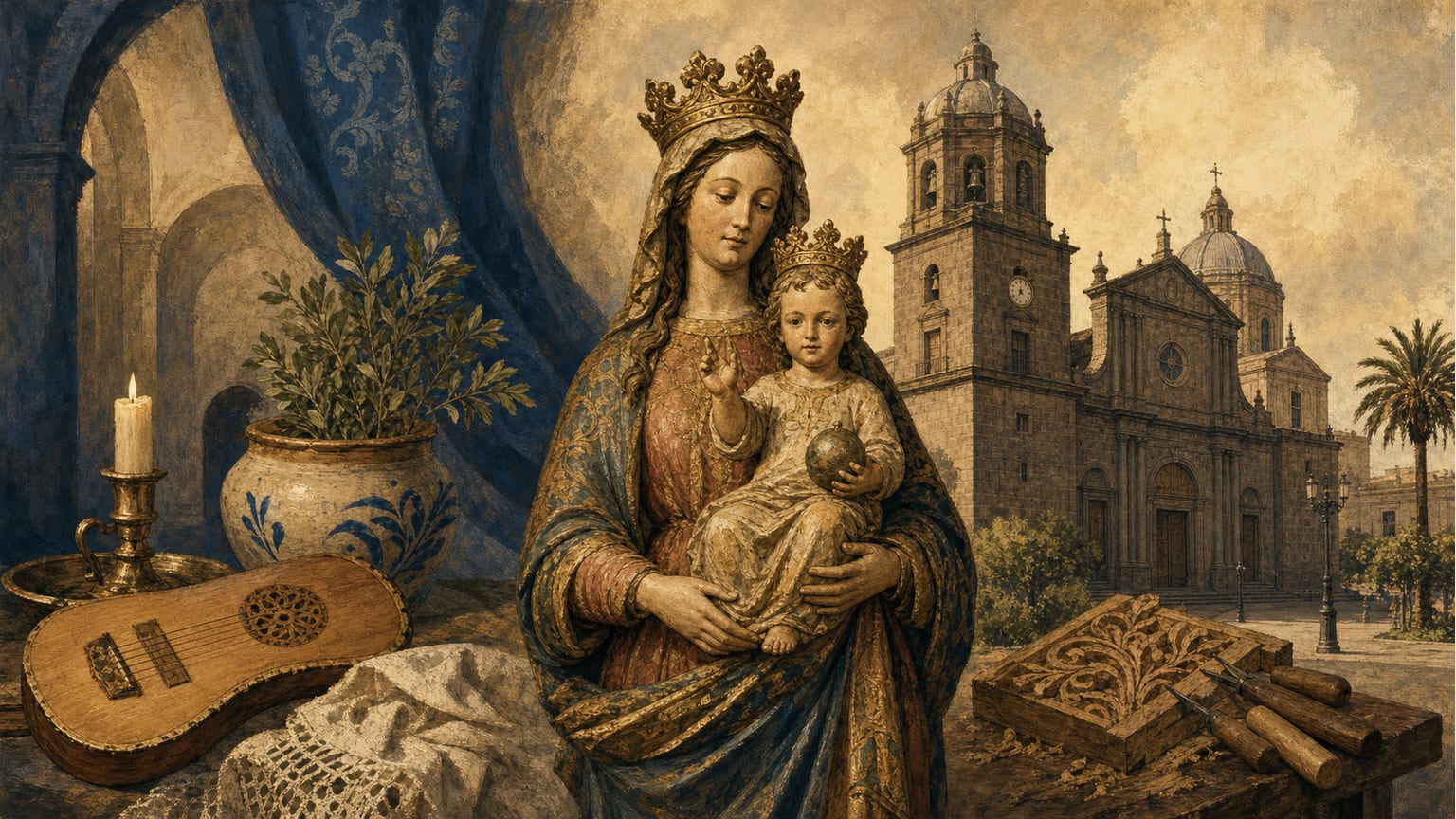
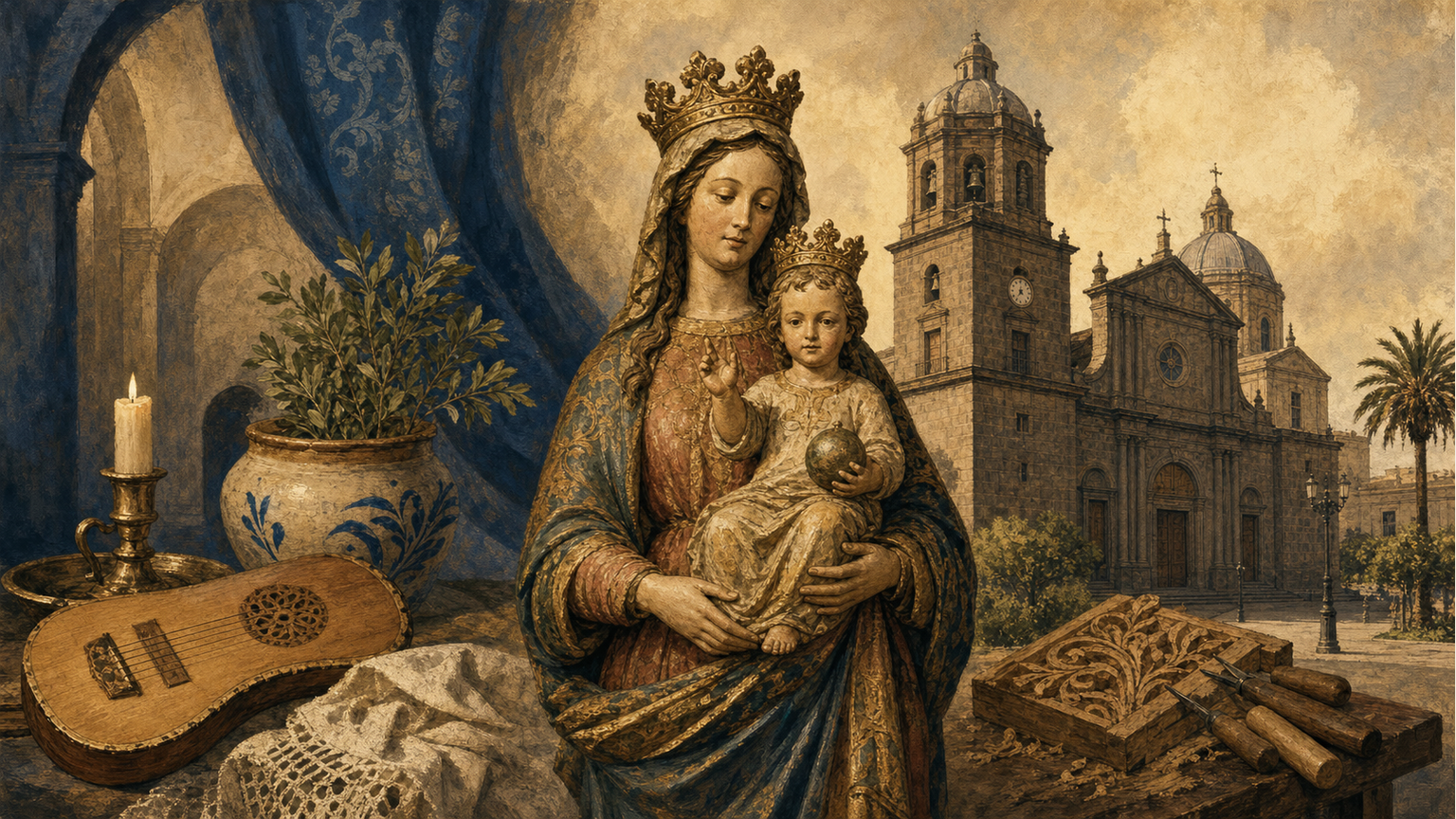
The Virgin of Light, housed in La Laguna Cathedral, is described by the Comisión Diocesana de Arte Sacro as the finest and most beautiful Marian sculpture in the temple and one of the most admirable in the Canary Islands[1]. This statue, made of barbusano wood, gilded and polychromed, stands 132 cm tall and is dated to the third quarter of the 16th century[1].
According to the source, the Virgin of Light was originally located in the nave of the Epistle in the old church of Los Remedios, in the altarpiece of Our Lady of Light. Before this, it was in the Chapel of the Transfiguration, founded by Salvador Fernández de Villarreal, who moved the image to his chapel as stated in his will[1]. However, 18th-century chronicler José Anchieta y Alarcón noted that the image existed even earlier, having been placed in the main chapel in a side niche, with its own altar erected by Lorenza Velázquez, who also owned the image[1].
The authorship of the Virgin of Light was debated. Rodríguez Moure rejected an anachronistic attribution to the 18th-century sculptor Rodríguez de la Oliva and suggested a link to Berruguete, though the 1963 source considers this hypothesis stylistically improbable[1]. Pedro Tarquis proposed a connection to Maestro Roberto, a sculptor active in the Canary Islands in the early 16th century, but the source dismisses this due to lack of evidence and stylistic and chronological differences[1].
The Comisión Diocesana de Arte Sacro concludes that the Virgin of Light is a sculptural interpretation of the famous Virgin of the Antigua from Seville Cathedral, a Gothic icon highly venerated in the Canary Islands. The treatment of the headdress, posture, the hand showing a fleur-de-lis (now lost), and the bird in the Child’s hand are inspired by this model[1]. The sculpture’s Sevillian origin is confirmed by comparison with works from 16th-century Sevillian workshops, especially those by the Flemish sculptor Roque de Balduque. However, the modeling and composition of the Virgin of Light display a greater maturity and a Mannerist tendency attributed to Juan Bautista Vázquez the Elder[1].
Comparisons with other works by Vázquez, such as the Virgin of the Fevers in the Magdalena of Seville, the Virgin of the Prado in San Sebastián, and the Virgin of the Pineapple in Lebrija, reinforce the attribution to this Castilian sculptor, according to the 1963 source[1]. Thus, the Virgin of Light is, in the opinion of the Comisión Diocesana de Arte Sacro, a product of the third quarter of the 16th century, when Vázquez the Elder was active in Seville, representing a midpoint between Balduque’s medieval style and Vázquez’s Sevillian Mannerism[1].