

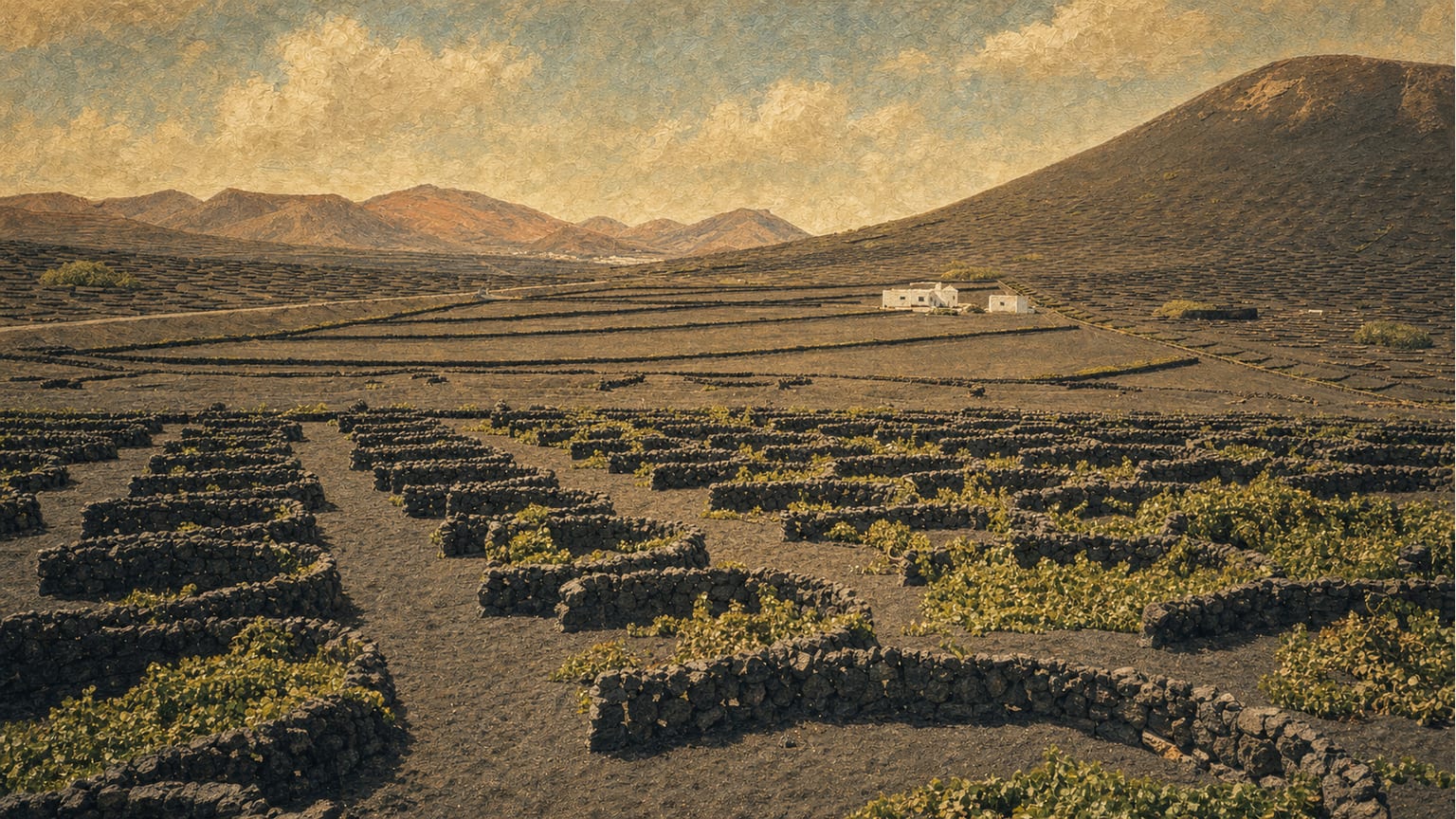
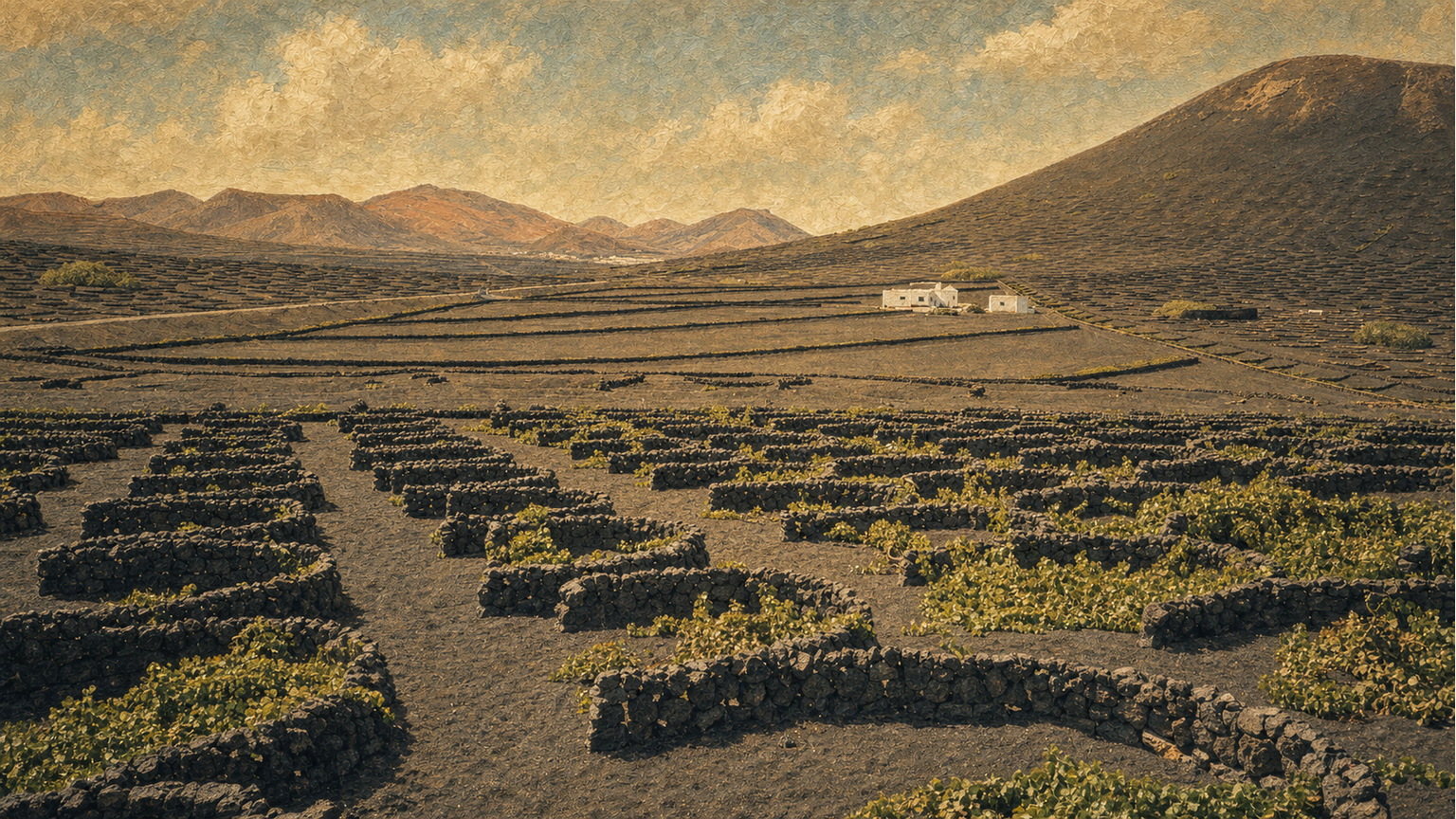
Some landscapes look like a mistake on the map. La Geria is one of them: a black hillside without a single tree, dotted with thousands of pits and, inside each one, a small vine sheltered by a half-moon stone wall. From the road it looks like a field of tiny craters, a lunar stage set. But it is a vineyard, and one of the most unusual in the world.[1][2] And the most curious thing is that it would not exist if the island had not come close to being lost.
A fertile valley beneath the lava
Before 1730, this area was one of the most fertile in Lanzarote. Then came Timanfaya. Between 1730 and 1736, eruptions from more than thirty volcanoes covered a quarter of the island and destroyed precisely its richest land.[1][2] In La Geria, the soil was buried under metres of volcanic rock and ash.[1] Anyone who saw it then might have thought it would never feed anyone again. It is the same eruption that the parish priest of Yaiza, Don Andrés Lorenzo Curbelo, described day by day: the catastrophe where this story also begins.[3]
Digging instead of fleeing
After the eruptions, the island had to reinvent itself. Far from giving up, Lanzarote’s farmers did something that at first sight seems absurd: instead of fighting the ash, they used it. They dug pits in the lapilli, like inverted cones, and planted the vine inside.[4] They covered the pit with a layer of picón, the small volcanic stones that islanders also call rofe, and protected it with a semicircular stone wall, the zoco, which acts as a windbreak.[3][2] That ingenuity was born of necessity, not theory: there was no master and no manual, only trial, error and patience, pit after pit. The islanders knew that these little stones are an excellent insulator: they keep the heat away, retain moisture and, by trapping the moisture carried by the ocean winds, protect the roots of the vine.[3]
A handmade miracle
That technique, known as enarenado, retains moisture, reduces evaporation and supplies minerals, and it is not limited to vines: it also works for potatoes, strawberries and legumes. The FAO devoted a report to it with a title that sums it up well: “The volcanic miracle of Lanzarote”.[2] In fact, large-scale vine growing on the island dates from the eighteenth century, right after the Timanfaya eruption: the catastrophe and the vineyard go hand in hand.[4] Where the volcano had left a quarter of the island under lava, people sowed again.[2]
What travellers visit today is, in reality, an enormous amount of manual labour accumulated over generations. Every pit was dug, every zoco raised stone by stone. La Geria is shared among several municipalities, including Yaiza and Tías, and the dominant variety is Malvasía Volcánica, a white grape. Almost three hundred years later, that soil which seemed lost produces wine. Over the black remains of Timanfaya, the vines bring the colour.[1]
There is something deeply Canarian in this story: an island that does not give up. If César Manrique understood Lanzarote as a work of art, the farmers of La Geria understood it as a work of survival. Every pit is one person’s answer to a catastrophe, a small wager made by hand. It is not a vineyard that survives in spite of the volcano, but thanks to it: the volcano destroyed everything and, from its own ash, came a way of farming unlike any other. Perhaps that is why La Geria moves even those who know nothing about wine.