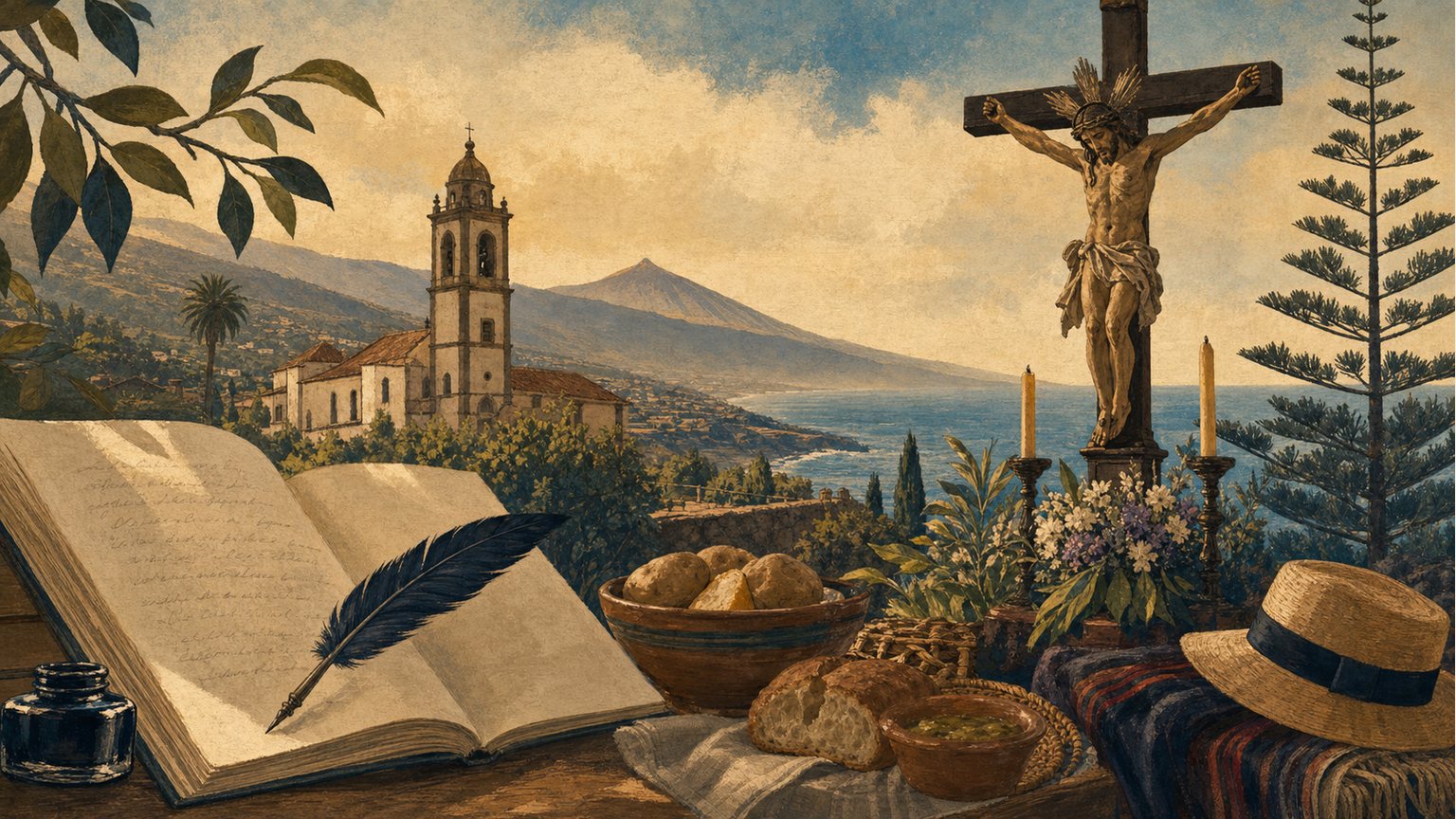

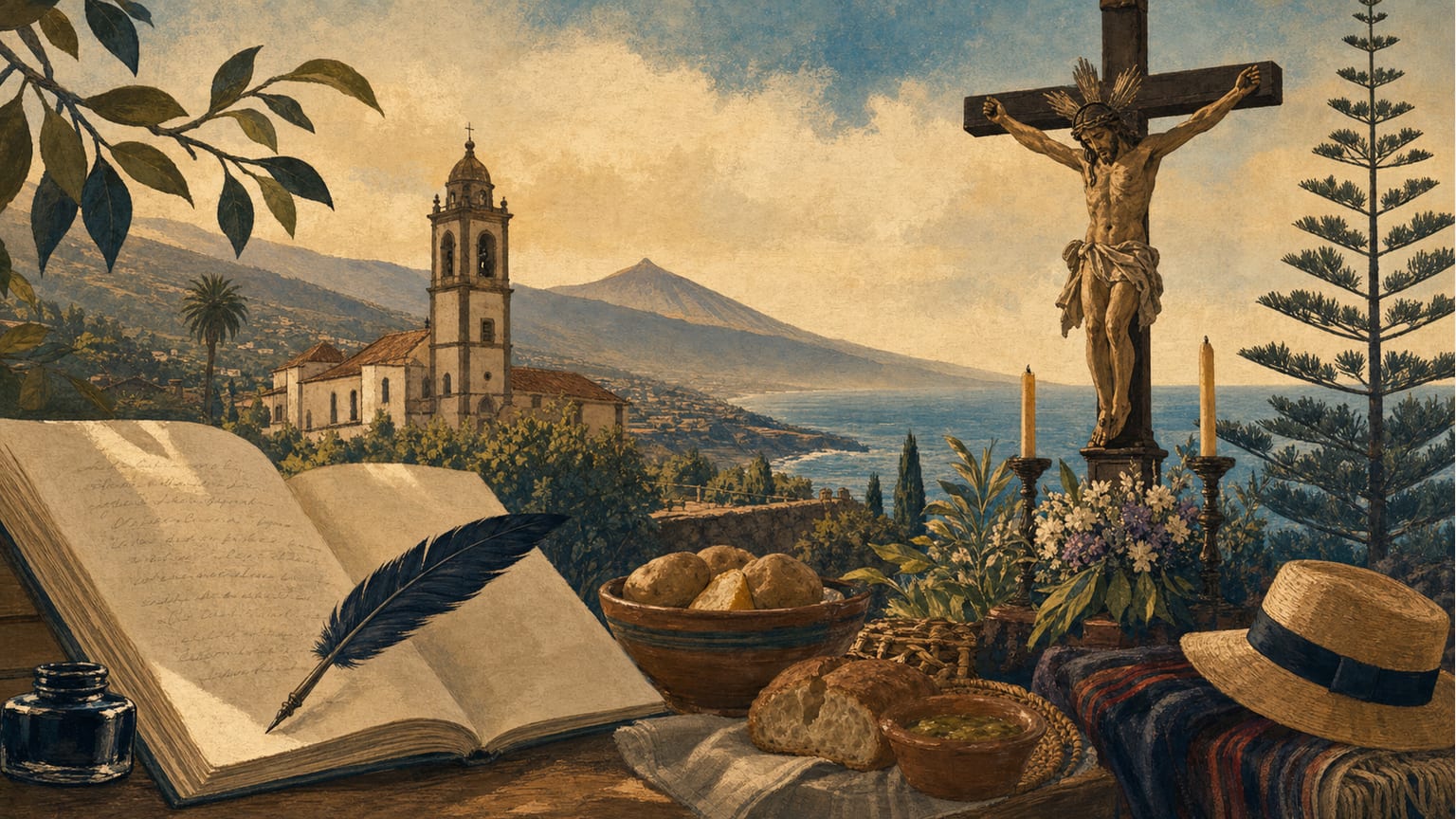

Emeterio Gutiérrez Albelo’s ‘Cristo de Tacoronte’ (1944) is a literary work in which the landscape of Tacoronte plays a central role in the poet’s spiritual and creative inspiration. According to the preliminary note to the first edition, the Instituto de Estudios Canarios launched the ‘Colección Retama’ with this volume, emphasizing the importance of regional literary creation and the poetic character of the series, which collects unpublished works by regional writers or those on local themes[1].
The retama, an emblematic plant of the island, is used symbolically in the introduction, comparing its flowering on the rocks of Teide to the grace of literary works that arise from scientific research. This metaphor establishes a parallel between nature and poetic production, positioning the landscape as a source of inspiration and life for the author[1].
The volume exalts the Cristo de Tacoronte, who, according to the source, “at the foot of his own Cross, blesses one of the most beautiful panoramas of Tenerife and the wide world: the fertile fields, with abundant crops and lush groves, where lights and colors combine with ineffable aromas”[1]. This description situates Tacoronte’s natural environment as a space of fertility, beauty, and spirituality, elements reflected in the poems included in the work.
In Gutiérrez Albelo’s verses, the landscape is presented as an interlocutor and an active element in the creative process. In the section ‘Variaciones sobre el mismo tema’, the poet writes: “You are my bride, land; you who gird your body with wheat veils and vineyard lace. You are my bride, land. Every day I love you with a deeper, firmer, and more lasting love”[1]. Here, the land of Tacoronte is personified and becomes the object of deep and renewed affection, highlighting the connection between the poet and his environment.
The landscape is not only a source of beauty but also of spiritual learning. In the poem ‘Si algún día tuviera…’, Gutiérrez Albelo states: “For you know, oh field, that in your bosom I have learned to love God again”[1]. This statement links the experience of the landscape with the development of the author’s faith and spirituality.
The work also highlights the importance of specific elements of the landscape, such as the canebrakes of Aguagarcía, the Hermitage of San Jerónimo, the Calvary of Tacoronte, and the Fuente Fría, which are mentioned and described in various poems. Each of these places is presented in detail and imbued with meaning, showing how the physical environment of Tacoronte is integrated into the poet’s daily and spiritual life[1].
In conclusion, according to the 1944 edition of ‘Cristo de Tacoronte’, the landscape of Tacoronte is a fundamental element in Gutiérrez Albelo’s poetry, serving as both a setting and a source of inspiration and spiritual experience, in a constant dialogue between nature and literary creation[1].