

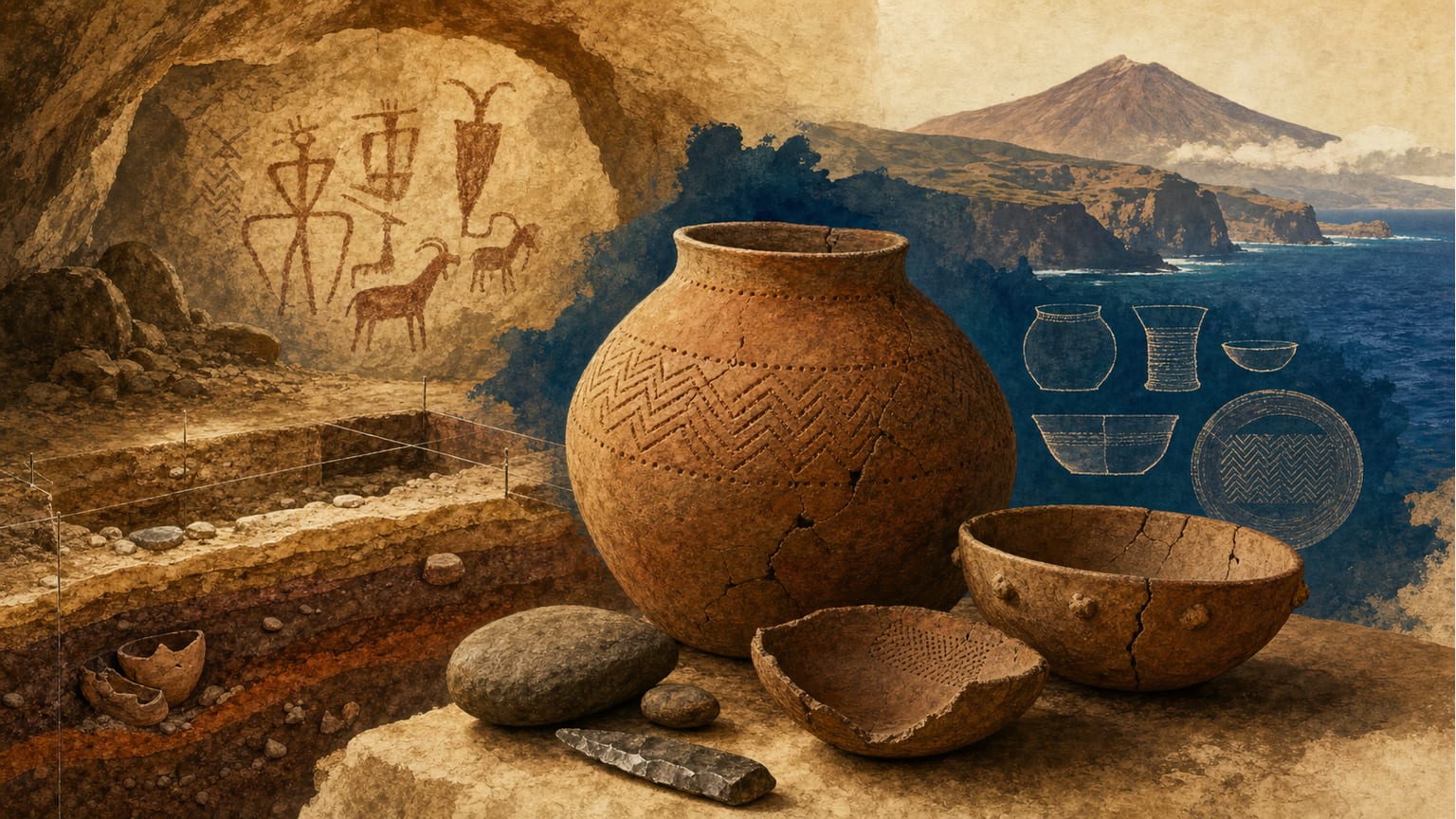
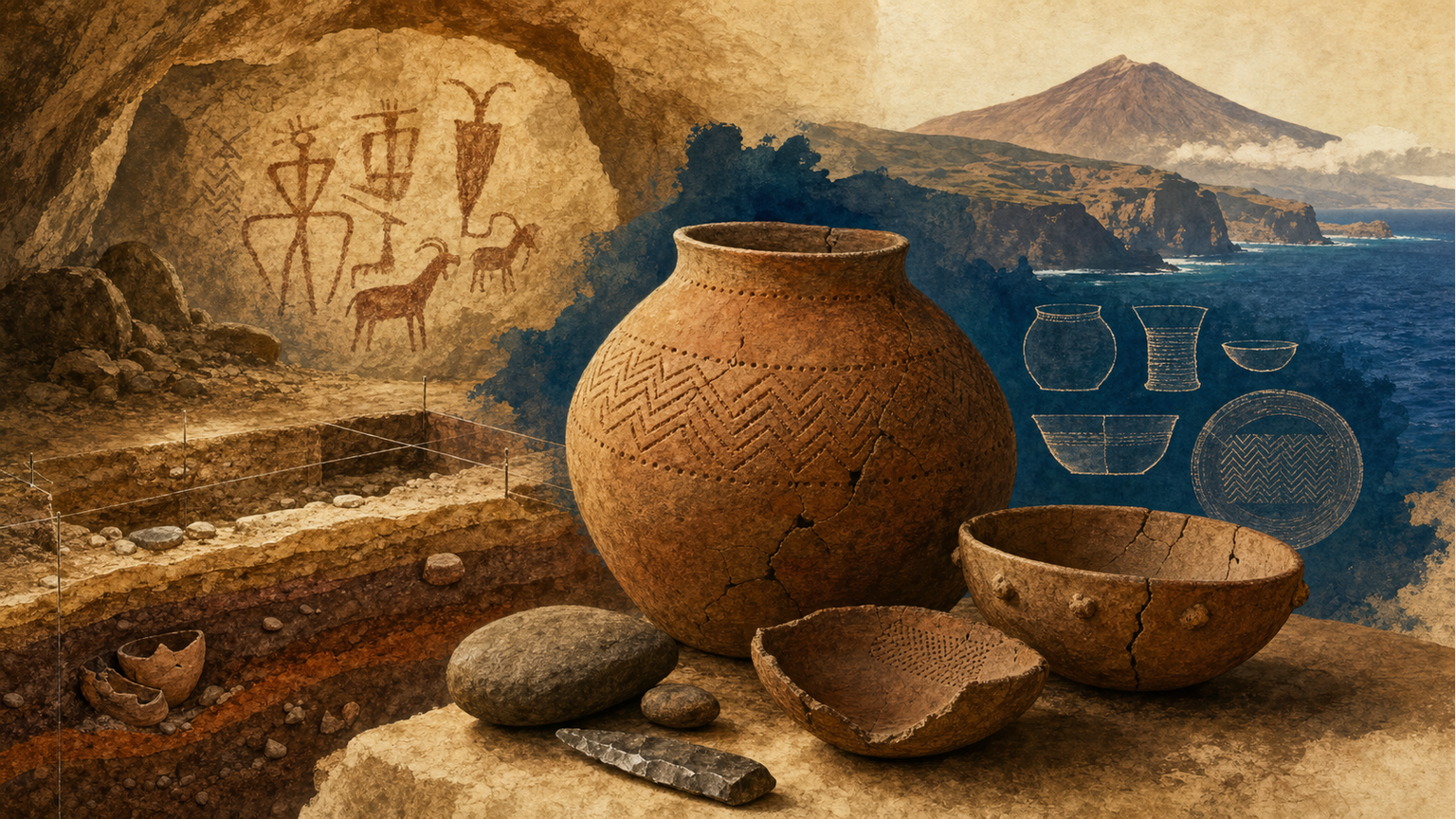
Guanche pottery from Tenerife is a key element in understanding the island’s aboriginal material culture, and the Hermógenes Afonso (HUPALUPA) collection is an essential reference for its study. This collection, housed at the Archaeological Museum of Tenerife, consists mainly of ceramics from the island, many of which are typologically exceptional, allowing for an in-depth analysis of the techniques, materials, and forms used by the ancient inhabitants[1].
The base material for Guanche ceramics is clay, which in the Canary Islands varies greatly in composition and physical properties. Clay, mixed with water and volcanic temper desgrasantes such as sanidines and plagioclases, becomes a plastic mass suitable for shaping. The size of the temper grains determines the quality of the paste and the final function of the vessel. According to grain size, pastes are classified as fine, semi-fine, and coarse, with the first two being most common in Guanche pottery[1].
Manufacturing was entirely manual, with no use of the potter’s wheel, following a paleoberber tradition. Pieces were shaped by hand using the coiling technique, and sometimes by hollowing out a lump of clay. Pottery was made exclusively by women, a tradition that has survived in island pottery until recent times[1].
After shaping, the vessel underwent several finishing stages: scraping, spatulating, and smoothing, all aimed at giving the final form and refining the surface. Firing was done in rudimentary kilns, typically shallow pits in the ground surrounded by stones, using softwood and brush as fuel. The process involved four phases: smoking, low-temperature firing, high-temperature firing, and cooling. The temperature reached between 650º and 900ºC, resulting in the characteristic fragility of the pieces[1].
The color of Guanche ceramics is irregular, a result of the firing atmosphere and the composition of the paste. Oxidizing colors (red, ochre, orange) predominate over reducing ones (black, greyish), with a ratio of three to one, according to Diego Cuscoy’s studies[1].
In terms of form, hemispherical and ovoid vessels dominate, with inward-sloping or straight rims and conical bases. The most common appendages are solid cylindrical handles, often with a blind hole, and spouts of conical or cylindrical section. Decoration is simple and concentrated on the rim and upper part of the vessels, using incised, grooved, and impressed techniques to create geometric motifs[1].
The Hermógenes Afonso collection includes outstanding examples of these types, such as ellipsoidal vessels with ear-like appendages and spouts, decorated with parallel horizontal grooves, as well as microceramics and wooden objects associated with the Guanche industry[1].