

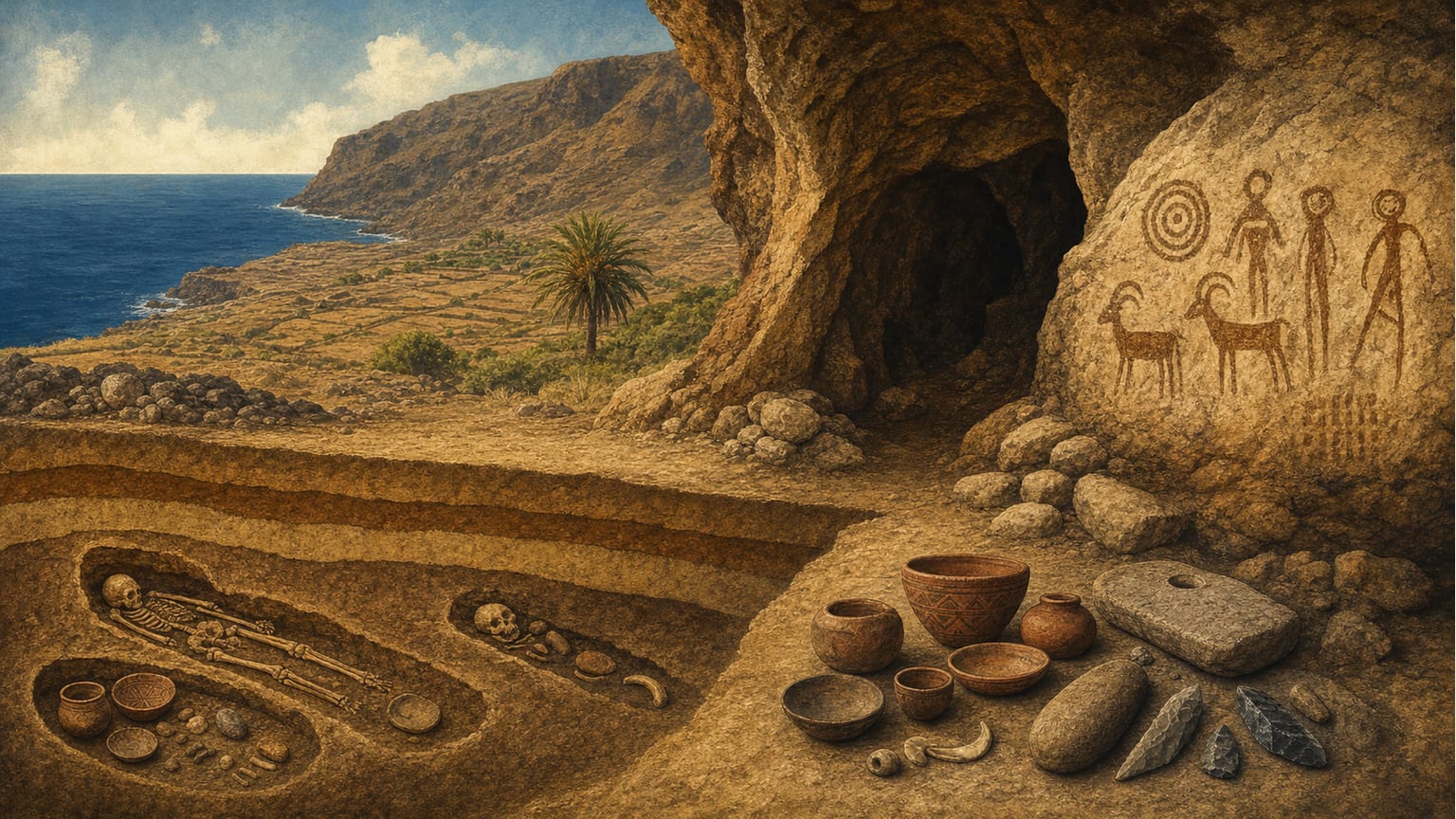
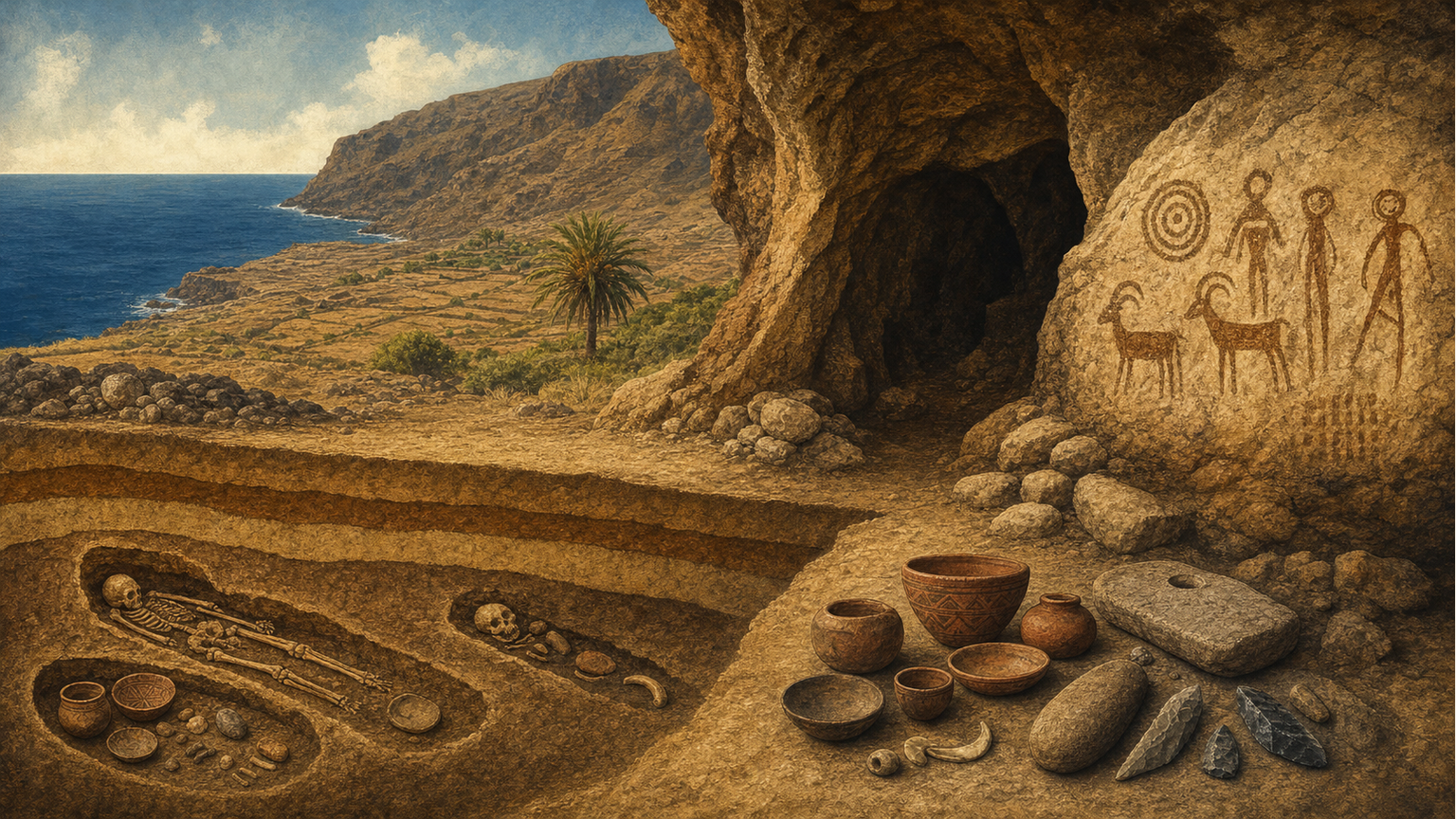
Archaeological research in Guía de Isora has revealed a remarkable wealth of Guanche funerary sites, highlighting the diversity of necropolises and burial practices among the ancient inhabitants of the area[1]. According to Soler Segura, Javier and his team, these findings have expanded and nuanced the traditional understanding of Guanche society in southwestern Tenerife.
One of the most significant discoveries is the Majagora cave, found in 1974 during construction works in the malpaís of Guía de Isora. This cave, located at 850 meters above sea level, contained human remains of at least eleven individuals, later studies identifying up to 35. The bodies were placed on a bed of juniper branches, with no funerary goods or evidence of mummification, which, according to Luis Diego Cuscoy, would reflect the limited living conditions of the group inhabiting this part of the island[1].
Another notable case is the Ucazme necropolis, located in the Barranco del Retamar (Adeje, sometimes attributed to Guía de Isora). This was a collective burial in a rock shelter, with evidence of shrouding and partial mummification rituals. Bioanthropological analysis identified seven individuals, both men and women, with signs of intense physical activity, consistent with herding and agricultural work described for the region. Practices such as intentional defleshing and bone staining were documented, as well as the possible existence of a skull cult due to the absence of skulls in some burials[1].
The Chajora cave, near Pico Viejo, is another example of an individual burial, where a skeleton was found on a bed of broom and retama branches, accompanied by an obsidian flake. The body was oriented east-west and protected by a small dry-stone wall[1].
In the 1990s and 2000s, further surveys identified more funerary sites, such as La Canal cave in the Barranco de Erques, with remains of at least three individuals, one a mummified woman. Bone remains were also recovered from Los Almendros cave (Las Chamuscadas), where five skulls and an almost complete body were found on a wooden bed[1].
These findings demonstrate the diversity of Guanche funerary practices in Guía de Isora, including both collective and individual burials, the use of plant beds, occasional mummification, and the preparation of caves with dry-stone walls. The presence or absence of grave goods, as well as differences in rituals, reflect the social and economic heterogeneity of Guanche groups in the region[1].
Finally, bioanthropological studies of human remains from these necropolises have provided insights into the demographics, health, and social organization of the Guanche population in southern Tenerife, offering a more complex and nuanced view of their life and death in Guía de Isora[1].