

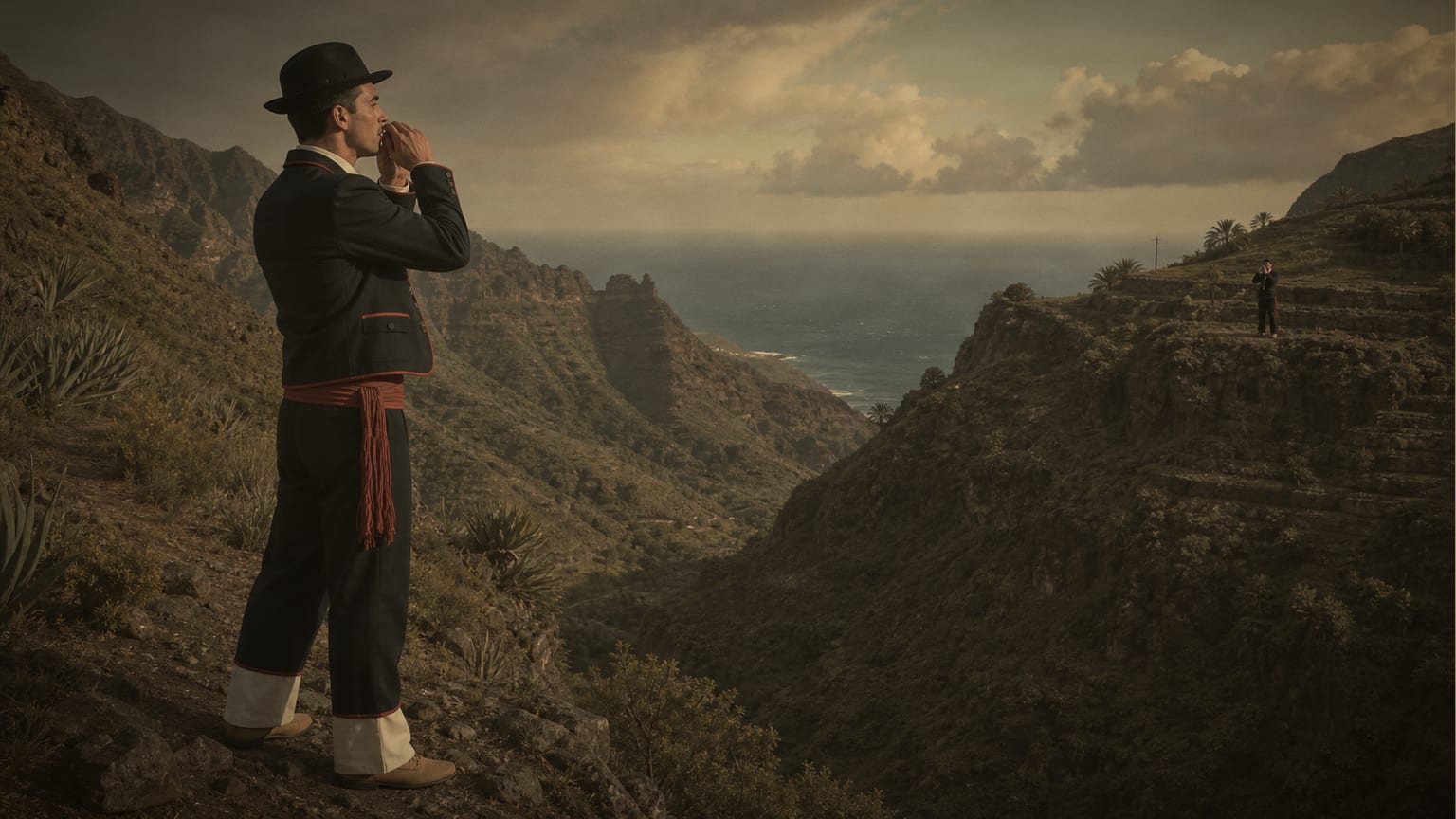
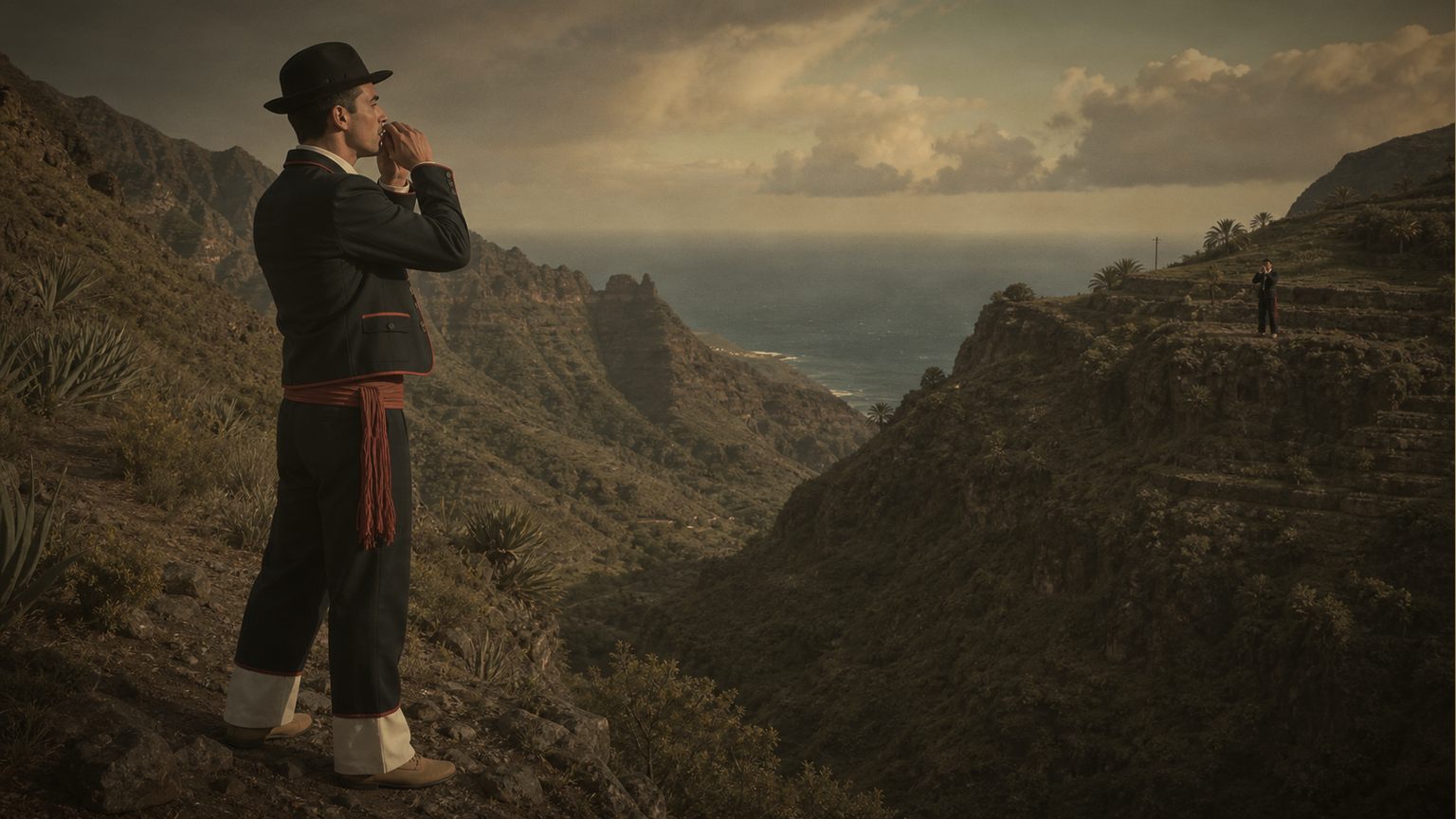
Silbo Gomero is one of the world’s most singular linguistic phenomena: a whistled communication system that carries messages across the deep ravines and mountains of La Gomera. Born from necessity and shaped by geography, this language has survived centuries of change —including the Castilian conquest— and today remains alive on the island that saw it born.[1]
A language born from geography
There are languages born from necessity, and few necessities are as concrete as this one: you have something urgent to say, the person who needs to hear it is on the other side of a ravine two hundred metres deep, and shouting is useless. The inhabitants of La Gomera solved that problem in a way that still surprises linguists: they invented a language made of whistles.
Silbo Gomero is not a code, or a distress signal, or a shepherds’ trick. It is an articulated language, with its own phonetic structure, capable of transmitting any message. It reproduces the Spanish spoken on the island with whistles: two distinct whistles replace the five Spanish vowels, and four others replace the consonants. With those six elements, an experienced whistler can say practically everything he would say by speaking — and make it travel five kilometres away, crossing valleys and ravines without losing clarity.[2]
From the Guanches to Castilian
The origin of silbo is pre-Hispanic. The first inhabitants of La Gomera, Aboriginal people of North African Berber origin, already used a form of whistled language to communicate across the island’s complicated geography. When the Castilian conquerors arrived in the fifteenth century, silbo did not disappear: it adapted. It changed its base language —from Guanche to Spanish— but kept its logic, its music, its usefulness. It is one of the few cases in history in which a cultural practice of Indigenous peoples not only survived conquest, but absorbed the conqueror’s language and continued forward.[2]
For centuries it functioned as communication infrastructure for the whole island. Coordinating herding, warning of dangers, transmitting news from one municipality to another — everything passed through silbo. Then the telephone arrived, and the urgency disappeared. By the mid-twentieth century, silbo began to fade, like so many things that cease to be necessary before someone decides they deserve to be preserved.[1]
Decline and revitalization
What happened afterwards is more interesting than the decline. Thanks to the effort of the local population and the institutions, Silbo Gomero was recovered and protected as cultural heritage. Today it is taught as a compulsory subject in the schools of La Gomera, guaranteeing its conservation for future generations.[3] According to UNESCO, it is understood by almost all islanders and practised by a large majority, especially older people and young people educated since 1999. In fact, UNESCO declared it Intangible Cultural Heritage of Humanity in 2009.[1]
There is something strangely modern in all this. At a time when the world’s minoritized languages are disappearing at an alarming rate, La Gomera took a practice that was about to disappear and put it into the school curriculum. Children learn to whistle in class. Grandparents, who learned it from their parents, listen to them and correct them. A language born from the geography of an island now survives because someone decided it was worth it.[1]
That an island of barely 370 square kilometres should have given rise to a whistled language of this complexity is no coincidence. UNESCO describes it as the only fully developed whistled language in the world practised by a large community, of more than 22,000 people. It is what happens when landscape forces imagination. After all, this is the magic of the Canary Islands.[1]