

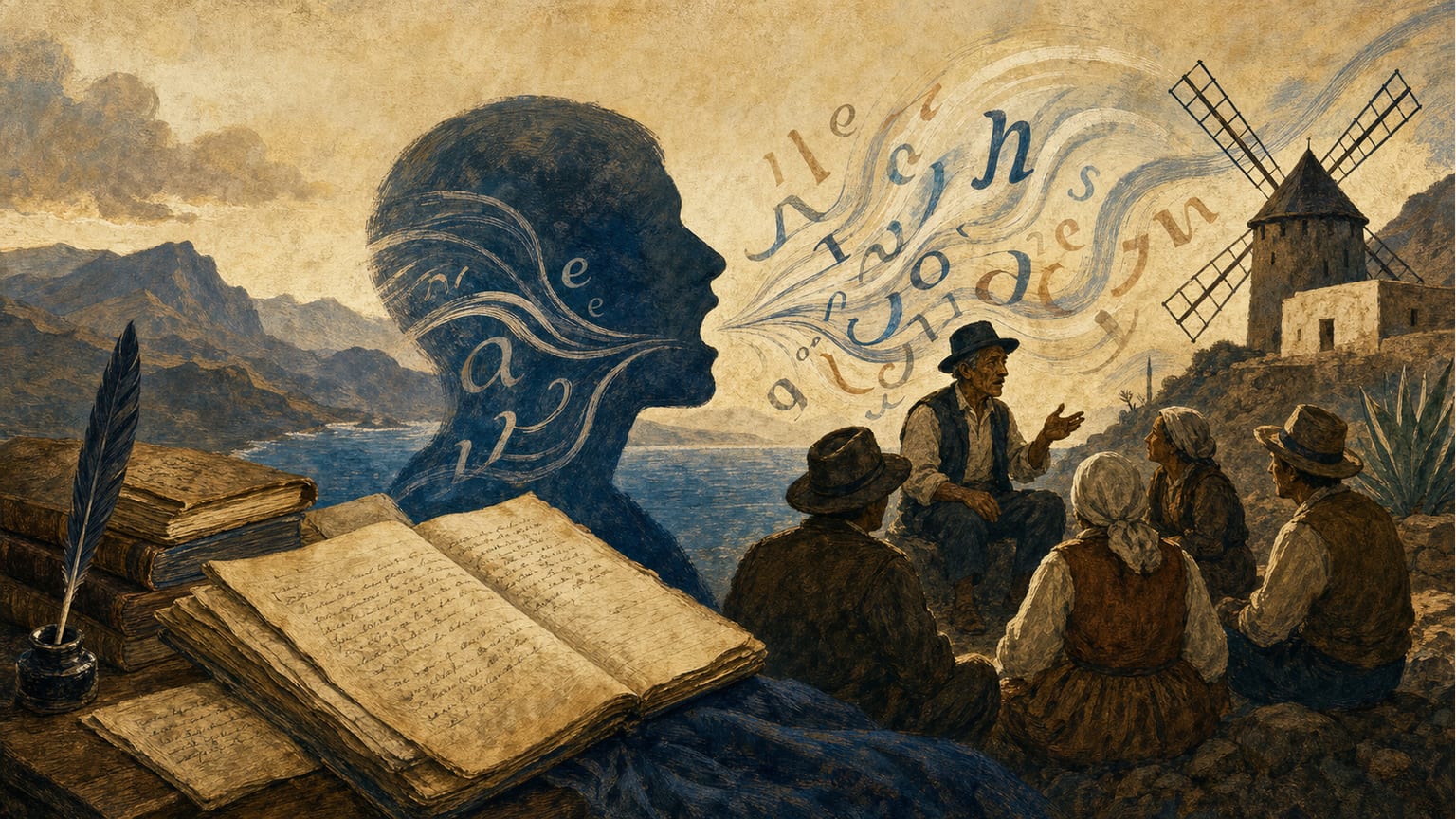
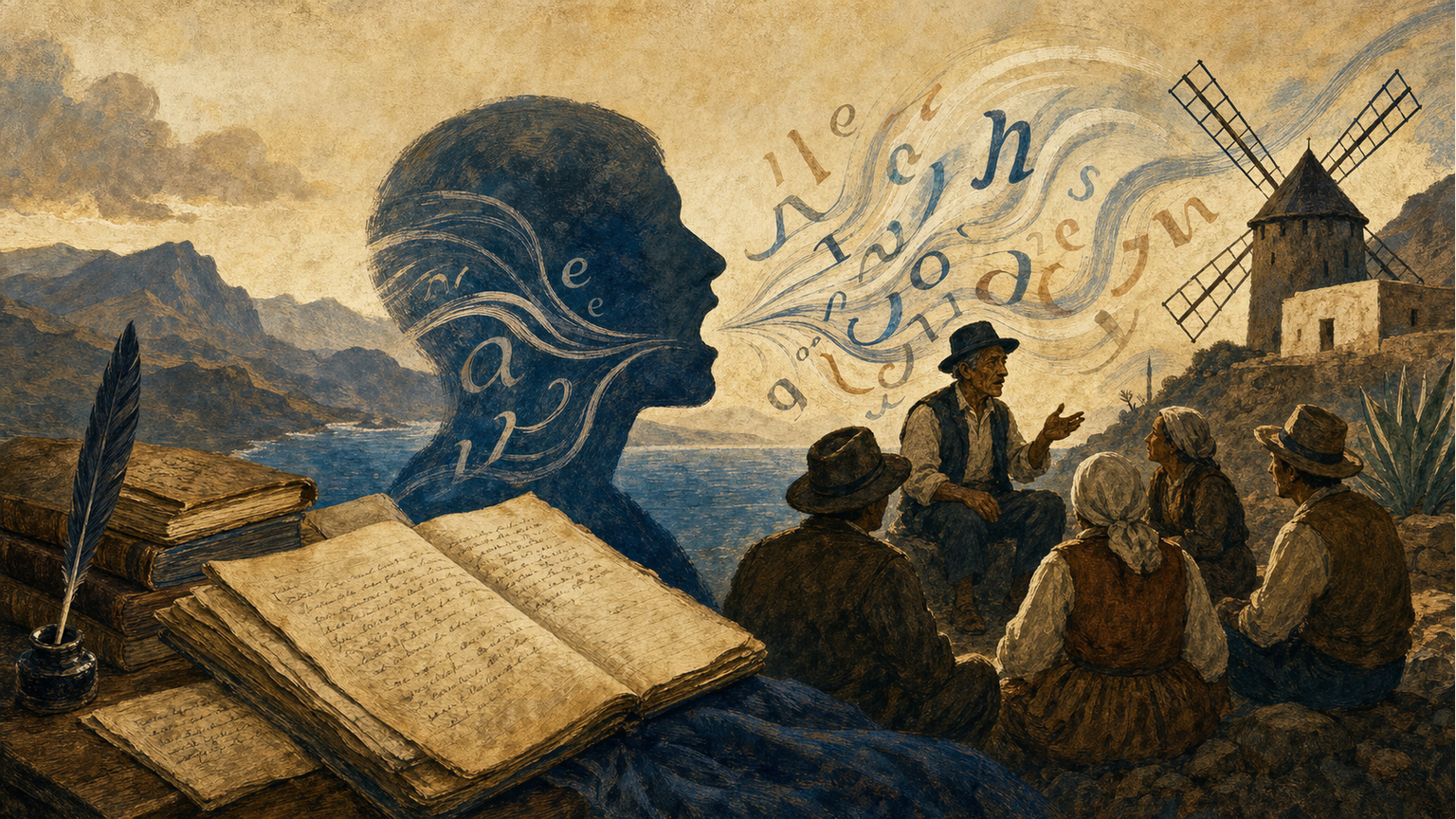
The volume edited by Carmen Díaz Alayón and Marcial Morera in tribute to Francisco Navarro Artiles emphasizes the fundamental role of orality in the transmission of Canarian vocabulary. According to the analysis presented, spoken language has been the main vehicle for the preservation and dissemination of words and expressions unique to the Canary Islands, many of which have not had a significant presence in written language[1].
In the Canarian context, orality is described as a primary source of linguistic information. The text points out that the intergenerational transmission of terms and idiomatic expressions has largely taken place through everyday, family, and community communication, allowing the survival of native words and the adaptation of others from various historical influences[1].
As highlighted in the tribute, Francisco Navarro Artiles asserts that orality has not only served to maintain vocabulary but also to enrich it by incorporating new forms and meanings, resulting from ongoing contact among speakers from different islands and regions[1]. This process has produced notable lexical variety, where archaisms, Canarianisms, and loanwords from other languages coexist, all mainly transmitted orally.
The text stresses that the written documentation of Canarian vocabulary is relatively recent and, in many cases, has depended on the work of researchers like Navarro Artiles, who have collected and systematized words that previously only circulated in oral tradition[1]. The direct collection of oral testimonies is highlighted as essential for the creation of dictionaries and lexicographical studies on Canarian Spanish.
Furthermore, the tribute points out that orality has allowed the survival of linguistic forms that might otherwise have disappeared due to the pressure of standard language norms and the standardization of Peninsular Spanish[1]. Spoken language has functioned as a space for resistance and creativity, where speakers have preserved and adapted their lexical heritage.
In conclusion, the volume edited by Díaz Alayón and Morera, in tribute to Francisco Navarro Artiles, underscores that orality is a key element for understanding the richness and diversity of Canarian vocabulary, as well as for appreciating the role of speakers in transmitting and preserving the linguistic identity of the Canary Islands[1].